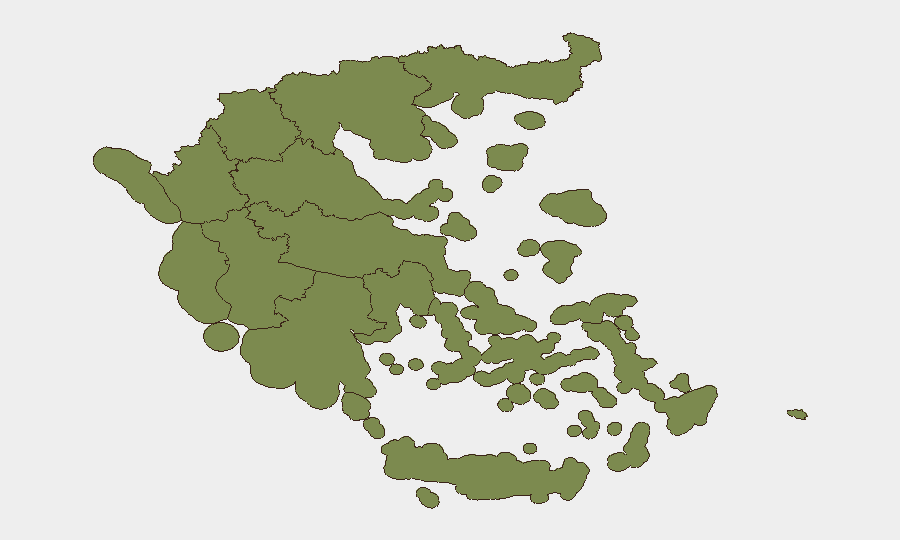
Situation Summary
Greece remains a lower-tier global security risk (rank #121, composite score 6) but faces a convergence of immediate operational threats spanning environmental hazard, violent crime targeting tourists, and ongoing counter-terrorism investigations. Attica dominates the sub-national risk profile, driven by wildfire danger and concentrated urban crime; secondary concerns in Eastern Macedonia and Thrace warrant monitoring. The security environment is stable but operationally demanding over the next 48–72 hours due to red-alert wildfire conditions and heightened police activity around central Athens.
Key Developments
- Attica, Euboea, Rhodes – 23 July 2026: Civil Protection issued a Category 4 "red alert" for very high wildfire risk, triggering full mobilisation of Greece's National Civil Protection Mechanism. Fast-moving fires pose direct threats to travel corridors, utilities, and personnel safety in the highest-risk zone. [1][2]
- Corfu Island – night of 21–22 July 2026: A midnight squall caused power outages and localized fires; electricity was gradually restored by 22 July. Infrastructure disruption affected mobility and services on the island. [2]
- Athens, Acropolis vicinity – 21 July 2026: An armed individual stabbed two Greek-American tourists near the Acropolis Museum; police arrested the attacker on scene, and both victims were hospitalised. Authorities characterised the incident as isolated; heightened police patrols now visible around Plaka, Syntagma, and the Acropolis area. [4][7][8]
- Thessaloniki & Crete – 22 July 2026: Anti-terror police arrested a fourth suspect linked to 1 July firebomb attacks on homes of ruling New Democracy politicians, after coordinated operations in Thessaloniki and Crete. The detainee allegedly aided concealment of a primary suspect. [6]
- Athens – 22 July 2026: The national security council is expected to approve a €3 billion Israeli-made air and missile defence system package ("Achilles' Shield") on 23 July, reflecting elevated regional security posture. This signals strategic-level concern but is not an immediate operational threat to corporate assets or personnel. [3]
Highest-Risk Areas
Attica dominates the risk landscape (score 31.4), driven by concentration of urban population, tourist infrastructure, and current wildfire emergency—all amplifying both environmental and security event likelihood. Eastern Macedonia and Thrace (score 8.2) ranks second, reflecting border proximity and residual regional tensions but remains substantially lower in absolute terms. All other regions score below 2.4 and do not present material incremental risk over baseline. Corporate and duty-of-care teams should prioritise operational continuity planning for Attica over the next 72 hours, particularly around transport, utilities, and personnel movement near tourist zones.
How GeoBit Would Assist
Security teams should deploy AOI Monitoring & Early Warning on Attica (Athens, Piraeus) and Eastern Macedonia to receive real-time alerts on wildfire spread, transport disruptions, and public-order incidents. Risk & Threat Assessment combined with OSINT feeds (X/Twitter, Telegram, Greek-language sources) will track ongoing counter-terrorism investigations and political violence signals. Routing & Network Analysis can identify alternative travel corridors and safe zones if main routes are compromised by fire or infrastructure failure.
7-Day Outlook
Wildfire risk will peak through 24–25 July; active fire suppression and possible localised evacuations may disrupt Attica travel and services. Police presence in central Athens will remain elevated through week's end as the Acropolis stabbing case proceeds and counter-terror operations continue. Assume elevated baseline operational friction in Attica; no material escalation to broader security environment is currently signalled.
Highest-Risk Areas — Ranked
| # | State / Region | Risk |
|---|---|---|
| 1 | Attica | 31.4 |
| 2 | Eastern Macedonia and Thrace | 8.2 |
| 3 | Thessaly | 2.3 |
| 4 | Peloponnese Region | 2 |
| 5 | South Aegean | 1.7 |
| 6 | Western Macedonia | 1.4 |
| 7 | Central Macedonia | 1.4 |
| 8 | Western Greece | 1.4 |
| 9 | Autonomous Monastic State of the Holy Mountain | 1.4 |
| 10 | Central Greece | 1.4 |
| 11 | Northern Aegean | 1.4 |
| 12 | Crete | 1.4 |
Sources
Previous Daily Briefs
A new Greece brief is written every day — each with its own risk map and downloadable CSV. Here's the last week; use the calendar to go further back.
📅 Browse every day by calendar →
Highlighted days have a brief. Tap a day for that day's map & analysis, or “csv” for that day's dataset ($5).
Atlas — our AI intelligence desk — emails them this snapshot personally. Nothing else, no list.