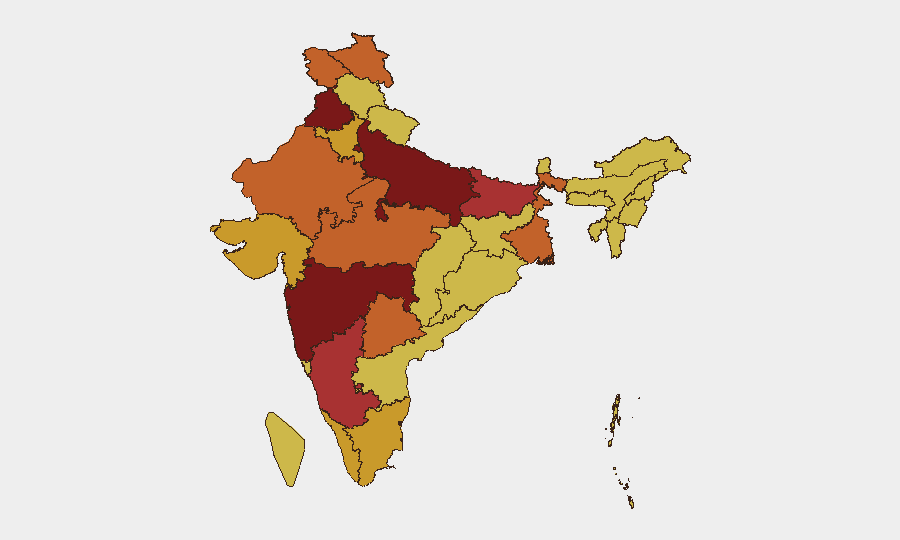
Situation Summary
India's composite threat score (100, rank #9 globally) reflects elevated risk across multiple threat vectors: communal tensions, transport-sector safety failures, organized crime, and institutional corruption. The past 48 hours have produced a cluster of violent incidents—train collisions, armed confrontations with security forces, and highway fatalities—alongside political detention and high-profile arrests, signaling stress across law-enforcement and public-safety systems. Delhi and Maharashtra remain the dominant risk drivers, though emerging incidents in Jammu & Kashmir, West Bengal, and Telangana warrant close monitoring. The trajectory suggests sustained operational risk for corporate operations and personnel, particularly in transit and public-facing environments.
Key Developments
- Karnasubarna, West Bengal – 2026-07-17: A school van and bicycle struck by a local train at a level crossing killed five people (four students, one resident) and critically injured two; transport-safety infrastructure and pedestrian exposure remain acute risks on regional rail networks.
- Kolhapur, Maharashtra – 2026-07-17: Police arrested two brothers within 12 hours in connection with the shooting of gangster Suraj Sakhare, indicating active organized-crime violence and law-enforcement operations in urban Maharashtra.
- Bhaderwah, Doda district, Jammu & Kashmir – 2026-07-17: A 30-year-old man was shot dead and three SOG personnel injured after an alleged attempt to snatch a service rifle; reflects heightened armed-force engagement and risk to civilians in J&K districts.
- Mumbai, Maharashtra (suburban rail & Bandra Kurla Complex) – 2026-07-16: A woman used pepper spray on commuters during a transit dispute; separately, the Passport Office received a bomb threat via email, triggering major security response—both highlight public-safety fragility and institutional security vulnerabilities.
- NH-48 (Mumbai region), Maharashtra – 2026-07-16: A speeding dumper truck fatally struck a delivery agent, triggering angry local protests and traffic disruption on a major national highway; reflects road-safety and supply-chain exposure.
- Hyderabad, Telangana – 2026-07-16: BJP leader Madhavi Latha was detained at the airport following calls for a protest over a school "Kalma recital" controversy, signaling ongoing communal/political tensions with potential for escalation.
- Bengaluru/Bhopal – 2026-07-16: The CBI arrested the Managing Director of Karnataka Antibiotics and Pharmaceuticals Limited while allegedly accepting a ₹5 lakh bribe, reflecting systemic corruption risk in PSU and pharmaceutical sectors.
Highest-Risk Areas
Delhi (100) and Maharashtra (93.5) dominate the risk landscape, with Delhi's top score driven by capital-city exposure to political volatility, law-enforcement operations, and transit density. Maharashtra's high score reflects organized crime (Kolhapur incident), institutional security gaps (bomb threat), and road-safety failures. Punjab (83.8), Uttar Pradesh (80.4), and Bihar (77.6) indicate elevated risk in northern and eastern zones; Jammu & Kashmir (74.1) and Ladakh (74.6) show persistent armed-force engagement and civilian safety concerns tied to counter-insurgency operations. Telangana's entry into the top 10 (74.1) signals emerging communal-political tension.
How GeoBit Would Assist
Organizations would deploy persistent Area-of-Interest monitoring and early warning on high-risk corporate hubs (Delhi, Mumbai, Bangalore) to detect protests, security incidents, or institutional disruptions. Network and actor analysis would map organized-crime and corruption networks affecting supply-chain and institutional risk. Routing and network analysis would identify alternative transport corridors and movement options to mitigate road-safety and transit-infrastructure vulnerabilities, particularly for personnel traveling on National Highways or regional rail.
7-Day Outlook
Expect sustained volatility in organized-crime and law-enforcement operations in Maharashtra and Kolkata. Communal/political tensions around educational and religious issues (Telangana) may produce localized detention or protest activity. Transport-sector incidents (rail and road) are likely to recur absent major infrastructure or enforcement interventions; personnel and supply-chain continuity should be stress-tested against transit disruption.
Highest-Risk Areas — Ranked
| # | State / Region | Risk |
|---|---|---|
| 1 | Delhi | 100 |
| 2 | Maharashtra | 93.5 |
| 3 | Punjab | 83.8 |
| 4 | Uttar Pradesh | 80.4 |
| 5 | Bihar | 77.6 |
| 6 | Karnataka | 77.1 |
| 7 | Ladakh | 74.6 |
| 8 | West Bengal | 74.5 |
| 9 | Jammu and Kashmir | 74.1 |
| 10 | Telangana | 74.1 |
| 11 | Madhya Pradesh | 74 |
| 12 | Rajasthan | 73.3 |
Sources
Previous Daily Briefs
A new India brief is written every day — each with its own risk map and downloadable CSV. Here's the last week; use the calendar to go further back.
📅 Browse every day by calendar →
Highlighted days have a brief. Tap a day for that day's map & analysis, or “csv” for that day's dataset ($5).
Atlas — our AI intelligence desk — emails them this snapshot personally. Nothing else, no list.