Situation Summary
Libya remains fractured by civil war, with armed groups, state forces, and transnational actors competing for territorial and political control across fragmented governance zones. The country ranks #21 globally for composite threat (score 80), driven by sustained armed conflict, criminal activity, and political instability. Diplomatic pressure and international involvement have intensified in early July 2026, though ground-level security dynamics remain volatile. The near-term trajectory shows no imminent de-escalation.
Key Developments
Note: Open-source reporting for 10–11 July 2026 has not yielded time-stamped, cross-confirmed incident data with specific locations. Recent event signals in the GeoBit feed reflect diplomatic actions (embassy relations, government statements, international statements), arrests, and investigative activity, but lack precise geo-temporal detail necessary for operational alerting. The following signals appear in the last 72 hours but require field corroboration:
- Diplomatic friction (9–10 July): U.S. statements rejecting Libyan positions; two separate embassy-to-Libya relation reductions recorded; unclear specific triggers or locations.
- Presidential & Government scrutiny (10 July): Presidential-level investigation initiated; government-to-Africa relations under investigation—context unclear from open sources.
- Criminal & Police activity (11 July): Police detentions recorded in Libya; separate disapproval of criminal activity flagged—specifics (location, individuals, charges) not confirmed.
- Company demand (11 July): Demand issued to a company operating in Libya—sector and location unconfirmed.
Recommendation: These signals suggest elevated diplomatic and law-enforcement activity but do not constitute verified security incidents (armed clashes, infrastructure disruption, IED detonations, kidnappings) with actionable location and timing for duty-of-care response.
Highest-Risk Areas
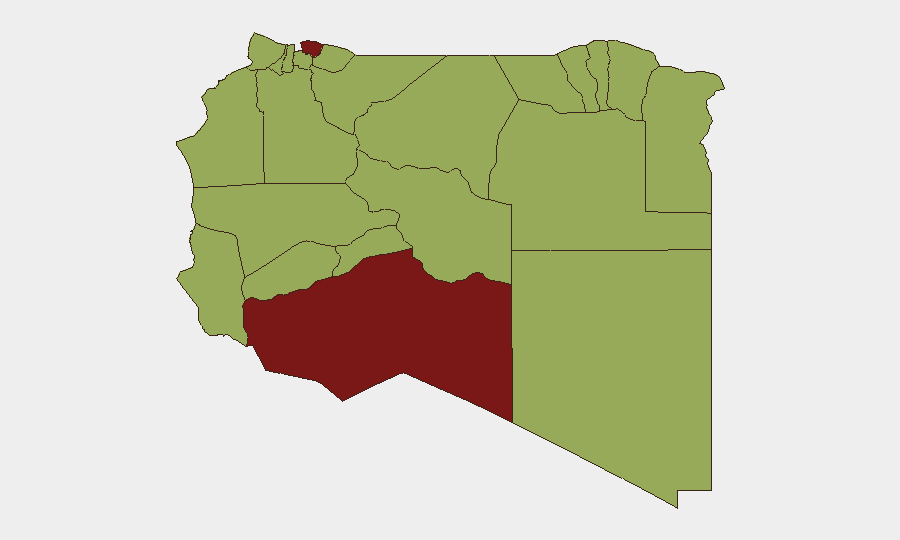
Tripoli (85.9) and Murzuq (81.6) dominate the risk profile, reflecting active armed conflict, state fragmentation, and competition among armed groups in Libya's two primary power centers. Tripoli's elevated score reflects ongoing clashes between Government of National Accord (GNA) and Libyan National Army (LNA) affiliates, plus criminal activity and kidnapping risk; Murzuq, in the south, remains a contested zone with weaker state presence, human trafficking, and cross-border militant activity. Ten additional districts (Nalut, Ghat, Az Zawiya, Kufra, and others) cluster at risk 55.9, reflecting secondary conflict zones, SAG (State-Affiliated Group) presence, and limited governance. Any expansion of personnel or operations should prioritize risk assessment in Tripoli and Murzuq before deployment.
How GeoBit Would Assist
Security teams should deploy AOI (Area-of-Interest) Monitoring & Early Warning on Tripoli and Murzuq with persistent alerting for armed clashes, checkpoint activity, and movement of key armed actors. Conflict & Military force-structure tracking and Network & Actor Analysis enable identification of command changes, splinter groups, and shifting territorial control that often precedes violence. Routing & Network Analysis supports duty-of-care teams in identifying safe transit corridors and alternate escape routes; Intel Sweep with multi-language OSINT fusion across X, Telegram, and local news sources provides real-time incident corroboration unavailable in open-source search alone.
7-Day Outlook
Diplomatic activity and law-enforcement operations will likely continue through mid-July, with potential for localized flare-ups in Tripoli and contested southern zones as armed factions respond to international pressure. No major ceasefire or political breakthrough is anticipated in the next week. Security teams should maintain heightened vigilance on personnel movements and consider contingency evacuation planning for high-risk postings.
Highest-Risk Areas — Ranked
| # | State / Region | Risk |
|---|---|---|
| 1 | Tripoli | 85.9 |
| 2 | Murzuq | 81.6 |
| 3 | Nalut | 55.9 |
| 4 | Ghat | 55.9 |
| 5 | Baladiyah Surman | 55.9 |
| 6 | Az Zawiya District | 55.9 |
| 7 | Wadi al Shatii | 55.9 |
| 8 | Wadi al Hayaa | 55.9 |
| 9 | Kufra | 55.9 |
| 10 | Nuqat al Khams | 55.9 |
| 11 | Jafara | 55.9 |
| 12 | Murqub | 55.9 |
Sources
Previous Daily Briefs
A new Libya brief is written every day — each with its own risk map and downloadable CSV. Here's the last week; use the calendar to go further back.
📅 Browse every day by calendar →
Highlighted days have a brief. Tap a day for that day's map & analysis, or “csv” for that day's dataset ($5).
Atlas — our AI intelligence desk — emails them this snapshot personally. Nothing else, no list.