Situation Summary
Mauritania remains a low-frequency threat environment globally (rank #115), but faces persistent fragmentation across its vast Saharan geography, with militant activity concentrated in the northeastern border zones and secondary risks in migration, maritime smuggling, and infrastructure crime. A multi-agency advisory downgrade issued October 1 flagged an uptick in incidents over the preceding four weeks across maritime security, political stability, civil unrest, and travel domains, though terrorism remained rated medium. The country's security profile reflects chronic capacity constraints, porous borders, and ongoing regional militant presence rather than acute, immediate national-level instability.
Key Developments
- Mauritania, October 1: INGO Advisory reportedly downgraded composite indicators for maritime security, political stability, civil unrest, travel, and infrastructure, citing increased incident frequency during the four weeks prior; terrorism risk held at medium level.
- Nouakchott, October 1: UK Foreign Office travel-advice feed reportedly added or updated warnings regarding protest activity in Mauritania; no specific location, timing, or incident details are yet available from open sources, but reflects elevated civil-unrest advisory posture.
- Mauritania–Senegal border, October 6: Contextual reporting on migrant smuggling and human trafficking networks reconfirmed ongoing cross-border illicit activity; open-source reports do not document a discrete operation or arrest during the seven-day window but underscore persistent facilitation infrastructure.
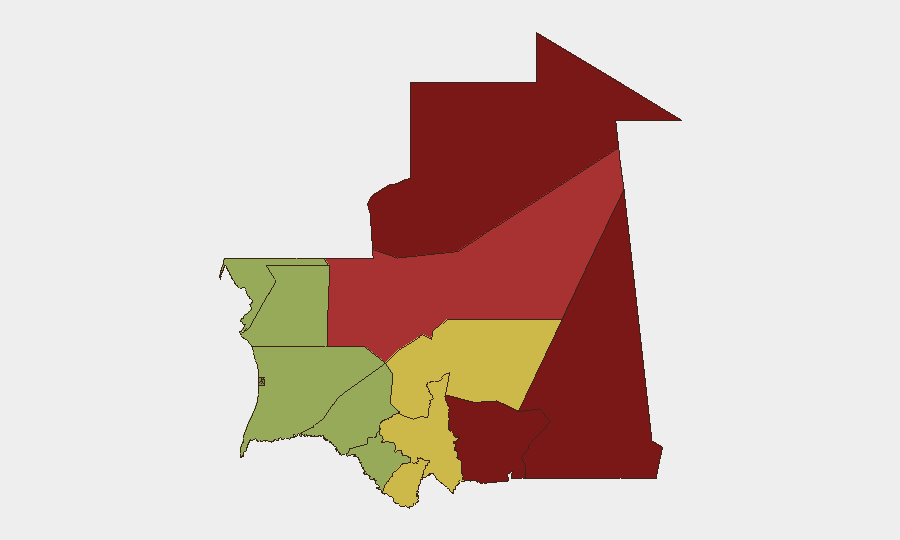
- Tiris Zemmour (northeastern border zone): Remains the highest-risk sub-national region (composite score 95) driven by militant presence and state capacity gaps; no discrete incident reported this week, but chronic threat posture warrants persistent monitoring.
- Hodh Ech Chargui and Hodh El Gharbi (eastern border zones, scores 85 and 80 respectively): Persistent secondary concentration of organized militant and transnational crime activity along Mali and Algeria borders; no new discrete event documented this week.
- Nouakchott (capital and economic hub, composite score absorbed in broader national metrics): Port and coastal access continue to be focal points for irregular migration (260 migrants rescued by Coast Guard September 27) and maritime crime; travel advisory updates suggest uptick in civil unrest reporting.
- Infrastructure crime (nationwide, September 25): Gendarmes arrested suspects in connection with theft of approximately four kilometers of electricity cable from a major power line; represents ongoing vulnerability to organized theft targeting critical infrastructure.
Highest-Risk Areas
Tiris Zemmour (95), Hodh Ech Chargui (85), and Hodh El Gharbi (80) dominate the risk landscape, forming a contiguous threat belt across Mauritania's northeastern border with Mali and Algeria. These regions host residual militant cells, limited state presence, and dense cross-border smuggling networks. Risk progressively attenuates westward and southward; Dakhlet Nouadhibou (45) and Brakna (48) in the northwest and west face maritime and migration-related risks, while Nouakchott itself has absorbed recent civil-unrest advisory upgrades without documentary confirmation of discrete events.
How GeoBit Would Assist
Organizations with personnel or assets in Mauritania should deploy AOI Monitoring & Early Warning on high-risk states (Tiris Zemmour, Hodh Ech Chargui) to capture emerging militant or criminal activity before escalation. Intel Sweep and Network & Actor Analysis capabilities enable tracking of smuggling and trafficking facilitators, particularly along the Senegal and Mali borders. Maritime & Aviation tracking combined with search & research on border and maritime risks provide early warning for irregular migration surges and coastal security incidents affecting Nouakchott and Dakhlet Nouadhibou.
7-Day Outlook
The trajectory reflects sustained low-level fragmentation rather than imminent major escalation. Continued maritime migration pressure, infrastructure crime, and civil-unrest reporting are probable; however, no evidence suggests a near-term shift in regional militant tempo or national political crisis. Organizations should maintain heightened vigilance in the Hodh and Tiris Zemmour regions and monitor port/coastal activity in and around Nouakchott.
Highest-Risk Areas — Ranked
| # | State / Region | Risk |
|---|---|---|
| 1 | Tiris Zemmour | 95 |
| 2 | Hodh Ech Chargui | 85 |
| 3 | Hodh El Gharbi | 80 |
| 4 | Adrar | 78 |
| 5 | Tagant | 68 |
| 6 | Guidimaka | 65 |
| 7 | Assaba | 62 |
| 8 | Gorgol | 58 |
| 9 | Trarza | 55 |
| 10 | Inchiri | 52 |
| 11 | Brakna | 48 |
| 12 | Dakhlet Nouadhibou | 45 |
Sources
Previous Weekly Briefs
A new Mauritania brief is written every Monday, covering the week — each with its own risk map and downloadable CSV. Use the calendar to go further back.
- September 29, 2026
- September 22, 2026
- September 15, 2026
- September 8, 2026
- September 2, 2026
- August 31, 2026
- August 28, 2026
📅 Browse past briefs by calendar →
Highlighted days have a brief. Tap a day for that day's map & analysis, or “csv” for that day's dataset ($5).
Atlas — our AI intelligence desk — emails them this snapshot personally. Nothing else, no list.