Situation Summary
North Korea remains a composite threat level 34 globally (score 58), with no verified security incidents or conflict events confirmed within North Korea's borders in the last 24–48 hours. Regional responses to DPRK military capabilities are accelerating: South Korea and Japan announced coordinated defense overhauls and equipment cooperation on June 28 in direct response to North Korean nuclear and missile programs. The security environment reflects sustained inter-Korean tension and international concern rather than an acute crisis, though civilian infrastructure vulnerabilities and isolated reports of weapons-testing failures underscore operational stress within DPRK military systems.
Key Developments
- South Korea – June 28, 2026 | Seoul announced plans for a complete overhaul of drone operations and counter-drone systems to address North Korean surveillance and strike capabilities. This is a policy response to assessed DPRK military threat, not a new North Korean incident.
- Japan–South Korea bilateral – June 28, 2026 | Japan's Defense Minister Koizumi and South Korea's Foreign Minister Cho held security consultations explicitly addressing North Korea's nuclear and missile posture, signaling deepened regional coordination.
- Japan–South Korea defense agreement – June 28, 2026 | The two countries agreed to advance talks on defense equipment and technology cooperation, framed as a response to North Korean nuclear and missile programs.
- Korean Peninsula (unconfirmed timing) – circa late June, 2026 | Unverified reporting indicates two DPRK officers sustained injuries during a failed rapid-fire test of a new anti-aircraft weapon; timing and cross-source confirmation remain unclear, limiting operational confidence.
- North Korea – background context (June 22, 2026 and earlier) | Kim Jong Un stated that expanding nuclear forces represents the "correct way" to address global instability; no new nuclear or weapons announcements with confirmed dates in the last 48 hours are available in open-source feeds.
- Regional security posture | No specific military movements, border incidents, or direct DPRK provocations are confirmed in the last 24–48 hours; elevated threat perception is driving neighboring-state defense decisions rather than new North Korean action.
Highest-Risk Areas
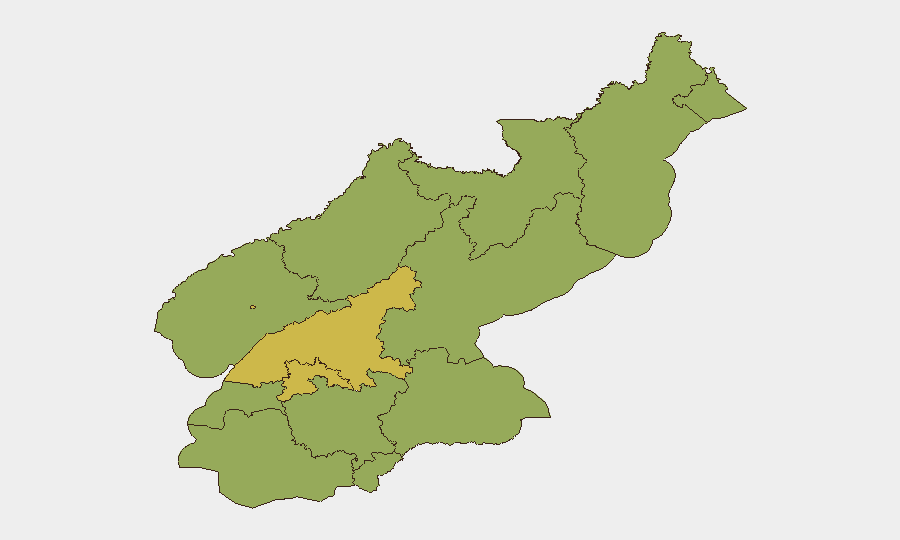
South Pyongan (70.5) and P'yŏngyang (65.9) register the highest composite risk scores, reflecting concentration of military command infrastructure, regime security operations, and political control mechanisms in these provinces. All other tracked regions cluster at 40.5, indicating baseline elevated risk across the country. The risk gradient reflects geopolitical sensitivity of the capital and proximity to the inter-Korean border rather than immediate, localized security events. Organizations with personnel or assets in South Pyongan and P'yŏngyang should prioritize contingency planning and movement restrictions.
How GeoBit Would Assist
Security teams should employ Intel Sweep and OSINT fusion (multi-language feeds, social-media monitoring, and cross-source corroboration) to detect early signals of weapons failures, supply-chain disruptions, or leadership instability before they escalate. AOI Monitoring and Early Warning on border regions, military bases, and transportation hubs would provide persistent watch for sudden force movements or regime security operations. Network and Actor Analysis can map command-and-control changes, sanctions evasion networks, and personnel movements that often precede policy shifts or internal instability.
7-Day Outlook
No imminent military escalation is signaled by available intelligence; the security environment will likely remain characterized by regional defensive posturing and diplomatic coordination among South Korea and Japan. Sustained attention to DPRK weapons-test cycles, fuel logistics, and leadership communications is warranted to detect any shift toward provocative action or internal instability.
Highest-Risk Areas — Ranked
| # | State / Region | Risk |
|---|---|---|
| 1 | South Pyongan | 70.5 |
| 2 | P'yŏngyang | 65.9 |
| 3 | Ryanggang | 40.5 |
| 4 | North Hamgyong | 40.5 |
| 5 | North Pyongan | 40.5 |
| 6 | Chagang | 40.5 |
| 7 | Nampo | 40.5 |
| 8 | South Hwanghae | 40.5 |
| 9 | North Hwanghae | 40.5 |
| 10 | South Hamgyong | 40.5 |
| 11 | Kaesong | 40.5 |
| 12 | Kangwon | 40.5 |
Sources
Previous Daily Briefs
A new North Korea brief is written every day — each with its own risk map and downloadable CSV. Here's the last week; use the calendar to go further back.
📅 Browse every day by calendar →
Highlighted days have a brief. Tap a day for that day's map & analysis, or “csv” for that day's dataset ($5).