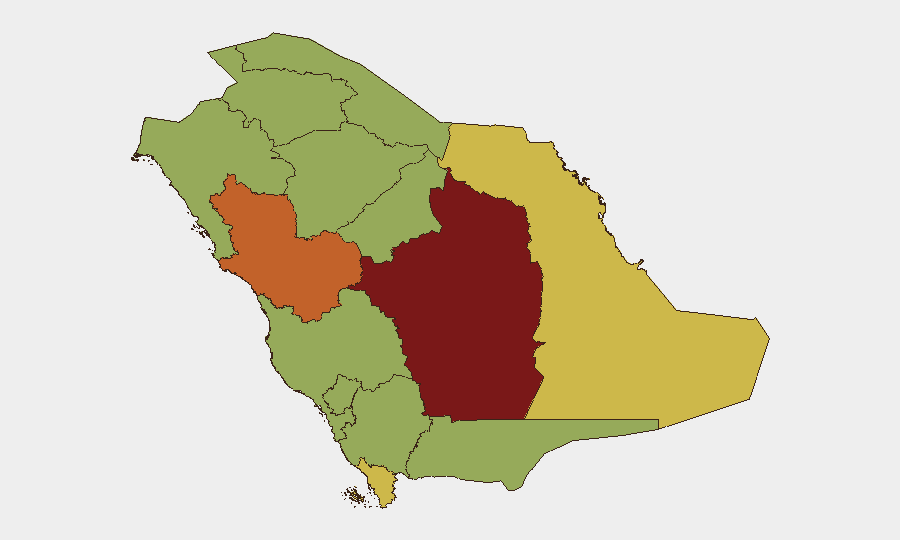
Situation Summary
Saudi Arabia faces an elevated threat environment driven by cross-border missile and drone activity originating from Yemen-based Houthi forces and Iran-backed militias in Iraq, concentrated on critical energy infrastructure, airports, and maritime corridors. Over the past 48 hours, coordinated attacks on Yanbu and Jizan have prompted civil defense alerts, temporary aviation suspensions, and precautionary security lockdowns, though reported casualties and material damage remain officially unconfirmed. The broader regional escalation cycle—marked by Saudi coalition airstrikes in Yemen and Iranian militia drone interceptions in the Eastern Province—shows no signs of de-escalation and continues to elevate risk for commercial and industrial operations across multiple governorates.
Key Developments
- Yanbu Governorate (Western Red Sea coast) – Saturday, 25 July, early morning. Civil Defense issued multiple emergency alerts via the National Early Warning Platform; Houthi sources claimed missile strikes on Saudi Aramco facilities and Yanbu Airport, with reports of explosions, fires, and temporary flight suspension. Saudi authorities later declared the threat passed without releasing casualty or damage assessments; photography has been restricted.
- Jizan/Jizan City (Southwestern Saudi Arabia) – Saturday, 25 July, early morning. Civil Defense alerts preceded Houthi claims of missile attack on the southern city. Regional outlets reported explosions, fires, power disruptions, and flight diversions; Jazan Airport suspended operations temporarily. Official Saudi statements have not confirmed specific impact.
- Red Sea Coalition Operations – Friday–Saturday, 24–25 July. Saudi-led coalition conducted airstrikes on Houthi military and telecommunications targets in Hodeidah (Yemen), framed as retaliation for Houthi attacks on commercial shipping and Saudi energy infrastructure. This cycle signals continued escalation risk.
- Eastern Province & Riyadh Region Oil Infrastructure – week of 27–31 July. Saudi authorities confirmed interception and destruction of multiple drones attributed to Iran-backed Iraqi militias targeting Saudi Aramco and critical energy assets. Heightened security posture around facilities, though direct assault frequency has declined in the last 48 hours.
- Jeddah Airport & Southern Saudi Aviation – Saturday, 25 July. Flight-tracking reports indicate broader disruptions in southern Saudi airspace; some sources report temporary Jeddah suspension, though Jizan and Yanbu airport closures are more widely corroborated.
- Ministry & Authority Public Statements – Thursday–Friday, 30–31 July. Multiple Saudi and U.S. official statements and investigative announcements on 30–31 July, alongside military spokesman and authority disapproval signals, suggest ongoing coordination and formal response development to recent incidents.
Highest-Risk Areas
Riyadh Region (88.3) dominates the sub-national risk ranking, reflecting both the capital's symbolic importance and the concentration of government, financial, and energy-sector targets vulnerable to drone and missile attack. Medina Province (74.9) follows, driven by the intersection of religious significance, pilgrimage-related crowds, and proximity to Yemen-based threat actors. The coastal and southwestern cluster—Eastern Province (63.1), Jazan (60.7), and Makkah (58.3)—concentrates maritime, port, and critical energy infrastructure, all primary Houthi and militia targeting priorities. The 48-hour pattern of Yanbu and Jizan strikes directly reflects this geography.
How GeoBit Would Assist
Security teams should deploy AOI Monitoring & Early Warning on Riyadh, Yanbu, Jazan, and Eastern Province energy clusters for persistent threat alerting; couple this with Maritime & Aviation Tracking to monitor shipping and airport activity disruption in real time. Conflict & Military force-structure and weapons-capability tracking, combined with OSINT fusion of Houthi and Iraqi militia communications, would provide 24–48-hour predictive warning of attack cycles and likely targeting patterns.
7-Day Outlook
The escalation cycle between coalition airstrikes in Yemen and retaliatory Houthi/militia attacks on Saudi infrastructure is likely to continue without diplomatic intervention. Personnel and asset exposure in Riyadh, coastal energy zones, and major airports should remain elevated; aviation delays and port-access restrictions are probable.
Highest-Risk Areas — Ranked
| # | State / Region | Risk |
|---|---|---|
| 1 | Riyadh Region | 88.3 |
| 2 | Medina Province | 74.9 |
| 3 | Eastern Province | 63.1 |
| 4 | Jazan Province | 60.7 |
| 5 | Northern Borders Province | 58.3 |
| 6 | Makkah Region | 58.3 |
| 7 | Al-Bahah Province | 58.3 |
| 8 | 'Asir Province | 58.3 |
| 9 | Najran Region | 58.3 |
| 10 | Tabuk Province | 58.3 |
| 11 | Al Jawf Region | 58.3 |
| 12 | Ḥa'il Province | 58.3 |
Sources
Previous Daily Briefs
A new Saudi Arabia brief is written every day — each with its own risk map and downloadable CSV. Here's the last week; use the calendar to go further back.
📅 Browse every day by calendar →
Highlighted days have a brief. Tap a day for that day's map & analysis, or “csv” for that day's dataset ($5).
Atlas — our AI intelligence desk — emails them this snapshot personally. Nothing else, no list.