Situation Summary
Uruguay remains one of Latin America's most stable countries, ranking 169th globally in composite threat score with a relatively low baseline risk profile. However, organized crime—particularly drug trafficking and gang activity—remains the primary security concern, concentrated in and around Montevideo. Recent government announcements signal an uptick in operational response to organized-crime threats, including cross-border cooperation initiatives and hardened police deployments. The security trajectory remains manageable for most sectors, but localized volatility in high-crime neighborhoods warrants continued monitoring.
Key Developments
- Montevideo, July 2026: Uruguay and Chile formalized a bilateral security cooperation agreement focused on organized-crime intelligence sharing and coordinated border enforcement, signaling regional acknowledgment of transnational criminal networks affecting both countries.
- Montevideo, July 2026: Uruguay's police force deployed twelve Mamba MK-7 armored vehicles to patrol high-crime neighborhoods in Montevideo under direct police command, indicating an escalation in law-enforcement posture against organized-crime operations.
- July 5, 2026: A territorial occupation incident was reported and circulated via media channels; specifics remain limited in available reporting, though the event triggered government statements and diplomatic communication with Venezuela regarding sovereignty and territorial claims.
- July 5, 2026: Uruguay issued multiple public statements, including diplomatic messaging toward Venezuela, suggesting either a bilateral dispute or a regional security incident requiring official clarification.
Note: Due to limited event-specific reporting in the last 24–48 hours, additional incident details are not available. Escalation of police operations and diplomatic statements indicate heightened official concern, though specific triggering incidents remain unclear from open sources.
Highest-Risk Areas
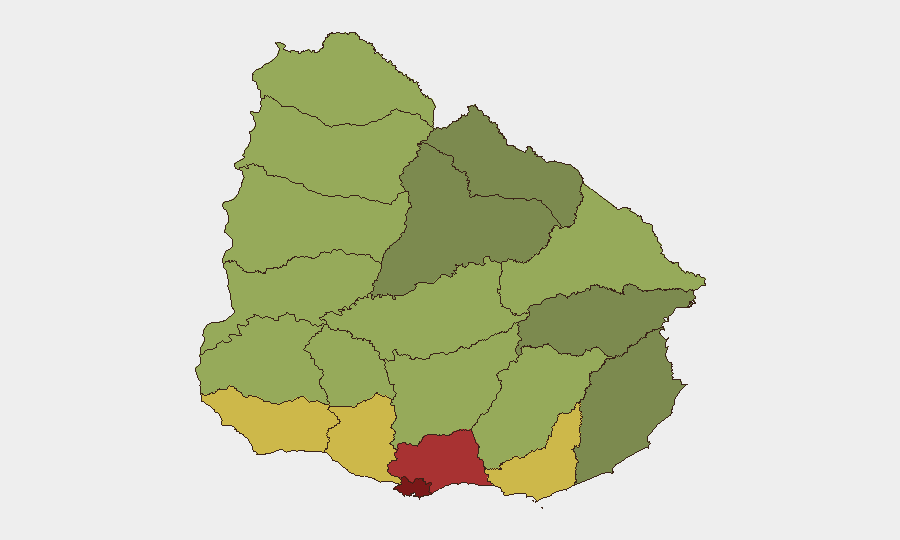
Montevideo (risk score 92) is the overwhelming driver of national risk, accounting for the majority of organized-crime activity, gang violence, and property crime. Canelones (78) and Maldonado (68) follow, with Canelones likely reflecting spillover from Montevideo and Maldonado potentially tied to drug-trafficking routes and border activity. The concentration of risk in the capital and immediately adjacent departments reflects Uruguay's urbanization pattern and the presence of major trafficking corridors; outer departments (Artigas, Paysandú, Flores) carry significantly lower risk, though not negligible given cross-border vulnerability. For corporate operations, asset concentration in Montevideo drives proportional exposure.
How GeoBit Would Assist
Security teams should deploy GIS & Spatial Analysis and AOI (Area-of-Interest) Monitoring & Early Warning to track organized-crime activity patterns in Montevideo and Canelones in near-real time, with automated alerting for incidents in specific neighborhoods. OSINT fusion (X/Twitter, news, and Telegram monitoring) coupled with multi-language entity extraction and sentiment analysis enables rapid detection of emerging gang activity, police operations, or diplomatic incidents that may affect duty-of-care obligations. Routing & Network Analysis can identify safer transit corridors for personnel and supply chains in and around Montevideo, particularly during periods of heightened police activity.
7-Day Outlook
Police deployments and bilateral security cooperation suggest sustained governmental focus on organized crime over the next week. The diplomatic messaging toward Venezuela and recent territorial claims signal potential for additional political statements but do not currently indicate imminent physical escalation. Corporate security teams should expect continued law-enforcement activity in Montevideo and maintain heightened situational awareness around police operations, which may temporarily disrupt transit and commerce in affected neighborhoods.
Highest-Risk Areas — Ranked
| # | State / Region | Risk |
|---|---|---|
| 1 | Montevideo | 92 |
| 2 | Canelones | 78 |
| 3 | Maldonado | 68 |
| 4 | San José | 64 |
| 5 | Colonia | 62 |
| 6 | Soriano | 58 |
| 7 | Río Negro | 56 |
| 8 | Salto | 54 |
| 9 | Artigas | 52 |
| 10 | Paysandú | 50 |
| 11 | Florida | 48 |
| 12 | Flores | 46 |
Sources
Previous Daily Briefs
A new Uruguay brief is written every day — each with its own risk map and downloadable CSV. Here's the last week; use the calendar to go further back.
📅 Browse every day by calendar →
Highlighted days have a brief. Tap a day for that day's map & analysis, or “csv” for that day's dataset ($5).
Atlas — our AI intelligence desk — emails them this snapshot personally. Nothing else, no list.