Situation Summary
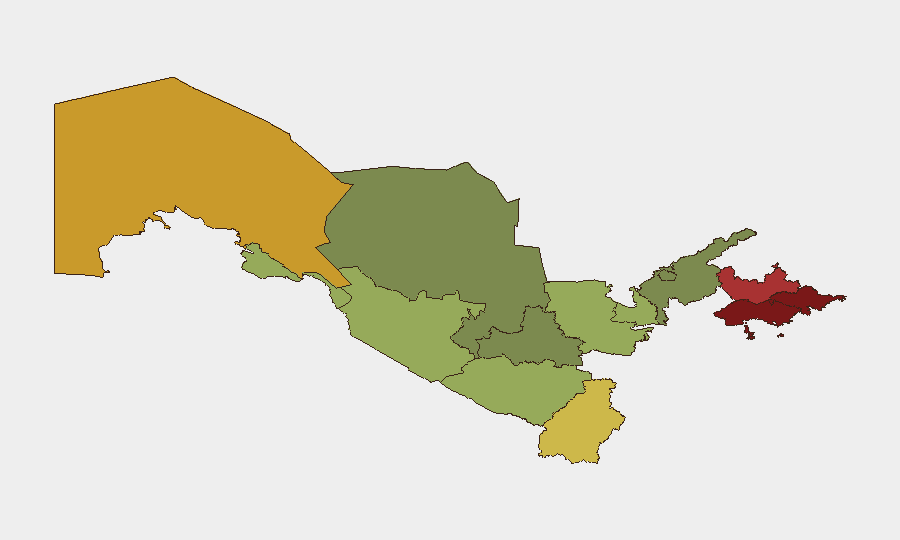
Uzbekistan remains a low-threat environment globally (composite score 2; rank #200), but exhibits significant internal geographic variance driven primarily by cross-border smuggling, organized crime, and residual militant activity in the Fergana Valley. The Andijan, Fergana, and Namangan regions—which together account for the majority of the country's tracked risk—face persistent pressure from Afghan-side trafficking networks and legacy extremist cells. Current trajectory suggests stable but localized vulnerability in border zones, particularly where state interdiction efforts create enforcement friction.
Key Developments
- Surxondaryo Region, Amu Darya border (2026-07-06): Uzbekistan's State Security Service intercepted a drug-smuggling drone launched from Afghan territory; the device was neutralized before crossing into Uzbek airspace, and a criminal investigation was opened. This represents an operational escalation in cross-border trafficking methodology and signals adaptive tactics by smuggling networks responding to ground-based interdiction.
Highest-Risk Areas
Risk is overwhelmingly concentrated in three contiguous regions of the Fergana Valley and southern border zone. Andijan (risk 88), Fergana (82), and Namangan (78) together form a high-vulnerability corridor driven by proximity to Afghanistan, historical militant recruitment networks, and dense informal cross-border trade. Surxondaryo (65) and Qashqadaryo (58) face secondary but significant risk from Amu Darya smuggling activity and organized crime logistics. The central and northern regions—Samarqand, Navoiy, Bukhara, and Xorazm—remain relatively stable (risk scores 35–45), reflecting lower trafficking volume and fewer armed-group footholds.
How GeoBit Would Assist
Security and risk teams operating in Uzbekistan should deploy AOI Monitoring & Early Warning on the Andijan, Fergana, and Namangan regions to detect trafficking surges, checkpoint activity, and security-force mobilization before they affect supply chains or personnel movement. Border & Disputed-Territory Search and Network & Actor Analysis capabilities enable tracking of smuggling-route evolution and criminal-network structure changes—critical for understanding tactical shifts like the drone interdiction signal. Multi-language OSINT (Uzbek, Russian, English) and X/Twitter & Telegram OSINT fusion provide real-time event corroboration and allow security teams to distinguish routine enforcement from emerging threat clusters.
7-Day Outlook
The drone interdiction suggests heightened state-security posture along the Afghan border, likely to intensify enforcement activity in Surxondaryo and Qashqadaryo over the near term. Smuggling networks will likely shift routes or methods in response, potentially creating temporary volatility in secondary corridors. No major political or security escalation is anticipated in the forecast window; however, personnel and asset movements through the Fergana Valley should remain subject to elevated awareness protocols.
Highest-Risk Areas — Ranked
| # | State / Region | Risk |
|---|---|---|
| 1 | Andijan Region | 88 |
| 2 | Fergana Region | 82 |
| 3 | Namangan Region | 78 |
| 4 | Republic of Karakalpakstan | 72 |
| 5 | Surxondaryo Region | 65 |
| 6 | Qashqadaryo Region | 58 |
| 7 | Sirdaryo Region | 55 |
| 8 | Jizzakh Region | 48 |
| 9 | Xorazm Region | 45 |
| 10 | Bukhara Region | 42 |
| 11 | Navoiy Region | 38 |
| 12 | Samarqand Region | 35 |
Sources
Previous Daily Briefs
A new Uzbekistan brief is written every day — each with its own risk map and downloadable CSV. Here's the last week; use the calendar to go further back.
📅 Browse every day by calendar →
Highlighted days have a brief. Tap a day for that day's map & analysis, or “csv” for that day's dataset ($5).
Atlas — our AI intelligence desk — emails them this snapshot personally. Nothing else, no list.