Situation Summary
Venezuela remains under a national State of Emergency following the 24 June earthquakes, with widespread power and Internet outages persisting into early July and severely limiting situational awareness across the country. Simón Bolívar International Airport (Caracas) remains closed to commercial traffic, forcing evacuation and business travel through regional airports in Valencia, Barcelona, Barquisimeto, and Maracaibo. While search-and-rescue operations continue in damaged coastal zones, the broader security picture is obscured by communications breakdown; no significant new crime, protest, or political-instability incidents have been reliably reported in the last 48 hours beyond ongoing emergency-response operations. The composite national threat ranking (50/169 events) reflects elevated but manageable risk outside disaster-affected areas.
Key Developments
- Caracas – Simón Bolívar International Airport closure (ongoing, 5–6 July). Commercial flights remain suspended due to earthquake damage; travelers are forced to rebook via Valencia, Barcelona, Barquisimeto, or Maracaibo airports, extending travel times and increasing logistical complexity for business continuity and personnel evacuation.
- Nationwide power and Internet outages (5–6 July). Widespread disruptions, declared in U.S. Embassy alerts as of 4 July with no improvement reported through 5–6 July, are degrading communications, emergency-services coordination, and corporate security-team ability to contact personnel or assets in-country.
- La Guaira and coastal zones west of Caracas – ongoing search-and-rescue operations (5–6 July). Teams continue extracting survivors from collapsed structures more than a week after the quakes; road closures and restricted access persist, limiting movement and increasing humanitarian and physical risk in these corridors.
- National rail network suspension (5–6 July). All domestic rail services remain cancelled due to structural damage and safety concerns, forcing reliance on damaged and congested road networks and complicating internal logistics and evacuation routes.
- Regional airport activation (5–6 July). Valencia, Barcelona, Barquisimeto, and Maracaibo airports are operationally functioning as primary exit points; international carriers are routing traffic through these hubs, though conditions remain fluid and delays are common.
- State of Emergency security posture (ongoing, 5–6 July). Security forces operating under expanded emergency powers are deployed nationwide; risk of arbitrary detention and security incidents is elevated, particularly in Caracas and coastal states under active disaster-response operations.
- Border-region status unchanged (5–6 July). Colombia, Brazil, and Guyana borders remain open but classified as *Do Not Travel* due to persistent kidnapping, armed-group activity, and detention risk; the Guayana Esequiba dispute continues to enable criminal activity on the Guyana border.
Highest-Risk Areas
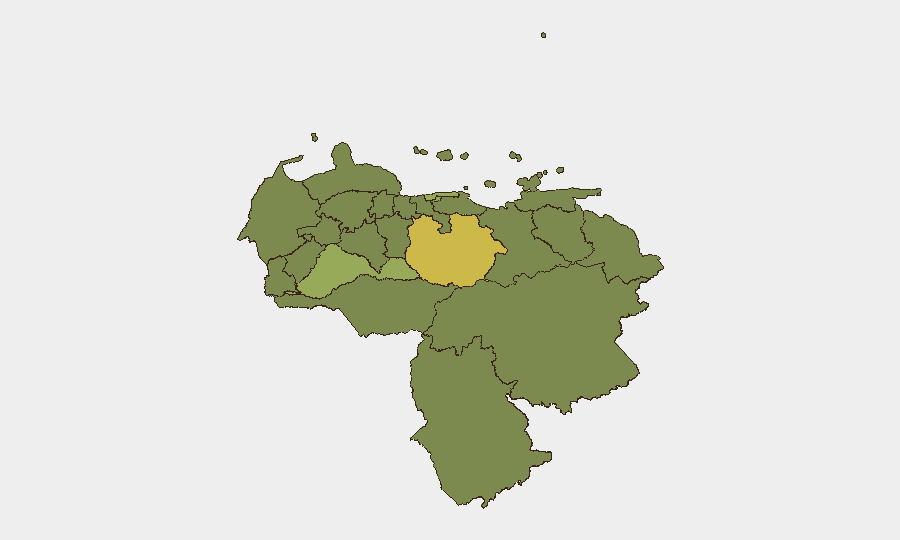
Guarico and Federal District (Caracas region) dominate the sub-national ranking at 65.1 and 59.9 respectively, driven by ongoing emergency operations, security-force deployments, and disrupted governance and communications. Vargas, Barinas, and Carabobo states (42–46 risk scores) are secondary concern zones; Vargas in particular includes coastal damage corridors and restricted-access zones from the earthquakes. All other tracked states remain below 40, indicating that risk concentration is primarily in the capital region and immediate northern corridor; southern and western border states carry persistent underlying kidnapping and armed-group risk independent of the earthquake emergency.
How GeoBit Would Assist
Teams operating in Venezuela should deploy AOI Monitoring & Early Warning on Caracas, coastal states, and border crossings to detect resumption of normal operations (airport reopening, power restoration, rail resumption) and any new security or political incidents. Intel Sweep and multi-language OSINT across X/Telegram and local news feeds will compensate for communications blackouts by surfacing crisis updates and personnel safety information faster than standard corporate channels. Routing & Network Analysis can model alternative supply-chain, evacuation, and personnel-movement paths around airport closures and road restrictions in real time.
7-Day Outlook
Power and communications are likely to remain disrupted through mid-July, with Simón Bolívar Airport reopening only after structural assessments are complete (likely 10–14 July at earliest). Security-force presence will remain elevated under the State of Emergency, sustaining elevated detention and incident risk in Caracas and coastal zones. No imminent political crisis or major crime surge is signaled by available intelligence, but low visibility means sudden developments cannot be ruled out.
Highest-Risk Areas — Ranked
| # | State / Region | Risk |
|---|---|---|
| 1 | Guarico State | 65.1 |
| 2 | Federal District | 59.9 |
| 3 | Vargas State | 46.1 |
| 4 | Barinas State | 42.1 |
| 5 | Carabobo State | 38 |
| 6 | Anzoategui State | 36.9 |
| 7 | Lara State | 36.3 |
| 8 | Zulia State | 35.1 |
| 9 | Falcon State | 35.1 |
| 10 | Federal Dependencies | 35.1 |
| 11 | Nueva Esparta State | 35.1 |
| 12 | Apure State | 35.1 |
Sources
Previous Daily Briefs
A new Venezuela brief is written every day — each with its own risk map and downloadable CSV. Here's the last week; use the calendar to go further back.
📅 Browse every day by calendar →
Highlighted days have a brief. Tap a day for that day's map & analysis, or “csv” for that day's dataset ($5).
Atlas — our AI intelligence desk — emails them this snapshot personally. Nothing else, no list.