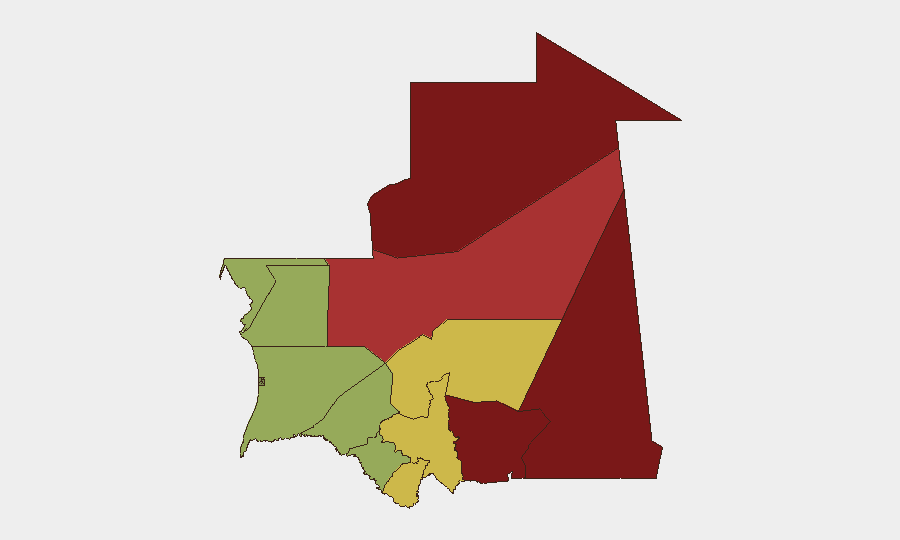
Situation Summary
Mauritania remains a low-frequency threat environment (rank #118 globally) with no significant security incidents or destabilizing events recorded during the past seven days. The country's risk profile is concentrated in the Saharan north and eastern border regions, where cross-border militant activity, human trafficking, and narcotics smuggling persist as chronic challenges. Overall security posture for international personnel and commercial operations in the capital and southern zones remains stable, though vigilance is warranted in high-risk peripheral areas.
Key Developments
- Nouakchott, 19 October 2026: Municipal authorities convened to discuss urban sanitation and city-governance improvements. No security incidents, civil unrest, or travel disruptions were reported in connection with this meeting.
- National, 15 October 2026: Civil-aviation authorities initiated training courses for 64 airport-security personnel. The scope, duration, and specific airport location were not disclosed in available reporting; no incident trigger was identified.
- Port of Nouakchott, 8 October 2026: Mauritanian police intercepted three vehicles and seized approximately 162,000 ecstasy tablets, resulting in the arrest of three foreign nationals. This represents routine narcotics interdiction activity consistent with ongoing port-security operations.
No additional security events within the 14–20 October 2026 reporting window could be independently verified. Regional developments in Mali, Senegal, and Mauritius were excluded from this brief.
Highest-Risk Areas
Tiris Zemmour (risk score 95) and the eastern Hodh regions (Hodh Ech Chargui: 85; Hodh El Gharbi: 80) remain the primary drivers of Mauritania's sub-national risk profile. These sparsely populated, desert-frontier territories serve as transit corridors for militant cells with affiliations to regional jihadist networks, human-trafficking networks, and arms smuggling. Adrar (78) and Tagant (68) present secondary risk through similar cross-border dynamics. By contrast, the capital region (Nouakchott, in Dakhlet Nouadhibou and Trarza) and southern agricultural zones maintain substantially lower risk and support the majority of international business and expatriate presence.
How GeoBit Would Assist
Security teams with Mauritania exposure should employ AOI Monitoring & Early Warning on high-risk northern and eastern border zones to detect emerging militant activity, trafficking patterns, or armed-group movement before they impact personnel or supply chains. Intel Sweep and X/Twitter OSINT capabilities enable continuous low-cost scanning for emerging threats, civil unrest, or port/aviation security changes that may not appear in formal official channels. Routing & Network Analysis supports identification of secure alternative travel corridors for staff transiting between Nouakchott and southern operating areas, particularly during periods of heightened activity in peripheral regions.
7-Day Outlook
No significant escalation in Mauritania's security environment is anticipated over the coming week. Routine narcotics and trafficking interdiction activity will likely continue at major ports and border crossings. Organizations with personnel or assets in the northern and eastern frontier regions should maintain current protective postures and situational awareness protocols, particularly given the chronic (though episodic) cross-border militant threat originating from Mali and the Sahel.
Highest-Risk Areas — Ranked
| # | State / Region | Risk |
|---|---|---|
| 1 | Tiris Zemmour | 95 |
| 2 | Hodh Ech Chargui | 85 |
| 3 | Hodh El Gharbi | 80 |
| 4 | Adrar | 78 |
| 5 | Tagant | 68 |
| 6 | Guidimaka | 65 |
| 7 | Assaba | 62 |
| 8 | Gorgol | 58 |
| 9 | Trarza | 55 |
| 10 | Inchiri | 52 |
| 11 | Brakna | 48 |
| 12 | Dakhlet Nouadhibou | 45 |
Sources
Previous Weekly Briefs
A new Mauritania brief is written every Monday, covering the week — each with its own risk map and downloadable CSV. Use the calendar to go further back.
- October 13, 2026
- October 6, 2026
- September 29, 2026
- September 22, 2026
- September 15, 2026
- September 8, 2026
- September 2, 2026
📅 Browse past briefs by calendar →
Highlighted days have a brief. Tap a day for that day's map & analysis, or “csv” for that day's dataset ($5).
Atlas — our AI intelligence desk — emails them this snapshot personally. Nothing else, no list.