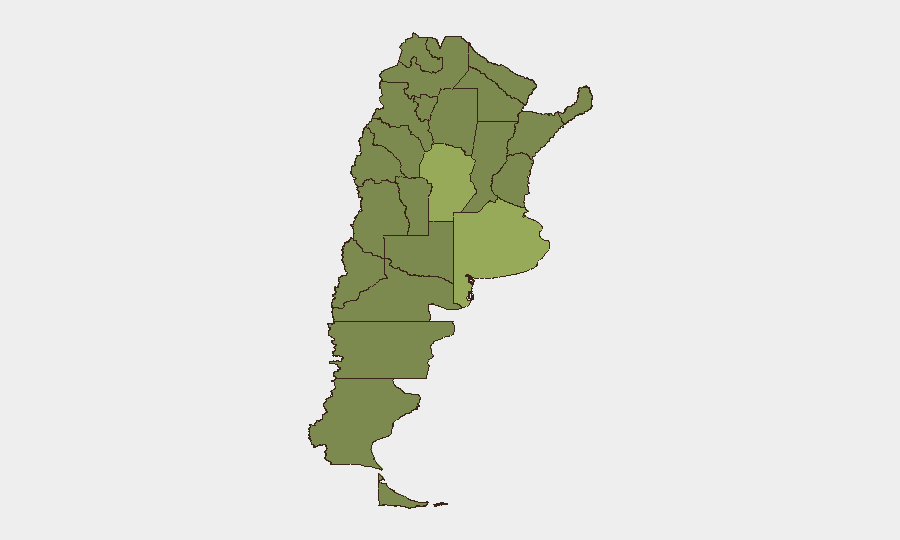
Situation Summary
Argentina remains at composite threat rank #46 globally with a moderate threat score of 35. Recent event signals (20–21 July) indicate domestic political friction, including presidential-legislative tension, international diplomatic strain with Spain, and localized enforcement actions. The security posture is stable but showing signs of underlying institutional strain; no acute nationwide crisis is evident, though sub-national variation is pronounced.
Key Developments
- 2026-07-20 · Presidential–Legislative Friction: Public statement by President vs. Argentina, coupled with Legislature rejection and Government demand signals, suggests policy divergence or constitutional friction at the federal level. Specific legislative outcome not yet detailed in available signals.
- 2026-07-20 · Spain–Argentina Diplomatic Tension: Disapproval statements from Spain toward Argentina and parallel Spanish disapproval of European entities signal a diplomatic dispute, possibly trade, immigration, or consular in nature. Escalation trajectory remains unclear.
- 2026-07-20 · Territory Occupation (Entrepreneur Context): An "Occupy Territory" event linked to an entrepreneur was recorded; geographic specificity and motive require deeper investigation to assess whether this reflects land dispute, property rights conflict, or labor/industrial action.
- 2026-07-20 · Judicial–Militant Arrest: A judge-authorized arrest of a militant suggests law enforcement action against a non-state actor; no casualty or widespread violence signal is evident, but localization and group affiliation warrant monitoring.
- 2026-07-19 · Police Relations Reduction: A "Reduce Relations" signal involving police may indicate internal institutional friction, budget cuts, or inter-agency conflict; context is limited.
- 2026-07-19 · Federal Investigation into Investor: Argentina-initiated investigation against an investor suggests either fraud, capital flight, or sanctions-evasion scrutiny; corporate teams with foreign investment exposure should monitor regulatory developments.
- Rosario Travel Status Improvement (Recent Confirmation): Argentine Ministry of Security has confirmed U.S. State Department removal of Rosario from highest-risk travel alert; the city remains monitored but no longer flagged as exceptional.
Highest-Risk Areas
Córdoba Province (54.5) and Buenos Aires Province (46.6) together drive over one-third of national risk signals and dominate the sub-national ranking. Córdoba's elevation likely reflects labor unrest, criminal organization activity, or protest cycles characteristic of Argentina's industrial heartland. Buenos Aires Province risk reflects the capital-region's population density, migrant flows, and economic volatility. Tucumán (35.7) ranks third and warrants attention for northern regional dynamics; mid-tier provinces (Chaco, Santiago del Estero, Misiones, Corrientes, Entre Ríos) cluster around 24–25 risk score, indicating distributed rather than localized instability.
How GeoBit Would Assist
Intel Sweep & OSINT Fusion would correlate the seven event signals above with open-source social media (X, Telegram), news, and radio intelligence to isolate motives, participants, and geographic centers. Area-of-Interest (AOI) Monitoring on Córdoba and Buenos Aires Province would enable persistent alerting on protest activity, enforcement actions, and critical infrastructure disruption. Risk & Threat Assessment modules would model escalation probability for the Spain dispute and investor investigation, informing duty-of-care protocols for staff and assets in high-risk zones.
7-Day Outlook
Near-term trajectory suggests managed institutional friction without imminent systemic breakdown. The Spain diplomatic strain and federal investigation signals require close diplomatic and regulatory monitoring but do not yet indicate sanctions or operational restrictions. Sub-national risks in Córdoba and Buenos Aires remain the primary focus for asset and personnel security; no acute spike is forecast in the next 7 days absent new triggering events.
Highest-Risk Areas — Ranked
| # | State / Region | Risk |
|---|---|---|
| 1 | Córdoba | 54.5 |
| 2 | Buenos Aires Province | 46.6 |
| 3 | Tucumán Province | 35.7 |
| 4 | Tierra del Fuego Province | 28.1 |
| 5 | Salta Province | 26 |
| 6 | Chaco Province | 25.4 |
| 7 | Santiago del Estero Province | 25.1 |
| 8 | Mendoza Province | 24.8 |
| 9 | Corrientes Province | 24.8 |
| 10 | Misiones | 24.8 |
| 11 | Entre Ríos Province | 24.8 |
| 12 | San Juan Province | 24.5 |
Sources
Previous Daily Briefs
A new Argentina brief is written every day — each with its own risk map and downloadable CSV. Here's the last week; use the calendar to go further back.
📅 Browse every day by calendar →
Highlighted days have a brief. Tap a day for that day's map & analysis, or “csv” for that day's dataset ($5).
Atlas — our AI intelligence desk — emails them this snapshot personally. Nothing else, no list.