Situation Summary
China's threat environment remains elevated at #14 globally (composite score 94), with 1,004 tracked events driving a complex picture of geopolitical tension, regulatory enforcement, and military activity. Since June 26, multiple signal categories—military mobilization (involving New Zealand), administrative sanctions, arrests, and public statements—indicate government response to domestic and external pressures. The absence of confirmed acute security incidents (protests, infrastructure disruption, violent crime) in the last 24–48 hours does not indicate de-escalation; rather, enforcement and surveillance activity suggests authorities are actively managing underlying tensions. Risk trajectory remains stable but tense.
Key Developments
- 2026-06-28 · Military Mobilization (China internal). Domestic military movement detected; context and scale unclear from available reporting. Monitor for signals of readiness posture or response to external pressure.
- 2026-06-28 · Arrest/Detain incidents. Two separate detention events recorded—one involving China Mobile in Hubei province. Suggests regulatory or security enforcement; specific charges and scale not yet clarified.
- 2026-06-26 · Military Mobilization (New Zealand vs. China). External military signaling detected; consistent with ongoing maritime or strategic posturing in Indo-Pacific region. Indirect China-presence risk.
- 2026-06-26 · Reduce Relations (China vs. Companies). Government action to downgrade ties with unspecified corporate entities; consistent with offshore-investment and financial-control crackdowns observed in parallel regulatory actions.
- 2026-06-26 · Administrative Sanctions. Enforcement action by Chinese authorities; scope (financial, trade, or individual-level) not detailed in available summaries.
- 2026-06-26 · Disapprove statements. Government disapproval signaled toward Japan and domestic (Xinjiang-related) actors; rhetorical but may signal tightened scrutiny on foreign and regional actors.
- Multiple Public Statements (2026-06-26/27). Official messaging on unspecified topics; consistent with government narrative management during periods of tension.
Note: No confirmed crime, civil unrest, infrastructure disruption, or acute travel incidents in mainland China over June 27–28, 2026 are available for reporting from cross-checked sources.
Highest-Risk Areas
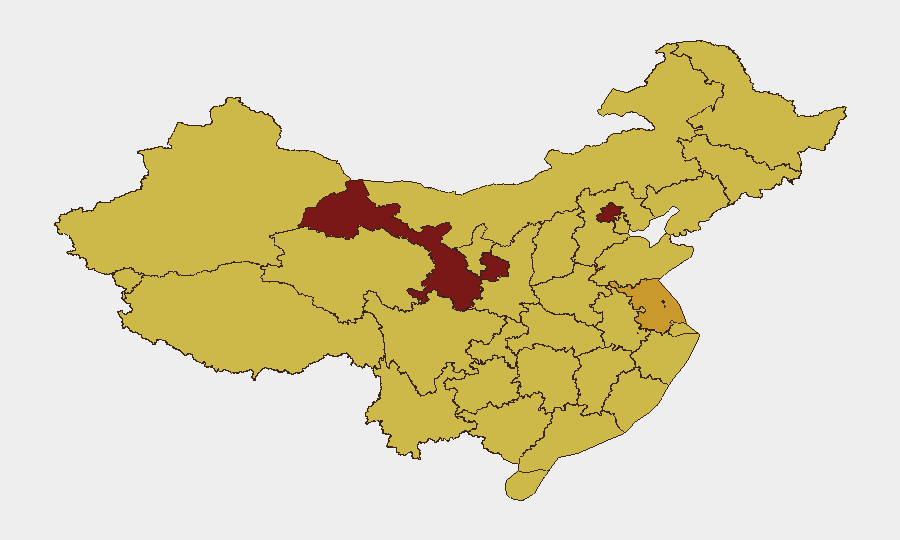
Gansu (95.7) and Beijing (91.9) dominate the sub-national ranking, with Gansu's elevated score likely driven by historical volatility and periphery-region sensitivities, while Beijing's score reflects capital-city concentration of political and security apparatus activity. The coastal and economically significant belt—Jiangsu, Guangdong, Shanghai, Zhejiang—cluster in the 68–72 range, indicating persistent commercial, regulatory, and maritime pressures. Eastern and central provinces (Jiangxi, Anhui, Jilin, Henan) remain in the 66–68 band, suggesting broad underlying risk distributed across industrial and transport corridors rather than localized hotspots.
How GeoBit Would Assist
Teams with assets or personnel in China should deploy AOI Monitoring & Early Warning on Gansu, Beijing, and coastal provinces to detect emerging civil unrest, infrastructure disruption, or security incidents in near real-time. Intel Sweep, X/Twitter & Telegram OSINT, and multi-language search capabilities enable continuous tracking of official announcements, regulatory enforcement, and social sentiment to anticipate policy shifts affecting corporate operations and foreigner movement. Network & Actor Analysis and sentiment analysis support rapid identification of regime-stability shifts and foreign-relations escalation that could trigger capital controls, visa restrictions, or supply-chain disruption.
7-Day Outlook
Regulatory enforcement and military posturing are likely to continue as near-term operational patterns. The absence of acute incidents does not signal risk decline; rather, active government management may be preventing escalation. Corporate teams should expect ongoing restrictions on financial flows, scrutiny of foreign partnerships, and potential visa/travel delays tied to geopolitical signaling.
Highest-Risk Areas — Ranked
| # | State / Region | Risk |
|---|---|---|
| 1 | Gansu | 95.7 |
| 2 | Beijing | 91.9 |
| 3 | Jiangsu | 72.1 |
| 4 | Guangdong Province | 69.7 |
| 5 | Shanghai | 69 |
| 6 | Jiangxi | 68.5 |
| 7 | Zhejiang | 68.1 |
| 8 | Anhui | 67.1 |
| 9 | Jilin | 66.8 |
| 10 | Guangxi | 66.6 |
| 11 | Sichuan | 66.6 |
| 12 | Henan | 66.4 |
Sources
Previous Daily Briefs
A new China brief is written every day — each with its own risk map and downloadable CSV. Here's the last week; use the calendar to go further back.
📅 Browse every day by calendar →
Highlighted days have a brief. Tap a day for that day's map & analysis, or “csv” for that day's dataset ($5).