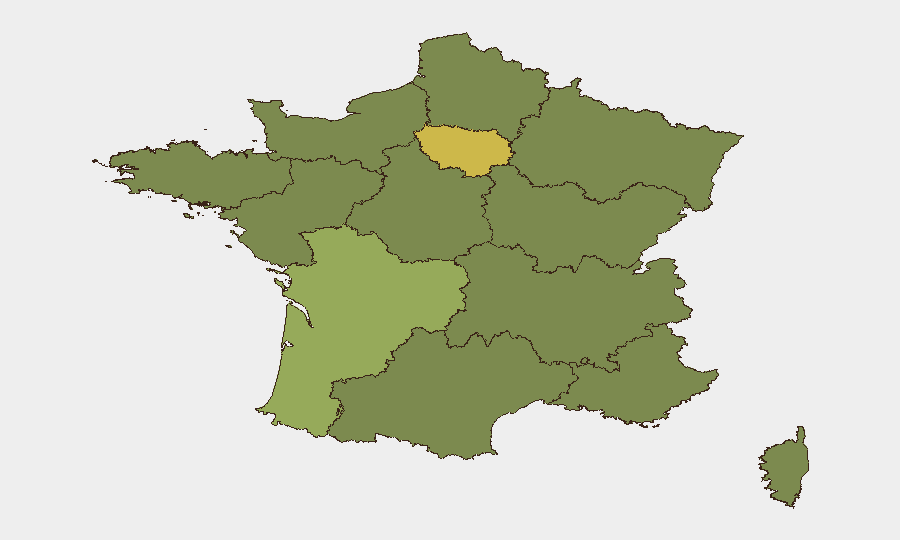
Situation Summary
France remains at composite threat level #44 globally, with 290 tracked events, but the security environment has deteriorated markedly over the past 48 hours. Ile-de-France dominates the risk landscape (60.2), driven by terrorism-related incidents, unconventional violence signals, and active cyber-espionage operations targeting national infrastructure. The confluence of a weapons-cache discovery near Paris, large-scale wildfires with suspected arson, shooting incidents in provincial cities, and cross-border cyber campaigns indicates elevated volatility across physical security, public order, and critical infrastructure domains.
Key Developments
- Sarcelles, Val-d'Oise (12 July, 2026): ~300 people evacuated following discovery of a suspicious vehicle containing weapons near a synagogue; prosecutors initiated terrorism investigation. Ile-de-France risk benchmark directly reflects this incident.
- Fontainebleau forest, Seine-et-Marne (weekend, reported 14 July, 2026): Wildfires consumed ~2,050 hectares and displaced ~1,000 residents; authorities suspect arson. A volunteer firefighter subsequently admitted to deliberately starting one of the fires; four individuals in custody.
- Clermont-Ferrand, Puy-de-Dôme (13 July, 2026): Five men aged 18–27 sustained gunshot wounds in an incident classified as violent crime, not terror-related at present reporting.
- Morbihan (ongoing since 14 July evening, 2026): Approximately 2,000 people assembled for an illegal rave party, creating sustained public-order and crowd-control challenges for local authorities.
- France–Russia cyber domain (13 July, 2026): French government summoned Russia's ambassador to address a "vast cyber campaign" involving sabotage and espionage targeting rail infrastructure across Europe, including French assets. Incident reflects active state-level cyber threat.
- Ussel, Corrèze (12 July, 2026): Tour de France support vehicle struck barriers after driver medical emergency; eight persons injured, including one seriously.
Highest-Risk Areas
Ile-de-France (60.2) dominates the national risk profile, reflecting both the density of critical infrastructure and confirmed terrorism-related activity (weapons cache, evacuation). Nouvelle-Aquitaine (46.1) follows at significant distance, suggesting more dispersed or lower-intensity drivers; the remaining ten regions cluster between 30–31, indicating relatively uniform baseline risk outside the capital region. The regional concentration suggests that national-level duty-of-care protocols should prioritize Paris and immediate suburbs for enhanced personnel and asset monitoring.
How GeoBit Would Assist
Security teams operating in France should deploy AOI Monitoring & Early Warning on Ile-de-France and Nouvelle-Aquitaine to track evolving terrorism and public-order signals in real time. Intel Sweep, global event feeds, and OSINT fusion across social platforms and official channels will provide corroboration and velocity assessment for emerging incidents (as demonstrated by the rapid confirmation of the Sarcelles evacuation and Fontainebleau arson). Network & Actor Analysis applied to the cyber campaign signals will help distinguish state-sponsored infrastructure attacks from lower-level criminal activity and inform critical-systems hardening priorities.
7-Day Outlook
Terrorism-related threat indicators remain elevated in and around Paris through at least mid-week; prosecutorial timelines and any public statements regarding the Sarcelles investigation will likely prompt secondary activity or copycat concerns. Wildfire risk remains seasonally high across central and southern regions; arson as a motivator suggests potential recurrence. Cyber pressure on rail and transport networks is expected to persist as part of the broader European campaign attributed to Russian actors.
Highest-Risk Areas — Ranked
| # | State / Region | Risk |
|---|---|---|
| 1 | Ile-de-France | 60.2 |
| 2 | Nouvelle-Aquitaine | 46.1 |
| 3 | Pays de la Loire | 33.5 |
| 4 | Auvergne-Rhône-Alpes | 31.4 |
| 5 | Hauts-de-France | 31.3 |
| 6 | Corsica | 30.4 |
| 7 | Brittany | 30.3 |
| 8 | Normandy | 30.3 |
| 9 | Occitania | 30.3 |
| 10 | Provence-Alpes-Côte d'Azur | 30.3 |
| 11 | Centre-Val de Loire | 30.2 |
| 12 | Grand Est | 30.2 |
Sources
Previous Daily Briefs
A new France brief is written every day — each with its own risk map and downloadable CSV. Here's the last week; use the calendar to go further back.
📅 Browse every day by calendar →
Highlighted days have a brief. Tap a day for that day's map & analysis, or “csv” for that day's dataset ($5).
Atlas — our AI intelligence desk — emails them this snapshot personally. Nothing else, no list.