Situation Summary
Guinea-Bissau remains classified as a lower-tier global security risk (#136, composite score 8) with no tracked acute incidents in the past 24–48 hours. However, the security environment is shaped by three concurrent stressors: military-led political rule since November 2025, a constitutional referendum scheduled for 30 August that has triggered opposition boycott calls, and Guinea-Bissau's first recorded mpox outbreak (seven confirmed cases as of 17 August, with roughly half affecting children). The absence of reported violence does not indicate stability; rather, it reflects a pattern of chronic, low-intensity political tension and institutional fragility under a security services–dominated interim government.
Key Developments
- Nationwide, 21 August 2026: Opposition party PAIGC formally called for a boycott of the constitutional referendum slated for 30 August, citing exclusion from the drafting process and alleging intent to "rig the process." This marks the most significant political event in the last 48 hours and raises protest and polarization risk in the final week before the vote.
- Nationwide, 21–22 August 2026: Transitional authorities reaffirmed the constitutional referendum timetable (30 August), with general elections planned for December 2026. The proposed shift to a stronger presidential system remains the subject of controversy among political parties and civil society.
- Nationwide, 20–22 August 2026 (announcement; data as of 17 August): Guinea-Bissau's first confirmed mpox outbreak was publicly highlighted by UNICEF and health agencies, with seven confirmed adult cases and no deaths reported as of 17 August. Health authorities identified children in roughly half of suspected cases and flagged the country as ill-prepared, requiring over US$150,000 in emergency support. This represents an ongoing public-health emergency with implications for humanitarian logistics and staff duty-of-care.
- Nationwide, 21 August 2026 (reporting on ongoing climate; referencing March 2026 killing): Media coverage underscored a persistent climate of intimidation and opposition self-censorship in Bissau and nationwide, linked to the March 2026 killing of opposition activist Vigario Luis Balanta and continued military rule. No new incidents of political violence were reported in the last 24–48 hours, but the reporting reflects active political repression and risk of renewed unrest around the referendum.
- Transnational, 18 August 2026: Senegalese transport operators suspended cross-border journeys to Guinea-Bissau following a dispute with Bissau-Guinean transport authorities. While pre-dating the 24–48 hour window, this reflects ongoing administrative friction and minor cross-border disruption.
- Nationwide, last 24–48 hours: No credible open-source reports of civil unrest, armed clashes, large-scale protests, infrastructure failures, or trafficking disruptions were detected, maintaining a "steady-state" low-incident profile despite underlying political and health tensions.
Highest-Risk Areas
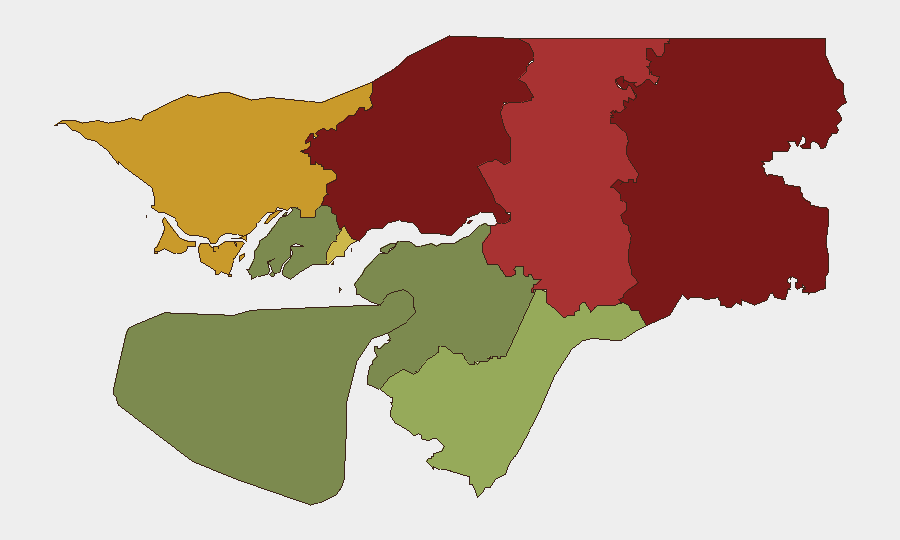
Gabu Region (risk 92) and Oio Region (risk 85) dominate the sub-national ranking, likely reflecting chronic cross-border trafficking, weak state authority, and proximity to Senegal. Bafatá Region (78) and Cacheu Region (72) follow, all concentrated in northern and eastern Guinea-Bissau where governance capacity is minimal and armed groups historically operate. The capital region, Bissau Autonomous Sector (68), ranks fifth—lower than the periphery—but remains a focal point for political tension, military oversight, and opposition activity. Southern regions (Tombali, Quinara, Biombo, Bolama) carry significantly lower scores, reflecting relatively stronger state presence and lower trafficking/conflict indicators.
How GeoBit Would Assist
Corporate and duty-of-care teams should employ AOI Monitoring & Early Warning on Gabu, Oio, and Bissau to detect protest activity, checkpoint movements, or security-force mobilization around the 30 August referendum. Election Monitoring and sentiment & temporal analysis of opposition media and social platforms (via Intel Sweep, X/Twitter OSINT, and multi-language search) will track polarization and boycott momentum. Environmental & Health tracking and humanitarian & NGO data integration will maintain visibility on the mpox response, healthcare capacity, and travel-health advisories affecting personnel.
7-Day Outlook
The constitutional referendum on 30 August is the dominant near-term risk driver, with potential for organized opposition demonstrations and possible security-force responses in Bissau and regional capitals. Concurrent mpox case identification and public-health strain will likely increase, potentially complicating logistics and staff safety protocols. No major escalation in armed violence is anticipated, but political polarization and administrative disruption should be expected through August and into December elections.
Highest-Risk Areas — Ranked
| # | State / Region | Risk |
|---|---|---|
| 1 | Gabu Region | 92 |
| 2 | Oio Region | 85 |
| 3 | Bafatá Region | 78 |
| 4 | Cacheu Region | 72 |
| 5 | Bissau Autonomous Sector | 68 |
| 6 | Tombali Region | 45 |
| 7 | Quinara Region | 38 |
| 8 | Biombo Region | 32 |
| 9 | Bolama Region | 15 |
Sources
Previous Daily Briefs
A new Guinea-Bissau brief is written every day — each with its own risk map and downloadable CSV. Here's the last week; use the calendar to go further back.
- August 20, 2026
- August 17, 2026
- August 15, 2026
- August 13, 2026
- August 11, 2026
- August 10, 2026
- August 8, 2026
📅 Browse every day by calendar →
Highlighted days have a brief. Tap a day for that day's map & analysis, or “csv” for that day's dataset ($5).
Atlas — our AI intelligence desk — emails them this snapshot personally. Nothing else, no list.