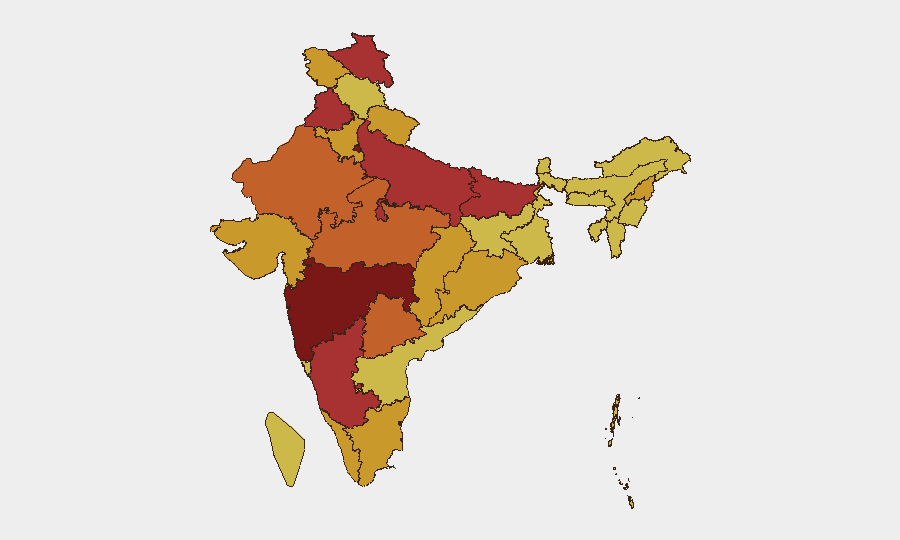
Situation Summary
India remains the third-highest-threat environment globally, with 824 tracked events and a composite threat score of 100. The past 48 hours have seen a convergence of protest activity, infrastructure incidents, financial-crime enforcement, and security-force confrontations across multiple states, with Maharashtra, Delhi, and Karnataka driving the highest aggregate risk. The security picture reflects sustained structural pressures: civil unrest around governance and resource demands, transport-safety gaps, and active law-enforcement operations against financial and smuggling networks.
Key Developments
- New Delhi, Delhi – July 18, 2026: Delhi Police detained multiple protesters and removed demonstrators from Jantar Mantar following clashes during activist Sonam Wangchuk's indefinite fast; Wangchuk was hospitalized at Safdarjung with health deterioration, and one activist was attacked with ink, prompting expanded police presence at the site.
- New Delhi, Delhi – July 18, 2026: Delhi Police erected multiple security layers, barricades, and enhanced vehicle checkpoints across New Delhi, Central Delhi, and North Delhi in advance of the Cockroach Janta Party's planned "Chalo Sansad" march scheduled for July 20, indicating pre-event threat posture ahead of a Parliament session.
- Vastral, Ahmedabad, Gujarat – July 18, 2026: An explosion at an illegal firecracker manufacturing unit killed at least five people and injured nine, triggering a major fire and large-scale rescue operations, underscoring unregulated industrial-safety risks in Gujarat's composite threat profile.
- Jammu & Kashmir – July 18-19, 2026: Authorities suspended onward pilgrimage movement from Baltal and Chandanwari base camps on the Shri Amarnathji Yatra due to adverse weather forecasts, restricting high-altitude travel and indicating elevated environmental and logistical risk in the region.
- New Delhi & Mumbai, Maharashtra – July 18, 2026: The Central Bureau of Investigation conducted searches at 15 premises linked to Reliance Commercial Finance and Reliance Home Finance companies in connection with registered financial-crime cases against the Anil Ambani-led Reliance ADA Group, reflecting ongoing high-profile corruption investigations.
- Bhaderwah, Jammu & Kashmir – July 17, 2026: A 30-year-old civilian was shot dead and three Special Operations Group personnel were injured during an incident involving an alleged attempt to snatch a service rifle, signaling escalated armed confrontation and security-force/civilian risk in Doda district.
- West Bengal – July 17, 2026: A local train struck a school van and bicycle at a level crossing in Murshidabad district, killing five people including four school students and critically injuring two, highlighting critical transport-safety infrastructure gaps.
Highest-Risk Areas
Maharashtra (100) and Delhi (95.8) drive the highest composite risk, with Maharashtra shaped by large-scale urban unrest, activist mobilization, and financial-crime enforcement, while Delhi's risk reflects active protest dynamics and pre-planned mass-movement security operations. Karnataka, Uttar Pradesh, and Punjab (79.7–78.1) maintain elevated risk from community demands, settlement disputes, and localized armed incidents. Jammu & Kashmir and Ladakh (76.8–72.8) face compounding pressures from civil unrest, pilgrimage-related disruption, and armed confrontations with security forces.
How GeoBit Would Assist
Security and risk teams monitoring India should deploy AOI Monitoring & Early Warning on high-volatility zones (Delhi, Maharashtra protest sites, J&K pilgrimage routes) to capture real-time event signals; use OSINT Fusion & Corroboration (Twitter, Telegram, local news feeds, multi-language search) to track activist narratives and police operations; and employ Routing & Network Analysis to plan alternative journeys and supply routes around protest sites and infrastructure disruptions.
7-Day Outlook
The July 20 "Chalo Sansad" march in Delhi will likely sustain heightened police mobilization and protest-related disruption through the week. Unregulated manufacturing incidents and transport-safety gaps will continue to generate secondary humanitarian and operational risk. Long-range weather impacts on Ladakh/J&K pilgrim routes and ongoing financial-crime investigations across major metros suggest sustained operational friction for corporate teams with India presence.
Highest-Risk Areas — Ranked
| # | State / Region | Risk |
|---|---|---|
| 1 | Maharashtra | 100 |
| 2 | Delhi | 95.8 |
| 3 | Karnataka | 79.7 |
| 4 | Uttar Pradesh | 78.6 |
| 5 | Punjab | 78.1 |
| 6 | Ladakh | 76.8 |
| 7 | Bihar | 76.6 |
| 8 | Rajasthan | 75.6 |
| 9 | Telangana | 75.4 |
| 10 | Madhya Pradesh | 73.6 |
| 11 | Jammu and Kashmir | 72.8 |
| 12 | Gujarat | 72.5 |
Sources
Previous Daily Briefs
A new India brief is written every day — each with its own risk map and downloadable CSV. Here's the last week; use the calendar to go further back.
📅 Browse every day by calendar →
Highlighted days have a brief. Tap a day for that day's map & analysis, or “csv” for that day's dataset ($5).
Atlas — our AI intelligence desk — emails them this snapshot personally. Nothing else, no list.