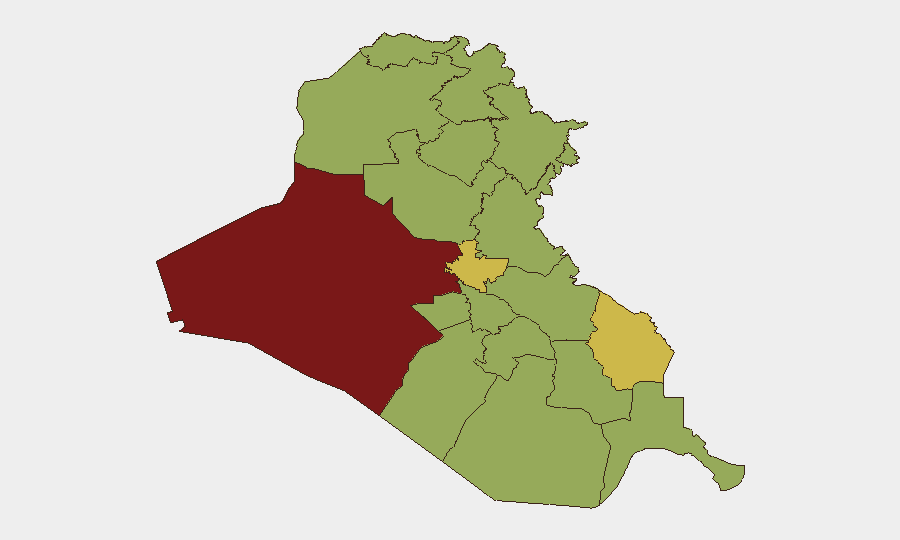
Situation Summary
Iraq remains at elevated risk (global rank #16, composite score 83), driven primarily by persistent insurgent activity across 440 tracked events. A major anti-corruption and security crackdown by federal authorities in Baghdad and nationwide over June 27–28 has dominated the most recent security picture, with over 45 arrests including politicians and senior officials. While the operation has been framed by authorities and analysts as a law-enforcement action rather than regime instability, it signals internal institutional tension and creates a near-term window of unpredictability in the capital and surrounding areas.
Key Developments
- Baghdad, Green Zone & surrounding neighborhoods – June 28, 2026 (pre-dawn): Iraqi Counter Terrorism Service (CTS) and other security units conducted large-scale raids targeting multiple politicians, lawmakers, and senior officials on corruption and money-laundering charges. Armored vehicles, including reported Abrams tanks, were deployed near the Sigma/Sikma residential complex adjacent to the U.S. Embassy; heavy gunfire was reported in parts of the Green Zone. (Reuters, AFP, Al Jazeera, ISW corroboration)
- Iraq nationwide – June 27–28, 2026: Federal government anti-corruption crackdown expanded to arrest over 45 individuals across the country, with concentration in Baghdad. Operation initiated by Prime Minister Ali al‑Zaidi as part of a purported strengthening of anti-money-laundering and counter-terrorist-financing measures. (Reuters, ISW)
- Baghdad political/security environment – June 28–29, 2026: Multiple social-media posts and video reports documented heavy security deployments in the Green Zone; local commentary disputed coup narratives, but the scale and pace of arrests of sitting politicians have created short-term uncertainty around governmental stability and civil–military relations.
- Regional threat signals (June 27–29): OPEC threats toward Iraq, Iranian military posturing vs. Iraq, and internal political dissent between military and government actors were recorded in the same 72-hour window, suggesting convergent pressure on the Baghdad government from multiple vectors—though these remain largely statements and posturing rather than kinetic events inside Iraq's borders.
Highest-Risk Areas
Al-Anbar Governorate (87.8) remains the primary driver of Iraq's national threat score, reflecting ongoing insurgent presence and conventional military activity in the country's western border region. Baghdad (67.3) has been elevated by the June 28 security operations and reflects the capital's status as the nexus of political, economic, and security decision-making. Maysan (65.4), Al-Basra (58.1), and the contiguous southern and central governorates cluster around 57.8–58.1, indicating dispersed but persistent mid-level risk across the southern oil-producing regions and frontier areas. The concentration of highest risk in the western (Al-Anbar) and central (Baghdad) zones reflects both residual insurgent sanctuaries and state capacity constraints.
How GeoBit Would Assist
Security teams should deploy Intel Sweep and OSINT fusion to corroborate and track the scope of the anti-corruption operation and detect signals of escalation or reversal. AOI Monitoring & Early Warning with persistent watch on Baghdad's Green Zone, the CTS, and ministerial compounds would provide alert capability if raids intensify or shift toward regime actors. Network & Actor Analysis and entity extraction across Arabic-language media, Telegram, and social sources would flag any cascading arrests or factional responses among armed groups and political blocs.
7-Day Outlook
The anti-corruption crackdown is expected to continue through early July; secondary waves of arrests targeting mid-level officials and militia-linked figures are likely. Risk of uncontrolled escalation or factional military response remains low but non-zero, particularly if the operation is perceived as targeting specific ethno-sectarian or party blocs. Attention should remain on Al-Anbar and Baghdad for any uptick in conventional military activity or insurgent response to government distraction.
Highest-Risk Areas — Ranked
| # | State / Region | Risk |
|---|---|---|
| 1 | Al-Anbar Governorate | 87.8 |
| 2 | Baghdad Governorate | 67.3 |
| 3 | Maysan Governorate | 65.4 |
| 4 | Al-Basra Governorate | 58.1 |
| 5 | Sulaymaniyah Governorate | 58.1 |
| 6 | Karbala | 58.1 |
| 7 | Babil Governorate | 57.8 |
| 8 | Wasit Governorate | 57.8 |
| 9 | Al-Qadisiyah Governorate | 57.8 |
| 10 | Dhi Qar Governorate | 57.8 |
| 11 | Al-Muthanna Governorate | 57.8 |
| 12 | Al-Najaf Governorate | 57.8 |
Sources
Previous Daily Briefs
A new Iraq brief is written every day — each with its own risk map and downloadable CSV. Here's the last week; use the calendar to go further back.
📅 Browse every day by calendar →
Highlighted days have a brief. Tap a day for that day's map & analysis, or “csv” for that day's dataset ($5).