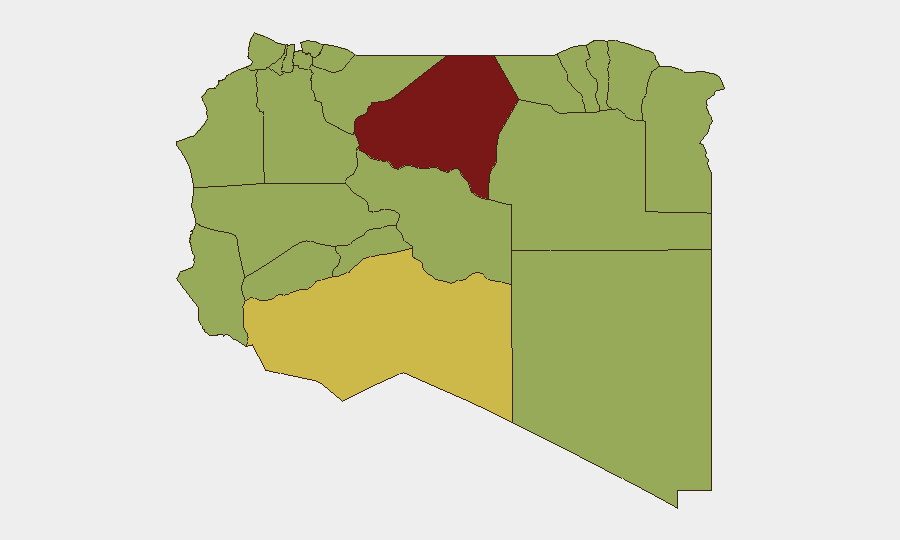
Situation Summary
Libya remains in a state of fragmented civil conflict with competing power centers and elevated criminal activity, ranking #22 globally on composite threat. While a notable political development occurred on 12 July—a meeting between rival military chiefs of staff in Sirte to discuss joint exercises and border security—current open-source reporting does not yet provide independently corroborated, time-stamped security incidents for 13–14 July 2026 that meet verification standards. The overall threat environment remains elevated across multiple regions, with military operations, organized-crime activity, and civil unrest signaled across Libya as of 13 July, though discrete incident details remain sparse in available open sources.
Key Developments
- Sirte – 12 July 2026 (outside 48h window, but operationally significant): Chiefs of staff of Libya's rival military forces met in Sirte with UNSMIL facilitation to discuss border security, internal stability, and a planned joint military exercise. This represents a rare direct dialogue between opposing command structures and signals potential de-escalation momentum, though implementation remains uncertain.
- Libya-wide – 13 July 2026 (aggregate signal, single-source): Commercial threat feeds report elevated military operations against organized-crime and gang elements on 13 July, though specific locations, force compositions, and casualty figures are not yet independently confirmed by news or official channels.
- Tripoli – date not precisely confirmed (flagged as recent but unverified timing): Demonstrators reportedly forced closure of the International Organization for Migration (IOM) office, blocking access in protest of migration policies. Confirmation of occurrence within the 13–14 July window and corroborating sources are pending.
- Libya-wide – 11–13 July 2026: Aggregate reporting indicates escalating law-enforcement activity, police detention operations, and political pressure statements, suggesting intensified state actions, though named incidents in specific locations are not yet publicly detailed.
Assessment: Open-source reporting for 13–14 July remains generalized and single-sourced. No independently corroborated, discrete security incidents with precise timestamps and locations have been confirmed in major news or official channels for the last 48 hours. Most detailed reporting available is either outside the 48-hour window or lacks the specificity and cross-verification required for operational briefing.
Highest-Risk Areas
Sirte (83.3) stands as the single highest-risk sub-national zone, reflecting its role as a strategic military flashpoint and meeting point for rival forces; Murzuq (62.1) follows with moderate-to-high threat, while Tripoli (54.6) remains elevated due to its status as the capital and seat of competing governance claims. The remaining nine tracked regions score 53.3, indicating a broad band of secondary-to-moderate risk extending across western, central, and southern Libya. Sirte's dominance reflects both military concentration and the fragility of any negotiated arrangements; secondary zones carry risk from criminal networks, tribal conflict, and resource competition rather than direct state-level military activity.
How GeoBit Would Assist
Security teams should deploy AOI Monitoring & Early Warning on Sirte, Tripoli, and Murzuq to receive alert-based updates on military movements and political developments as they occur. Network & Actor Analysis combined with multi-language OSINT (X/Twitter, Telegram, local sources) would provide real-time sentiment and actor-intent tracking across rival military and political factions. Battle Mapping and force-structure tracking capabilities enable continuous assessment of deployment patterns and capability shifts among competing armed groups.
7-Day Outlook
Near-term trajectory remains contingent on the implementation timeline and political will behind the 12 July chiefs-of-staff agreement. If joint military exercises proceed, expect temporary reduction in inter-force friction; absence of visible progress may signal a return to elevated tensions. Criminal activity and civil unrest are likely to persist independently of military-level developments.
Highest-Risk Areas — Ranked
| # | State / Region | Risk |
|---|---|---|
| 1 | Sirte | 83.3 |
| 2 | Murzuq | 62.1 |
| 3 | Tripoli | 54.6 |
| 4 | Nalut | 53.3 |
| 5 | Ghat | 53.3 |
| 6 | Baladiyah Surman | 53.3 |
| 7 | Az Zawiya District | 53.3 |
| 8 | Wadi al Shatii | 53.3 |
| 9 | Wadi al Hayaa | 53.3 |
| 10 | Kufra | 53.3 |
| 11 | Nuqat al Khams | 53.3 |
| 12 | Jafara | 53.3 |
Sources
Previous Daily Briefs
A new Libya brief is written every day — each with its own risk map and downloadable CSV. Here's the last week; use the calendar to go further back.
📅 Browse every day by calendar →
Highlighted days have a brief. Tap a day for that day's map & analysis, or “csv” for that day's dataset ($5).
Atlas — our AI intelligence desk — emails them this snapshot personally. Nothing else, no list.