Situation Summary
Pakistan's security environment remains volatile, driven primarily by sustained insurgent activity across multiple provinces and renewed cross-border militant operations. The past 48 hours have seen a significant escalation in militant attacks and state counter-operations, including a coordinated assault on security installations in Karachi, concurrent ground operations along the Afghanistan border, and precision strikes on militant hideouts across the frontier. This pattern signals heightened tactical coordination among insurgent networks and an intensified military response, raising immediate risk to personnel and assets in urban centers and border regions.
Key Developments
- Karachi, Sindh (evening 27–28 June): Vehicle-borne IED and armed assault on Sindh Rangers headquarters in Gulistan-e-Jauhar; 3–4 Rangers personnel and 5–6 attackers killed; clearance operations ongoing into 28 June.
- Bajaur, Khyber Pakhtunkhwa (28 June): Ground counter-terrorism operation near Pakistan–Afghanistan border killed senior Jamaat-ul-Ahrar commander ("Khan Farosh") and three associates; weapons stockpiles destroyed.
- Paktia, Paktika, and Kunar provinces, Afghanistan (28 June): Precision strikes on Jamaat-ul-Ahrar and Pakistani Taliban hideouts killed approximately 25 militants; operation confirmed by Pakistani officials and conducted on intelligence basis.
- Liaquatabad, Karachi (27 June): Police encounter killing of two suspected armed criminals near post office; seizure of firearms; reflects elevated urban armed-crime activity in Karachi.
- National (27–28 June): 5.4-magnitude earthquake felt across Islamabad, Lahore, and Karachi; minor infrastructure damage reported; underscores structural vulnerability in urban centers.
- Khyber Pakhtunkhwa and Balochistan (27–28 June): National Disaster Management Authority issued flash-flood alerts; elevated risk of road disruption, supply-chain interruption, and constrained humanitarian access.
- Quetta, Balochistan (verdict 25 June, protested 27 June): Life sentences handed to Baloch activist Mahrang Baloch and co-defendant; civil unrest and protest mobilization risk signaled for Balochistan and major urban centers.
- National (27–28 June): Heightened security posture and reinforcement around diplomatic and strategic sites in Islamabad, Rawalpindi, Lahore, and Karachi; increased likelihood of regional-tension-linked protests affecting movement and incidental travel risk.
Highest-Risk Areas
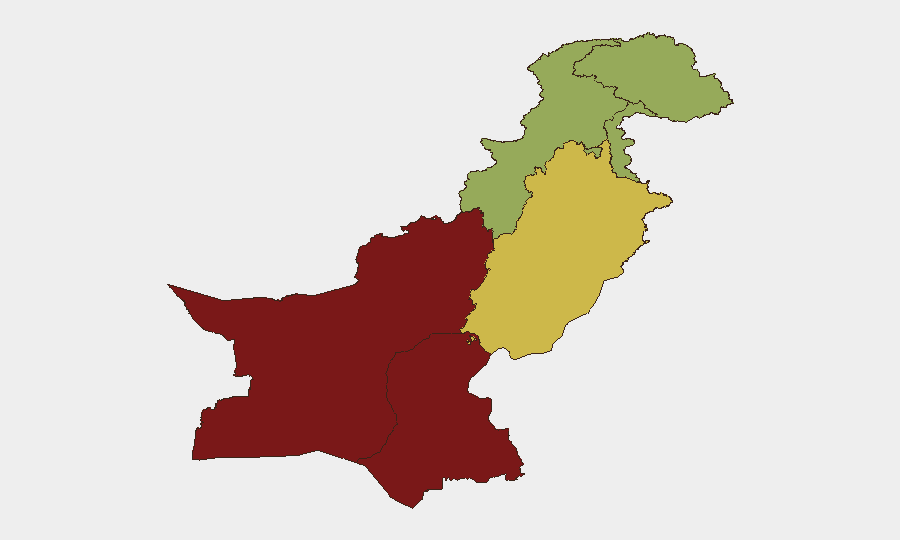
Balochistan (83) and Sindh (80.6) remain Pakistan's most volatile provinces, driven by sustained insurgency, sectarian militancy, and organized criminal activity. Sindh's elevated rank reflects high-profile militant infrastructure targeting and urban militant cells, as exemplified by the 28 June Karachi Rangers assault. Balochistan's risk stems from Baloch nationalist insurgency, sectarian conflict, and security-force counter-operations, compounded by the recent sentencing of prominent activists and associated protest risk. Khyber Pakhtunkhwa (56.5), despite lower ranking, remains a critical frontier zone given active Taliban and Jamaat-ul-Ahrar presence, cross-border strike activity, and geographic proximity to Afghanistan—making it operationally significant for any forward-facing security posture.
How GeoBit Would Assist
Security and risk teams should leverage AOI Monitoring & Early Warning on Karachi, Quetta, and Bajaur to detect operational patterns and retaliation signals in real time. Network & Actor Analysis combined with OSINT fusion (X/Telegram monitoring, entity extraction) would track Jamaat-ul-Ahrar command-structure changes and coordination signals following leadership losses. Routing & Network Analysis enables identification of safe transit corridors in high-risk provinces, accounting for active operational areas and flood-disruption risk.
7-Day Outlook
Immediate risk of secondary attacks and retaliation operations is elevated, particularly in Karachi and along the northwest frontier, as militant networks respond to leadership losses and border strikes. Protest activity linked to the Baloch sentencing verdict and ongoing cross-border tensions is likely to disrupt urban movement in Islamabad, Lahore, and Karachi through early July. Flood risk in Khyber Pakhtunkhwa and Balochistan will compound access constraints and operational unpredictability through the monsoon season.
Highest-Risk Areas — Ranked
| # | State / Region | Risk |
|---|---|---|
| 1 | Balochistan | 83 |
| 2 | Sindh | 80.6 |
| 3 | Punjab | 63.3 |
| 4 | Islamabad Capital Territory | 59.1 |
| 5 | Khyber Pakhtunkhwa | 56.5 |
| 6 | Azad Kashmir | 53.1 |
| 7 | Gilgit-Baltistan | 53 |
Sources
Previous Daily Briefs
A new Pakistan brief is written every day — each with its own risk map and downloadable CSV. Here's the last week; use the calendar to go further back.
📅 Browse every day by calendar →
Highlighted days have a brief. Tap a day for that day's map & analysis, or “csv” for that day's dataset ($5).