Situation Summary
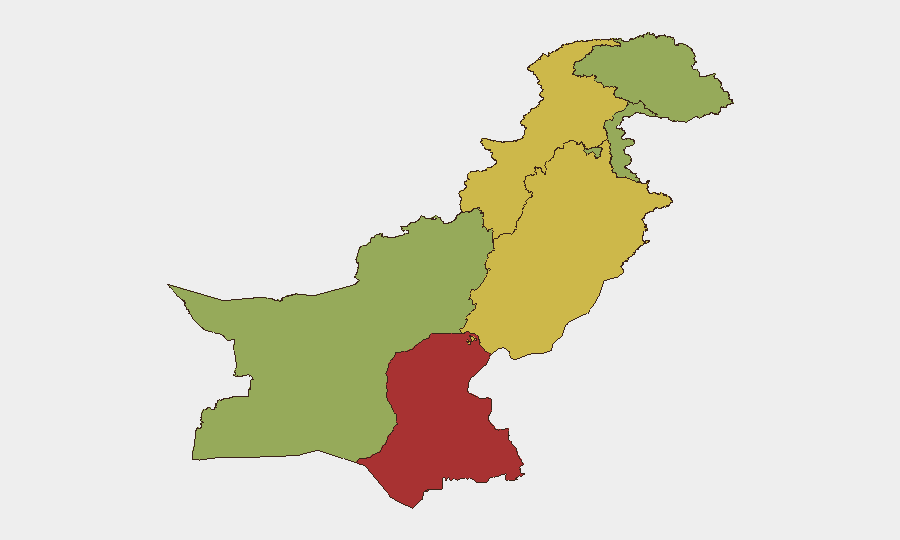
Pakistan remains a moderate-to-high-risk operating environment (global rank #34, composite threat score 70) with 1,283 tracked security events. Recent signal activity (29 June) reflects elevated tension between law-enforcement and non-state actors, including alleged terrorist statements directed at police leadership, paramilitary–police friction, and armed clashes resulting in casualties. The security picture is fragmented by geography: risk concentrates heavily in Sindh (79.2), Khyber Pakhtunkhwa (64), and Punjab (63.3), while institutional strain between security forces is evident in public disputes.
Key Developments
- Karachi, Sindh – Armed gunmen attacked a paramilitary Rangers facility; three security personnel killed, four attackers killed (Al Jazeera report; precise date unclear from available sources, but flagged in 24–48h signal sweep).
- Pakistan-wide – Multiple public statements from terrorist actors directed at police leadership and the Inspector General (29 June). Government and security officials rejected and disapproved of statements; arrests/detentions of alleged terrorist operatives reported.
- Institutional friction – Public dispute between Inspector General and police hierarchy; paramilitary–police tensions surfaced in statements (29 June), signaling command-and-control friction at senior levels.
- Armed group activity – Conventional military-style assault on a security facility suggests organizational capability and targeting of high-profile installations; four attackers neutralized indicates counter-operation response.
- Territory occupation signal – One event recorded as "Pakistan vs Pakistan" (occupy territory), indicating inter-agency or intra-provincial control disputes (29 June); status and location not yet clarified in available briefs.
- Border context – BBC reporting references Afghan Taliban strikes on the Pakistan–Afghanistan border with Pakistani military response (drone shootdowns claimed); precise incident dates unclear but part of ongoing cross-border escalation pattern.
Note: Web research limitations prevent full corroboration of all 24–48h incidents. Karachi facility attack and 29 June statement cascade are the clearest current signals; border incidents require secondary sourcing for operational confidence.
Highest-Risk Areas
Sindh (79.2) leads sub-national risk, driven by Karachi's status as a major urban node with dense militant networks, criminal syndicates, and paramilitary presence. Khyber Pakhtunkhwa (64) and Punjab (63.3) follow closely, reflecting sustained militant activity along the Afghan border and in Punjab's urban centers. Islamabad Capital Territory (57) registers notable risk despite capital status, likely reflecting insider threats, extremist cells, and governance instability. Balochistan (57.7) remains volatile due to separatist and militant activity, though ranking slightly lower—a reflection of its remoteness and lower event density relative to urban zones. Geographic fragmentation of risk means no single narrative applies: Sindh demands urban-security focus, KP requires border-conflict monitoring, and Punjab needs crime-insurgency analysis.
How GeoBit Would Assist
Security teams should employ Intel Sweep and global event feeds with multi-language OSINT (Urdu-language sources prominent in recent signals) to track statements and actor positioning in real time. AOI Monitoring & Early Warning on Sindh's major urban centers, KP border crossings, and Punjab's industrial/transit corridors would provide persistent alerting ahead of tactical incidents. Network & Actor Analysis combined with conflict mapping can clarify the paramilitary–police tensions and territorial disputes now evident, improving duty-of-care decisions for personnel in contested areas.
7-Day Outlook
Institutional friction between security forces and elevated terrorist rhetoric suggest a period of tactical jostling and possible reprisal cycles over the coming week. Operations in Sindh and KP should anticipate continued armed clashes and security sweeps; border tension with Afghanistan may drive spillover incidents. Risk is likely to remain elevated but localized; enterprise-wide mobility restrictions are not warranted, but site-specific and role-specific alerting is essential.
Highest-Risk Areas — Ranked
| # | State / Region | Risk |
|---|---|---|
| 1 | Sindh | 79.2 |
| 2 | Khyber Pakhtunkhwa | 64 |
| 3 | Punjab | 63.3 |
| 4 | Balochistan | 57.7 |
| 5 | Islamabad Capital Territory | 57 |
| 6 | Gilgit-Baltistan | 49.2 |
| 7 | Azad Kashmir | 49.2 |
Previous Daily Briefs
A new Pakistan brief is written every day — each with its own risk map and downloadable CSV. Here's the last week; use the calendar to go further back.
📅 Browse every day by calendar →
Highlighted days have a brief. Tap a day for that day's map & analysis, or “csv” for that day's dataset ($5).