Situation Summary
Russia faces sustained high-tempo Ukrainian drone and missile strikes targeting energy infrastructure and military assets across multiple regions, with Moscow and western border oblasts experiencing the heaviest pressure. NATO and EU rhetoric has hardened in parallel, signaling a shift toward reduced diplomatic engagement and reinforced deterrence postures. The composite threat score of 100 reflects ongoing conventional military escalation, infrastructure degradation, and emerging civilian casualty risks that extend well beyond active conflict zones into major population centers.
Key Developments
- Moscow region, 25 June: Ukrainian long-range drone strikes hit multiple oil and refinery targets across the Moscow region overnight; Russian air defense reported intercepting 84 drones headed toward the capital, indicating sustained high-volume attack tempo and partial penetration of air defenses.
- Orenburg, 25 June: Ukrainian forces struck the Orenburg gas-processing complex, a critical national energy asset, in a coordinated overnight offensive against Russian fuel and power infrastructure.
- Moscow region, 25 June: Satellite communications centers inside Russia were struck during the same wave of attacks, signaling expansion of targeting beyond energy to command-and-control and logistics nodes.
- Nizhny Novgorod region, 24–25 June night: A Ukrainian drone strike killed one civilian and wounded two others, extending casualty risk to regions nominally outside primary conflict zones.
- Belgorod region, 24–25 June night: One civilian killed by drone strike in Russia's western border region, where repeated attacks have created persistent security and civilian-safety concerns.
- Crimea, 21–25 June: Occupied Crimea authorities halted civilian fuel sales, imposed electricity-use restrictions, and tightened public-event controls in response to drone pressure and infrastructure shortages; street lighting in Sevastopol was reduced, reflecting widespread logistics stress.
- NATO and EU, 23–24 June: Brussels and European capitals issued public statements rejecting Russian positions on Ukraine, and the EU formally moved to reduce diplomatic relations, signaling hardened Western stance and reduced off-ramp potential in near term.
Highest-Risk Areas
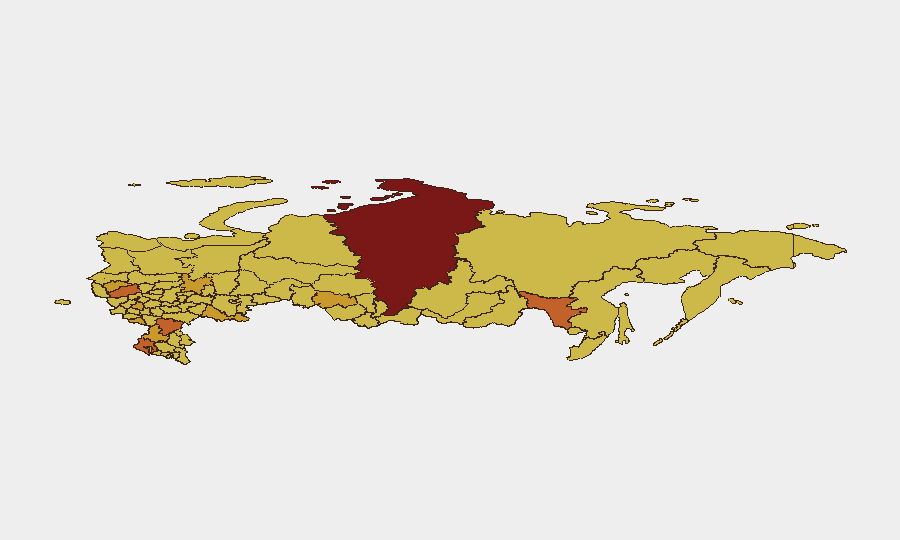
Moscow (risk 100) and Krasnoyarsk Krai (90.4) dominate the sub-national ranking, driven by repeated drone strikes on energy infrastructure and air-defense engagement; Volgograd, Krasnodar, and Amur oblasts (74–75 range) face secondary military and logistics pressures. Western border oblasts—Belgorod, Tver, Novgorod—remain elevated (71–74) due to proximity to Ukraine and repeated cross-border strike activity. Saint Petersburg (73.8) and Novosibirsk (72.5) show sustained risk from critical infrastructure targeting and strategic military presence. The pattern indicates Ukrainian strategy is deliberately broadening geographic scope beyond Donbas to degrade Russian energy capacity and command nodes nationwide.
How GeoBit Would Assist
Security teams should deploy persistent area-of-interest (AOI) monitoring on high-risk oblasts—particularly Moscow, Saint Petersburg, and border regions—configured for near-real-time alerts on drone activity, air-defense engagement, and infrastructure strikes. Conflict mapping and force-structure tracking linked to multi-language OSINT fusion (X/Telegram, official statements, regional media) will maintain situational awareness on attack tempo, targeting patterns, and air-defense effectiveness. Routing and alternative-journey planning capabilities enable duty-of-care teams to model safe travel corridors around active strike zones and coordinate personnel movement in real time.
7-Day Outlook
Drone strike intensity is likely to remain high through early July, with continued focus on energy and logistics targets; civilian exposure in Moscow, Saint Petersburg, and western oblasts will persist. EU and NATO hardening suggests diplomatic off-ramps are narrowing, reducing prospect of near-term de-escalation. Risk to personnel and operations across all major Russian population centers should be treated as elevated and monitored continuously.
Highest-Risk Areas — Ranked
| # | State / Region | Risk |
|---|---|---|
| 1 | Moscow | 100 |
| 2 | Krasnoyarsk Krai | 90.4 |
| 3 | Volgograd Oblast | 74.9 |
| 4 | Krasnodar Krai | 74.3 |
| 5 | Amur Oblast | 74 |
| 6 | Saint Petersburg | 73.8 |
| 7 | Tver Oblast | 73.8 |
| 8 | Novosibirsk Oblast | 72.5 |
| 9 | Tula Oblast | 72.2 |
| 10 | Belgorod Oblast | 71.8 |
| 11 | Novgorod Oblast | 71.1 |
| 12 | Kirov Oblast | 71.1 |
Sources
Previous Daily Briefs
A new Russia brief is written every day — each with its own risk map and downloadable CSV. Here's the last week; use the calendar to go further back.
📅 Browse every day by calendar →
Highlighted days have a brief. Tap a day for that day's map & analysis, or “csv” for that day's dataset ($5).