Situation Summary
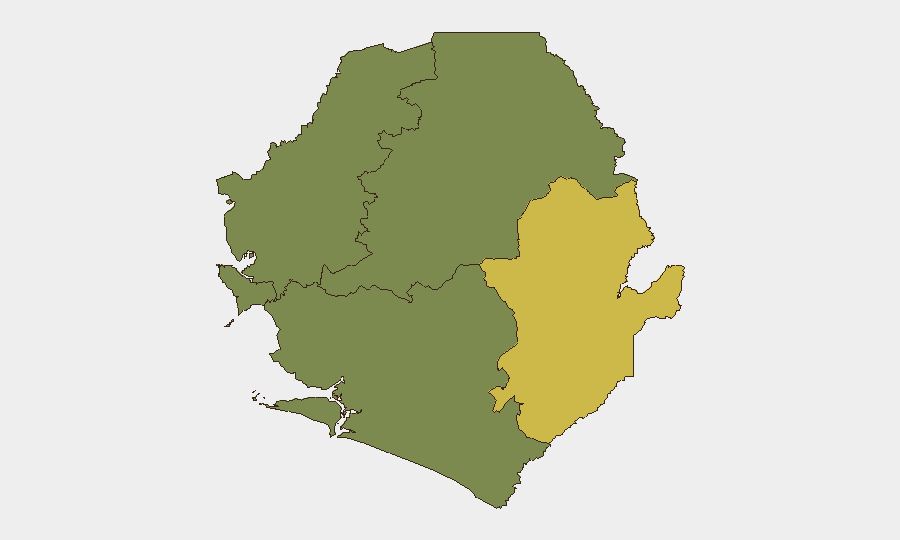
Sierra Leone remains a low-threat environment globally (rank #103, composite score 9), with no discrete security incidents recorded in the current reporting window. The country's threat profile is geographically concentrated in the Eastern Province, which accounts for the majority of national risk; the Western Area (containing Freetown) presents moderate risk. Near-term stability appears steady, though regulatory enforcement and aviation-sector changes signal ongoing governance activity.
Key Developments
- Freetown International Airport — 6 July 2026 — The government suspended the $25 Airport Security Fee indefinitely pending contract review and audit completion. This administrative action may affect traveler throughput and fee structures but does not indicate operational or security disruption at the airport itself.
- National level — 9 July 2026 — The government ordered seven NGOs to halt operations following a registration compliance review. This enforcement action reflects tightened regulatory oversight of civil-society organizations but does not constitute civil unrest or security incident activity.
No corroborated security, crime, conflict, or civil-unrest incidents were verified in Sierra Leone during the 24–48 hour reporting window.
Highest-Risk Areas
The Eastern Province carries substantially elevated risk (score 68) compared to all other regions and should remain the focus of duty-of-care planning for personnel or assets in that zone. The Western Area, which includes the capital and primary commercial hub Freetown, presents moderate residual risk (score 35) and warrants standard security monitoring. The Northern Province, North West Province, and Southern Province all register minimal current risk signals. Organizations should prioritize Eastern Province travel assessments, local security liaison, and contingency planning; Western Area operations can proceed under standard risk protocols.
How GeoBit Would Assist
Security teams managing Sierra Leone exposure should deploy Area-of-Interest (AOI) Monitoring & Early Warning focused on the Eastern Province to detect emerging civil unrest, crime clusters, or instability signals in real time. OSINT fusion (social media, local news, and Telegram/X feeds) across English and local languages will provide early visibility into regulatory or political shifts—as demonstrated by the recent NGO enforcement action—allowing duty-of-care teams to anticipate policy changes affecting operations. Risk & Threat Assessment and Routing & Network Analysis capabilities enable alternative-route planning and contingency site identification should conditions in high-risk areas deteriorate.
7-Day Outlook
No significant security escalation is forecast for the next seven days. Attention should remain on the Eastern Province as the primary risk vector and on regulatory developments (such as further NGO reviews or aviation-sector policy shifts) that may affect operational logistics. Standard monitoring posture is appropriate for Western Area and all other regions.
Note: The current 24–48 hour reporting window yielded limited verified security-relevant developments. Sustained AOI Monitoring and daily Intel Sweeps are recommended to capture emerging threats early, particularly in the Eastern Province.
Highest-Risk Areas — Ranked
| # | State / Region | Risk |
|---|---|---|
| 1 | Eastern Province | 68 |
| 2 | Western Area | 35 |
| 3 | North West Province, Sierra Leone | 0 |
| 4 | Northern Province, Sierra Leone | 0 |
| 5 | Southern Province, Sierra Leone | 0 |
Sources
Previous Daily Briefs
A new Sierra Leone brief is written every day — each with its own risk map and downloadable CSV. Here's the last week; use the calendar to go further back.
📅 Browse every day by calendar →
Highlighted days have a brief. Tap a day for that day's map & analysis, or “csv” for that day's dataset ($5).
Atlas — our AI intelligence desk — emails them this snapshot personally. Nothing else, no list.