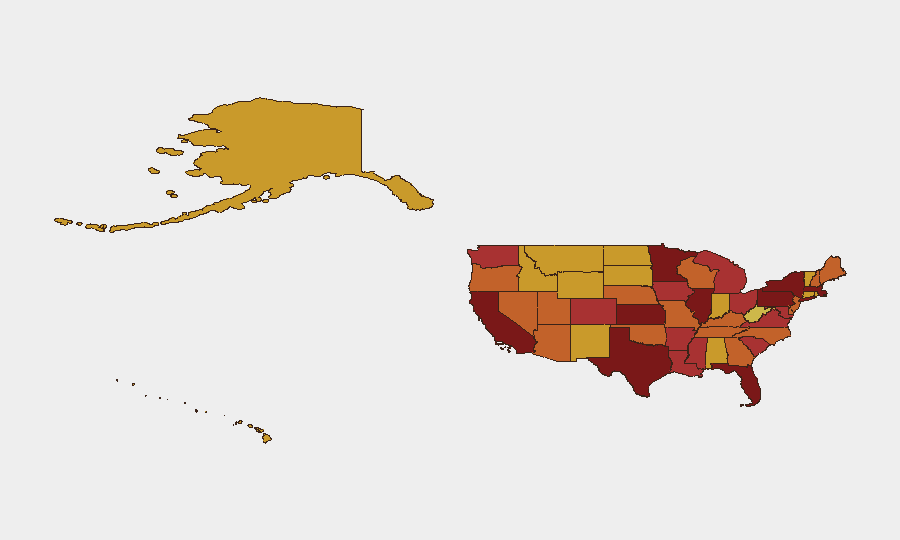
Situation Summary
The United States ranks second globally in GeoBit's composite threat assessment (score 100; 6,898 tracked events), reflecting elevated risk across multiple domains including cyber infrastructure, data breaches, and administrative/political friction. Texas, California, and New York remain the highest-risk sub-national jurisdictions, collectively accounting for a significant portion of recent event signals. The threat environment is driven primarily by ongoing cybersecurity vulnerabilities affecting critical infrastructure and healthcare systems, compounded by cascading impacts from large-scale third-party vendor breaches disclosed in late June and early July 2026.
Key Developments
- United States (nationwide) – July 2–4, 2026 – CISA cybersecurity advisories and ICS vulnerability alerts. The Cybersecurity and Infrastructure Security Agency has issued recent alerts regarding industrial control system vulnerabilities and active exploitation campaigns affecting U.S. infrastructure operators, with advisories covering newly disclosed software flaws and ransomware targeting critical sectors. Precise advisory timestamps within the 24–48-hour window are not fully exposed in accessible public feeds.
- United States (nationwide) – July 2026 – Conduent third-party vendor breach impact expansion. The Conduent data breach, originally disclosed in late June, has expanded into early July with affected population now exceeding 62.2 million individuals. Ongoing regulatory notification, healthcare provider follow-up, and fraud-risk mitigation activities remain active in the current period.
- Texas – July 2026 – Texas Parks and Wildlife Department license-vendor breach aftermath. Originally disclosed on 18 June 2026, the compromise of a third-party hunting and fishing license system (affecting 3+ million customers, including driver's license and passport data) continues to generate Texas Attorney General involvement and remedial actions into early July, sustaining elevated identity-theft and fraud risk.
- Oregon and multi-state jurisdictions – July 2026 – large-scale vendor breach remediation ongoing. A major multi-state breach affecting at least 25.9 million individuals (with updates suggesting significantly higher totals) continues active regulatory reporting and remedial actions into July 2026, maintaining identity-theft and secondary criminal-exploitation risk.
- Pullman, Washington – July 2, 2026 – localized public-safety incidents. Washington State University Police logged minor security incidents including a burglary alarm response, marijuana-use warning, and vehicle speeding reports, reflecting low-level localized activity.
- Event Signal Activity – July 2–4, 2026 – elevated administrative and intelligence messaging. GeoBit's event-signal tracking indicates recent public statements from Interior Secretary, Washington administrative entities, and intelligence officials, alongside "Reduce Relations" signaling from Colorado and "Disapprove" messaging from intelligence channels toward Washington. "Conventional Military Force" and "Authorities vs. Police" signals on July 4 require further corroboration and context determination.
Highest-Risk Areas
Texas, California, and New York (composite scores 100, 98.5, and 95.5 respectively) drive the national risk profile, with Texas leading due to ongoing critical-infrastructure cyber exposure, third-party vendor breach cascades, and state-level administrative response activity. California's ranking reflects administrative sanctions on media entities and breach-disclosure volume, while New York's position reflects multi-sector cyber and data-security pressures. Kansas, Illinois, and Massachusetts (scores 91.6–82.9) indicate that cyber-infrastructure and data-breach risk is geographically dispersed rather than concentrated, affecting energy, healthcare, and technology hubs nationwide.
How GeoBit Would Assist
Corporate security teams would deploy Intel Sweep and OSINT feeds (X/Twitter, Telegram, multi-language sources) for real-time detection of emerging breach disclosures, administrative friction, and cyber-threat advisories. AOI Monitoring & Early Warning with persistent watch on high-risk state jurisdictions (Texas, California, New York) would surface emerging administrative, political, or infrastructure-security signals before broad media exposure. Risk & Threat Assessment and Network & Actor Analysis capabilities would enable teams to correlate vendor-breach impact, remediation timelines, and secondary exploitation risk across their supply chains and employee populations.
7-Day Outlook
Cyber-infrastructure vulnerability disclosure and data-breach notification activity will likely remain elevated through mid-July as CISA advisories continue and healthcare/third-party vendor breach remediation progresses. Political and administrative messaging signals (evidenced by Interior Secretary statements and intelligence-versus-Washington friction) suggest potential near-term policy or regulatory changes affecting risk posture, warranting sustained monitoring of Federal Register and agency announcements.
Highest-Risk Areas — Ranked
| # | State / Region | Risk |
|---|---|---|
| 1 | Texas | 100 |
| 2 | California | 98.5 |
| 3 | New York | 95.5 |
| 4 | Kansas | 91.6 |
| 5 | Illinois | 86 |
| 6 | Massachusetts | 82.9 |
| 7 | Florida | 82.1 |
| 8 | Pennsylvania | 81.2 |
| 9 | Minnesota | 80.3 |
| 10 | Ohio | 79.1 |
| 11 | Colorado | 79 |
| 12 | Michigan | 78.5 |
Sources
Previous Daily Briefs
A new United States brief is written every day — each with its own risk map and downloadable CSV. Here's the last week; use the calendar to go further back.
📅 Browse every day by calendar →
Highlighted days have a brief. Tap a day for that day's map & analysis, or “csv” for that day's dataset ($5).
Atlas — our AI intelligence desk — emails them this snapshot personally. Nothing else, no list.