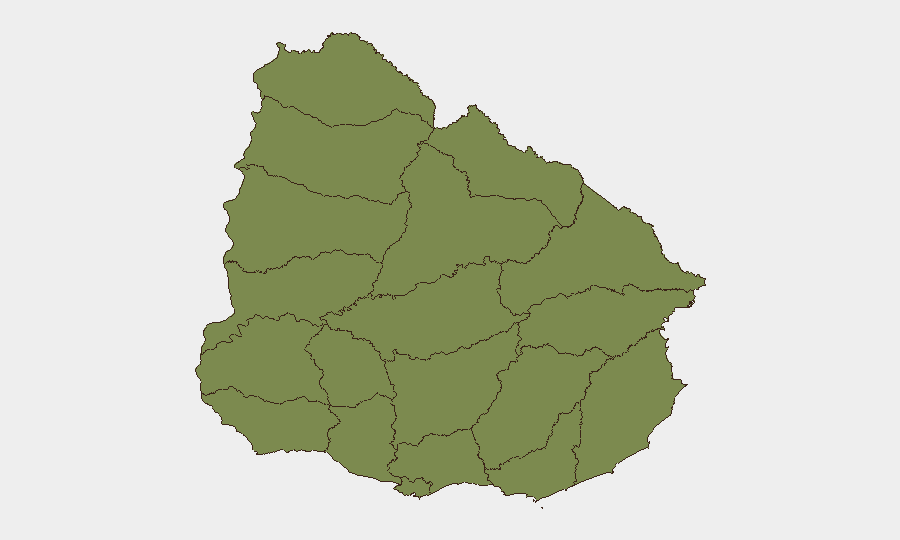
Situation Summary
Uruguay maintains a composite global threat ranking of #180 (score 3/100), reflecting its relative stability within Latin America. However, sub-national risk concentration in Durazno department (31.8) signals localized organized-crime activity that contrasts sharply with national averages. Recent event signals indicate political friction over governance and judicial matters, alongside international pressure on domestic policy, creating a layered but non-acute threat environment. Current trajectory suggests managed tension with operational security measures in place.
Key Developments
- Montevideo, 2026-07-08: Uruguay and Chile formalized a deepened intelligence and border-security partnership to counter organized crime and drug-trafficking networks, including expanded information-sharing protocols and joint patrol coordination.
- Montevideo, 2026-07-08: The National Army's 12 Mamba MK-7 armored vehicles deployed to Montevideo neighborhoods under police command targeting the highest-crime-rate zones, operationalizing anti-organized-crime enforcement.
- National level, 2026-07-09: Business sector issued a public statement; same date, a merchant entity and judicial officer both rejected unnamed proposals or actions, suggesting friction over commercial or regulatory matters.
- National level, 2026-07-08: Unions issued a public statement against the President; separate intelligence and investigative activity was initiated, indicating internal governance tension and security-sector scrutiny.
- National level, 2026-07-09: A priest and the Holy See both registered disapproval or public challenge to Uruguay policy, signaling international religious-institutional pressure on domestic governance.
Highest-Risk Areas
Durazno department dominates sub-national risk (31.8), with a risk score approximately five times higher than the second-ranked region (Paysandú, 6.7). This concentration reflects organized-crime operational presence, likely linked to drug-trafficking logistics along the Brazil–Paraguay–Uruguay corridor. Paysandú's secondary elevation (6.7) aligns with its position as a northwestern border zone; remaining departments cluster at low risk (1.8), indicating risk is geographically confined and operational rather than systemic. Corporate and government personnel should treat Durazno as a restricted-movement zone pending further intelligence clarification.
How GeoBit Would Assist
Security teams should deploy Intel Sweep and multi-language OSINT feeds to monitor emerging union, religious, and merchant-sector statements for escalation signals ahead of policy announcements. AOI Monitoring with alerting on Durazno and Paysandú will provide persistent early warning of organized-crime activity, cartel movement, or trafficking infrastructure changes. Network & Actor Analysis applied to Uruguayan organized-crime nodes and regional smuggling networks will enable duty-of-care teams to assess risk to specific supply chains, personnel transit routes, and asset locations in real time.
7-Day Outlook
Political and religious friction is expected to remain rhetorical; no operational disruption to government or business function is forecast. Organized-crime enforcement activity will likely intensify in Montevideo's high-crime neighborhoods as the armored-vehicle deployment gains operational maturity. Uruguay's assumption of MERCOSUR presidency on 2026-07-08 may accelerate border-modernization initiatives, improving security infrastructure but creating short-term administrative delays in cross-border trade and transit.
Highest-Risk Areas — Ranked
| # | State / Region | Risk |
|---|---|---|
| 1 | Durazno | 31.8 |
| 2 | Paysandú | 6.7 |
| 3 | Artigas | 1.8 |
| 4 | Salto | 1.8 |
| 5 | Rivera | 1.8 |
| 6 | Tacuarembó | 1.8 |
| 7 | Soriano | 1.8 |
| 8 | Colonia | 1.8 |
| 9 | Río Negro | 1.8 |
| 10 | Flores | 1.8 |
| 11 | San José | 1.8 |
| 12 | Florida | 1.8 |
Sources
Previous Daily Briefs
A new Uruguay brief is written every day — each with its own risk map and downloadable CSV. Here's the last week; use the calendar to go further back.
📅 Browse every day by calendar →
Highlighted days have a brief. Tap a day for that day's map & analysis, or “csv” for that day's dataset ($5).
Atlas — our AI intelligence desk — emails them this snapshot personally. Nothing else, no list.