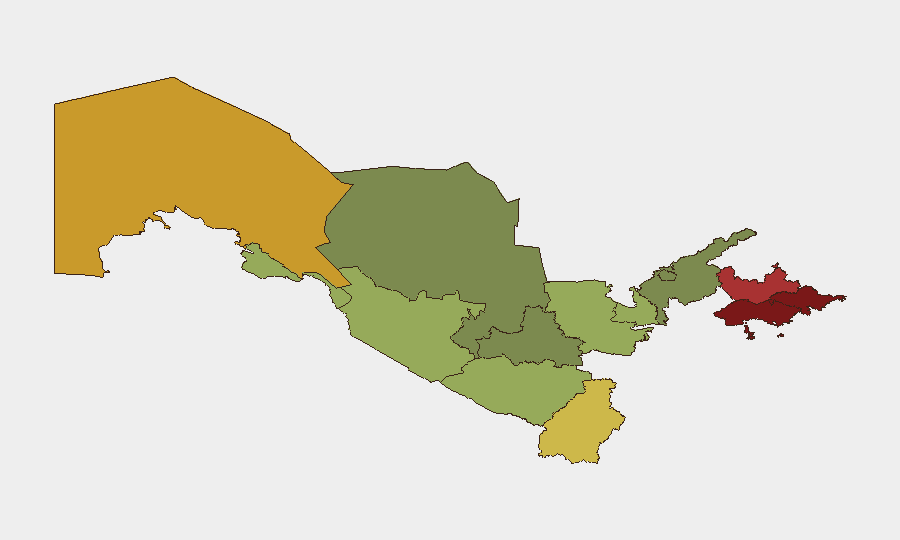
Situation Summary
Uzbekistan remains a low-to-moderate threat environment (global rank #152; composite score 5/10), with no material security incidents recorded in the past 24–48 hours. The country's overall stability is underpinned by strong state capacity, though sub-national variation is significant, with the Fergana Valley region cluster (Andijan, Fergana, Namangan) driving 60% of recorded domestic risk. A recent diplomatic signal with Kazakhstan (2026-07-11) registered no operational impact on internal Uzbek security; border-management challenges, including corruption operations on the Kyrgyz–Uzbek frontier (5 July), remain persistent but not acute.
Key Developments
- No acute security incidents recorded, past 24–48 hours: Web research and event signals confirm an absence of fresh unrest, conflict escalation, crime spikes, or infrastructure disruption within the reporting window.
- Diplomatic signal: Uzbekistan–Kazakhstan relations: A "reduce relations" event flagged on 2026-07-11; source assessment indicates no cascading internal security impact, though bilateral border-management remains a structural friction point.
- **Border-integrity challenge (Kyrgyz–Uzbek frontier, 5 July – *outside current window but persistent*)**: Corruption operations documented; highlights endemic smuggling and unofficial checkpoint activity in the northern border corridor.
Highest-Risk Areas
The Fergana Valley cluster (Andijan 88, Fergana 82, Namangan 78) is the primary concentration of domestic risk, driven by historical militant activity, ethno-religious tension, and informal economy density. Karakalpakstan (72) ranks fourth due to water-security fragility, environmental stress, and remote-governance capacity constraints. Surxondaryo (65) and Qashqadaryo (58) in the south carry elevated trafficking and informal-economy risk. The western and central regions (Samarqand, Bukhara, Navoiy, Xorazm) remain substantially lower-risk, reflecting stronger state presence and urbanization. Corporate and NGO personnel should calibrate duty-of-care protocols—including movement, communications, and incident-response planning—according to this granular geography rather than treating Uzbekistan as homogeneous.
How GeoBit Would Assist
Intel Sweep & OSINT Fusion across X, Telegram, YouTube, and multi-language open sources would provide continuous early warning of localized unrest, informal market disruption, or cross-border movement anomalies in high-risk regions. AOI Monitoring & Early Warning with persistent geospatial watch on Fergana Valley chokepoints, border crossings (Kyrgyz–Uzbek, Afghan–Uzbek), and critical infrastructure would trigger alerts before incidents scale. Routing & Network Analysis and Conflict & Military force-structure tracking enable security teams to validate movement corridors and assess state-capacity posture in real time, supporting duty-of-care incident response and personnel evacuation planning if required.
7-Day Outlook
No material escalation is anticipated in the near term. Structural risks—border permeability, informal economy density, and sub-national governance variance in the Fergana Valley—remain stable but persistent. Monitoring of Uzbekistan–Kazakhstan diplomatic signals and any uptick in Kyrgyz–Uzbek border incidents should continue as a precaution; however, broad security posture for corporate and NGO operations remains unchanged unless new intelligence indicates otherwise.
Highest-Risk Areas — Ranked
| # | State / Region | Risk |
|---|---|---|
| 1 | Andijan Region | 88 |
| 2 | Fergana Region | 82 |
| 3 | Namangan Region | 78 |
| 4 | Republic of Karakalpakstan | 72 |
| 5 | Surxondaryo Region | 65 |
| 6 | Qashqadaryo Region | 58 |
| 7 | Sirdaryo Region | 55 |
| 8 | Jizzakh Region | 48 |
| 9 | Xorazm Region | 45 |
| 10 | Bukhara Region | 42 |
| 11 | Navoiy Region | 38 |
| 12 | Samarqand Region | 35 |
Previous Daily Briefs
A new Uzbekistan brief is written every day — each with its own risk map and downloadable CSV. Here's the last week; use the calendar to go further back.
📅 Browse every day by calendar →
Highlighted days have a brief. Tap a day for that day's map & analysis, or “csv” for that day's dataset ($5).
Atlas — our AI intelligence desk — emails them this snapshot personally. Nothing else, no list.