Situation Summary
Yemen remains in a volatile equilibrium following mid-July escalations involving Iranian diplomatic engagement, cross-border airstrikes, and missile launches between state and Houthi-aligned forces. The 2022 UN-brokered truce framework continues to fray amid stalled prisoner-exchange negotiations and renewed military posturing. Overall risk is assessed as medium, with a composite national threat score of 96 and 60 tracked events, but the trajectory shows increased tension between key state and non-state actors.
Key Developments
GeoBit's current event signals reflect escalating activity as of 18–19 July, though open-source verification of incidents strictly within the last 24–48 hours remains constrained by publication delays in Yemen reporting:
- Countrywide – 17–18 July: Militia actors issued threats and executed conventional military operations against Saudi Arabia; simultaneous disapproval signals from Yemen toward Iran and Iranian entities suggest diplomatic friction alongside military action.
- Diplomatic/Sanctions Activity – 17 July: Tehran and Iran both imposed administrative sanctions related to Yemen; Reuters published a public statement; the International Community issued threats (likely in response to escalatory rhetoric or military moves).
- Cross-Border Hostility – 18 July: Militia-versus-Saudi Arabia conventional military force event recorded; terrorist actors issued disapproval toward Yemen state (possible sectarian or ideological positioning).
- Government Demand – 18 July: Yemeni authorities issued formal demands (subject and recipient unclear from signal data, but consistent with pressure on prisoner releases or militia compliance).
Note on recency: Open-source feeds provide limited granular location tagging and precise timestamps for incidents on 18–19 July. Incidents from early-to-mid July (Sanaa airport runway strikes, Hodeidah clashes, Tehran–Sanaa flight) remain well-documented but fall outside the strict 24–48-hour window. Duty-of-care teams requiring real-time incident location and casualty data should activate premium maritime, aviation, and X/Telegram OSINT feeds.
Highest-Risk Areas
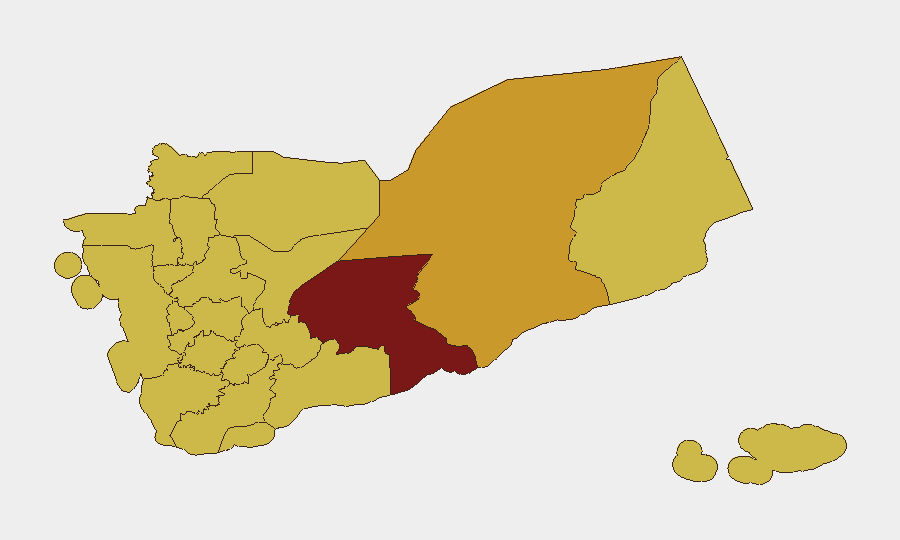
Amanat Al Asimah (Sanaa metropolitan area, risk 97.4) dominates the sub-national ranking and serves as the epicenter of state-militia confrontation, airport infrastructure targeting, and diplomatic flashpoints. Shabwah Governorate (risk 86.8) follows as a secondary hotspot, likely reflecting militia activity and cross-border spillover. The northern cluster—Sa'dah, Hajjah, 'Amran, and Sana'a Governorates (all 67.4)—shows elevated uniform risk, indicating a sustained Houthi-affiliated operational footprint and cross-border missile/drone launch capabilities. Hadramaut and Marib (71.1 and 70.4, respectively) reflect ongoing territorial competition and economic-strategic importance, while Ta'izz (68.5) remains contested ground between government and non-state forces.
The concentration of risk in the capital and northern governorates underscores Tehran–Sanaa alignment as a primary driver of instability, offset by state/Saudi attempts to maintain territorial and air-defense presence.
How GeoBit Would Assist
Security teams with personnel or assets in Yemen should activate AOI Monitoring & Early Warning on high-risk governorates (Sanaa, Shabwah, Hadramaut) to flag airstrikes, clashes, and movement of armed groups in real time. Maritime & Aviation Tracking, coupled with Intel Sweep and X/Telegram OSINT, enables near-real-time detection of cross-border missile/drone launches and port/airport closures affecting supply chains and evacuation routes. Battle Mapping and GIS & Spatial Analysis provide precise location and casualty context for incidents, critical for duty-of-care incident response and staff safety assessments.
7-Day Outlook
Tensions are expected to remain elevated over the next week as prisoner-exchange talks stall and Iranian diplomatic and military support to Yemen-based actors continues. Risk of renewed large-scale airstrikes or missile exchanges between state/Saudi and Houthi forces remains elevated, particularly in Sanaa and Hadramaut. Duty-of-care teams should maintain heightened readiness for evacuation or shelter-in-place protocols, especially in the capital.
Highest-Risk Areas — Ranked
| # | State / Region | Risk |
|---|---|---|
| 1 | Amanat Al Asimah | 97.4 |
| 2 | Shabwah Governorate | 86.8 |
| 3 | Hadramaut Governorate | 71.1 |
| 4 | Marib Governorate | 70.4 |
| 5 | Ta'izz Governorate | 68.5 |
| 6 | Sa'dah Governorate | 67.4 |
| 7 | Hajjah Governorate | 67.4 |
| 8 | Al Mahwit Governorate | 67.4 |
| 9 | Al Hudaydah Governorate | 67.4 |
| 10 | 'Amran Governorate | 67.4 |
| 11 | Sana'a Governorate | 67.4 |
| 12 | Raymah Governorate | 67.4 |
Sources
Previous Daily Briefs
A new Yemen brief is written every day — each with its own risk map and downloadable CSV. Here's the last week; use the calendar to go further back.
📅 Browse every day by calendar →
Highlighted days have a brief. Tap a day for that day's map & analysis, or “csv” for that day's dataset ($5).
Atlas — our AI intelligence desk — emails them this snapshot personally. Nothing else, no list.