Situation Summary
China remains at composite threat rank #20 globally (score 77), with 689 tracked events reflecting a complex security environment marked by state actions, military activity, and international diplomatic friction. Recent signals (27–29 June) include internal investigations and arrests, military mobilization, and coordinated disapproval from Western governments (US, UK, Germany). The threat environment is moderately elevated but stable; no systemic breakdown or imminent mass casualty event is indicated in available reporting.
Key Developments
- 2026-06-28 · Military Mobilization (China vs. Military). Unspecified military activity detected; no geographic specificity or casualty reports in current intelligence. Requires urgent clarification on scale, location, and duration.
- 2026-06-28 · Arrest/Detain (China Mobile vs. Hubei). China Mobile personnel arrested or detained in Hubei Province; possible regulatory enforcement, compliance violation, or corporate governance action. Commercial telecom operations may face disruption or scrutiny.
- 2026-06-28 · Arrest/Detain (China, general). At least one additional arrest/detention event recorded without sectoral or geographic detail; reinforces pattern of enforcement activity mid-late June.
- 2026-06-27 · Admin Sanctions (China vs. Taiwan). Administrative sanctions imposed on Taiwan; consistent with ongoing cross-strait policy coercion. No escalation to kinetic action reported.
- 2026-06-29 · Coordinated International Disapproval. US, UK, and Germany issued near-simultaneous statements disapproving of Chinese policy or action (likely human rights, trade, or geopolitical conduct). Diplomatic isolation signals but does not indicate imminent sanctions or military response.
- 2026-06-27 · Investigation & Public Statement (China). Internal investigation and official public communication on undisclosed subject; context insufficient to assess severity or sectoral impact.
Data Limitation: Available open-source and platform feeds do not provide granular incident detail, specific locations (beyond Hubei), or confirmed casualty/economic impact for most signals. Geographic precision and subject matter remain opaque pending additional reporting.
Highest-Risk Areas
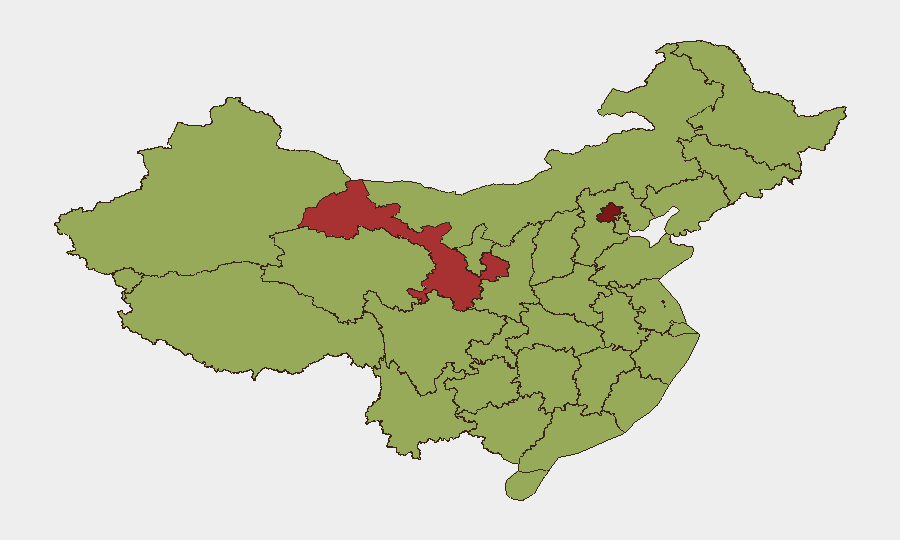
Beijing (83.5) and Gansu (79.4) carry the highest composite risk scores and are the primary drivers of national-level threat. Beijing's elevated rank likely reflects capital-city concentration of state security apparatus, protest/dissent monitoring, and cybersecurity enforcement; Gansu's ranking may signal Xinjiang-adjacent regional instability, minority-area surveillance, or infrastructure vulnerability. The next tier—Guangdong, Jiangsu, Zhejiang—represents economically critical zones where foreign investment, supply chains, and port activity concentrate; moderate risk (55–58) reflects dual exposure to state control and transnational exposure. Shanghai (54), despite major financial-hub status, ranks lower, suggesting current security posture is manageable for international firms; however, teams should not assume immunity from regulatory action or travel restriction.
How GeoBit Would Assist
Security and risk teams should deploy AOI Monitoring & Early Warning on Beijing, Gansu, and key commercial hubs (Shanghai, Guangdong ports) to detect emerging enforcement, protest activity, or infrastructure disruption in real time. Intel Sweep and X/Twitter & Telegram OSINT with multi-language entity extraction will capture official announcements, corporate disclosures, and on-ground reporting faster than wire delays. Network & Actor Analysis will map enforcement actors (state security, Ministry of Industry and Information Technology, regional authorities) to predict targeting of specific sectors or foreign entities.
7-Day Outlook
Near-term trajectory is consolidation: international friction is unlikely to escalate beyond diplomatic statements in the next week absent new kinetic incident or major corporate arrest. Internal enforcement (arrests, investigations) will likely continue at current cadence. Teams with staff or assets in Beijing and Gansu should review access controls, communication protocols, and travel approval matrices; monitor official statements from relevant ministries for sector-specific notices.
Highest-Risk Areas — Ranked
| # | State / Region | Risk |
|---|---|---|
| 1 | Beijing | 83.5 |
| 2 | Gansu | 79.4 |
| 3 | Guangdong Province | 58.4 |
| 4 | Jiangsu | 56.5 |
| 5 | Zhejiang | 55.7 |
| 6 | Jilin | 54.7 |
| 7 | Liaoning | 54.5 |
| 8 | Henan | 54.2 |
| 9 | Shanghai | 54 |
| 10 | Tibet | 53.9 |
| 11 | Guangxi | 53.9 |
| 12 | Chongqing | 53.9 |
Sources
Previous Daily Briefs
A new China brief is written every day — each with its own risk map and downloadable CSV. Here's the last week; use the calendar to go further back.
📅 Browse every day by calendar →
Highlighted days have a brief. Tap a day for that day's map & analysis, or “csv” for that day's dataset ($5).