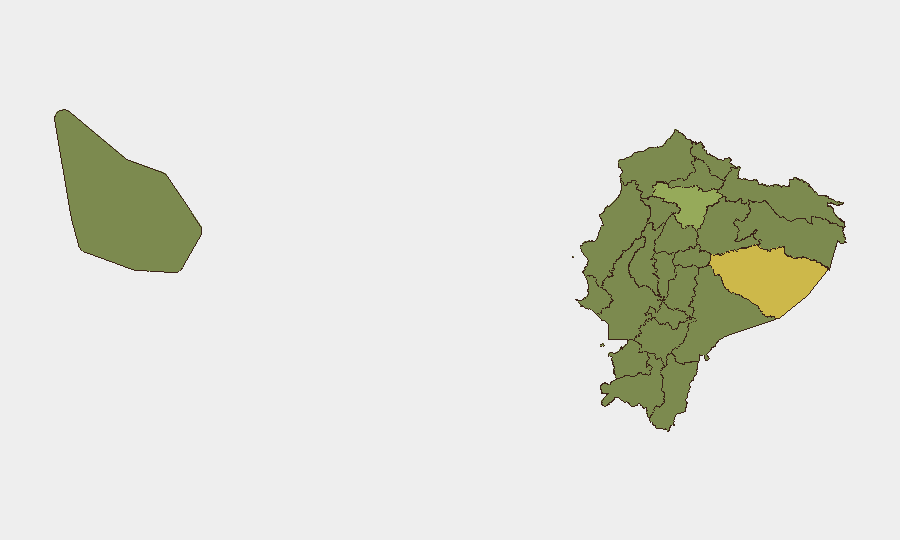
Situation Summary
Ecuador remains a mid-tier global security concern (rank #45, composite score 47) with 103 tracked events, driven primarily by subnational gang violence, prison instability, and border-zone trafficking activity. The last 48 hours have surfaced multiple conventional-force incidents involving residents, police, and authorities, alongside a U.S. terrorist designation affecting organized-crime networks operating within Ecuador. The security trajectory is fluid but elevated in frontier provinces, particularly Pastaza (score 62.5) and Pichincha (45.4), where criminal organization activity and state-capacity constraints intersect.
Key Developments
- 2026-07-02 · Conventional Military Force / Residents vs. Police — Active confrontation between civilian populations and police forces recorded; specific location and casualty data pending clarification from field sources.
- 2026-07-02 · Conventional Military Force / Authorities — Authorities engaged in armed response operations; geographic focus and operational context require real-time corroboration.
- 2026-07-02 · Small Arms Combat / "Saint" Actor — Armed engagement involving an entity designated "Saint" in open signals; tactical context and location not yet confirmed.
- 2026-07-01 · Mexico–Ecuador Investigation — Bilateral investigative activity flagged; likely related to cross-border trafficking, extradition, or organized-crime coordination.
- 2026-07-02 · Threat Against Presidential Candidate — Documented threat event targeting electoral figure; electoral security and protective detail implications for international observers and corporate presence in political hub regions.
- 2026-07-02 · Ministry vs. Worker / Public Statement — Labor or administrative dispute escalated to public statement level; context suggests potential labor unrest or industrial disruption.
- 2026-07-01 · Ecuador–Germany Conventional Military Force — Diplomatic or security interaction flagged; likely training, naval/defense cooperation, or incident investigation context.
Note: Open signals lack granular geographic attribution for most incidents. Web research within the last 24–48 hours did not yield corroborated headline reporting on these events; signals are derived from GeoBit event feed. The U.S. State Department designation of the Chone Killers as a foreign terrorist organization (reported mid-week) is relevant to trafficking and prison-gang networks but specific date confirmation is pending.
Highest-Risk Areas
Pastaza Province (62.5) and Pichincha Province (45.4) dominate the subnational landscape. Pastaza's elevation reflects remote-zone trafficking, minimal state presence, and transnational criminal operations; Pichincha encompasses Quito and associated urban gang activity, prison volatility, and organized extortion networks. The remaining nine tracked provinces cluster between 32.5 and 37, indicating dispersed but significant secondary risk across the Amazon frontier (Napo, Orellana, Sucumbíos), coastal zones (Guayas, Manabí, Esmeraldas), and border regions (Carchi, Imbabura). Corporate and expatriate presence in Quito and Guayaquot remains the primary exposure point despite Pichincha's mid-tier ranking.
How GeoBit Would Assist
Security teams should deploy AOI Monitoring & Early Warning on Pastaza, Pichincha, and Guayas Provinces to detect emerging gang violence, prison incidents, and trafficking activity with persistent alerting. Multi-language OSINT Fusion on Telegram and X/Twitter, combined with entity extraction and network analysis, enables tracking of criminal organization signals and state-force movements in real time. Routing & Network Analysis supports alternative journey planning for personnel and assets, while conflict and actor network mapping clarifies the operational structure of gangs and their geographic control zones.
7-Day Outlook
Expect continued volatility in Pastaza and Pichincha over the near term, with potential for escalation in prison-system incidents or cross-border trafficking activity as organizations adapt to recent U.S. designations. Electoral threats and labor disputes may generate secondary flashpoints in urban centers. Monitoring of bilateral Mexico–Ecuador investigations and any cascading security-force operations should remain continuous.
Highest-Risk Areas — Ranked
| # | State / Region | Risk |
|---|---|---|
| 1 | Pastaza Province | 62.5 |
| 2 | Pichincha Province | 45.4 |
| 3 | Napo Province | 37 |
| 4 | Guayas Province | 34.9 |
| 5 | Sucumbíos Province | 32.5 |
| 6 | Orellana Province | 32.5 |
| 7 | Manabí Province | 32.5 |
| 8 | Galápagos | 32.5 |
| 9 | Esmeraldas Province | 32.5 |
| 10 | Carchi Province | 32.5 |
| 11 | Imbabura Province | 32.5 |
| 12 | Santo Domingo de los Tsáchilas Province | 32.5 |
Sources
Previous Daily Briefs
A new Ecuador brief is written every day — each with its own risk map and downloadable CSV. Here's the last week; use the calendar to go further back.
📅 Browse every day by calendar →
Highlighted days have a brief. Tap a day for that day's map & analysis, or “csv” for that day's dataset ($5).