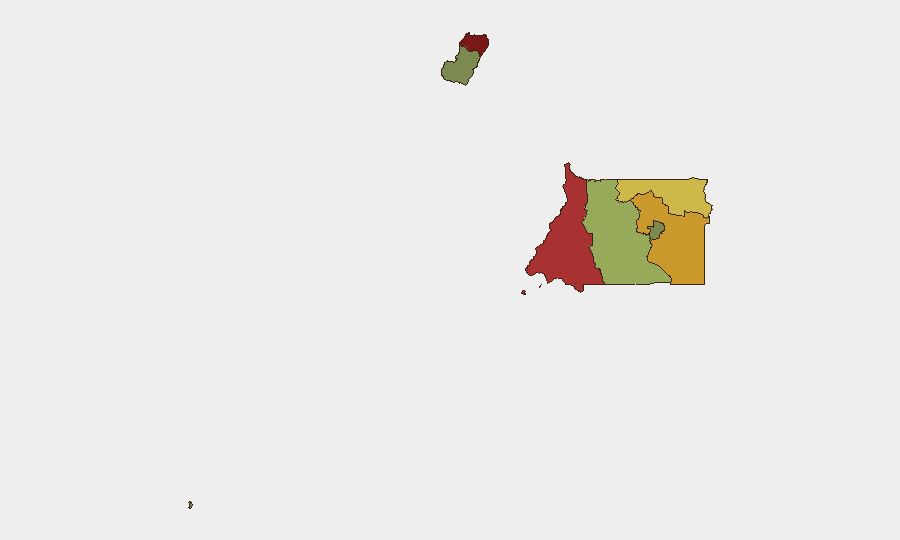
Situation Summary
Equatorial Guinea remains a low-threat environment globally (ranked #162), with no discrete security events recorded in the current assessment window. However, sub-national risk concentrations persist in Bioko Norte and Litoral Province, driven by underlying governance, resource-competition, and detention-system vulnerabilities rather than active violence. A U.S. deportation operation on 21 August has surfaced acute human-rights and detention conditions at a Malabo facility, introducing potential flashpoints for civil-society pressure and localized instability.
Key Developments
- Malabo, Bioko Island – 21 August 2026, ~20:50 local time: Five migrants forcibly disembarked from a U.S. charter flight and placed in de facto detention at a decommissioned hotel after refusing removal in Monrovia. Facility holds approximately 30–40 third-country deportees under a U.S.–Equatorial Guinea arrangement. Human-rights monitors report restrictive conditions, inadequate medical care, and denial of legal assistance, elevating detention-related security and reputational risk in the capital.
No other discrete security incidents (protests, armed conflict, infrastructure failures, or criminal spikes) have been documented in Equatorial Guinea during the last 24–48 hours by available credible sources.
Highest-Risk Areas
Bioko Norte (risk score 85) and Litoral Province (risk 78) account for the largest share of national threat exposure. Bioko Norte—home to Malabo, the capital and seat of government—faces elevated risk from detention-system vulnerabilities, unresolved migrant and deportee populations, and governance capacity constraints. Litoral Province ranks second, likely reflecting historical resource competition, weak rule-of-law infrastructure, and limited state presence in outlying districts. Wele-Nzas Province (score 72) and Kié-Ntem Province (score 68) remain elevated due to border permeability and transnational movement, though active incidents are absent. Centro Sur and southern regions show substantially lower risk profiles.
How GeoBit Would Assist
Security teams with personnel or assets in Equatorial Guinea should deploy AOI Monitoring & Early Warning on Malabo and key provincial capitals to detect civil-society mobilization, detention-facility incidents, or state-security responses in real time. Network & Actor Analysis and OSINT fusion (including X/Twitter, Telegram, and multi-language web search) would track human-rights organization statements, government reactions, and international diplomatic pressure around the deportation facility. Risk & Threat Assessment capabilities, combined with election monitoring (if polling cycles approach), would provide early signals of regime-stability shifts or protest organizing tied to detention conditions.
7-Day Outlook
The immediate risk trajectory hinges on international and civil-society response to the Malabo detention facility. If pressure escalates without rapid access or policy concessions from Equatorial Guinea authorities, localized demonstrations or civil-society mobilization in Malabo could drive short-term security incidents. Absent a major external shock (e.g., regional spillover from Gabon, Cameroon border instability, or oil-sector disruption), the national threat profile is expected to remain low-to-moderate; however, duty-of-care teams should monitor detention-related developments and monitor Bioko Norte closely for secondary effects.
Highest-Risk Areas — Ranked
| # | State / Region | Risk |
|---|---|---|
| 1 | Bioko Norte | 85 |
| 2 | Litoral Province | 78 |
| 3 | Wele-Nzas Province | 72 |
| 4 | Kié-Ntem Province | 68 |
| 5 | Centro Sur Province | 45 |
| 6 | Bioko Sur | 38 |
| 7 | Djibloho | 15 |
| 8 | Annobón Province | 8 |
Sources
Previous Daily Briefs
A new Equatorial Guinea brief is written every day — each with its own risk map and downloadable CSV. Here's the last week; use the calendar to go further back.
- August 20, 2026
- August 18, 2026
- August 16, 2026
- August 14, 2026
- August 12, 2026
- August 10, 2026
- August 8, 2026
📅 Browse every day by calendar →
Highlighted days have a brief. Tap a day for that day's map & analysis, or “csv” for that day's dataset ($5).
Atlas — our AI intelligence desk — emails them this snapshot personally. Nothing else, no list.