Situation Summary
Eswatini remains a low-threat environment globally (rank #148) with minimal discrete security events reported in the past week. However, a significant government digital infrastructure outage beginning September 23 has disrupted core services including passport, identity, email, and payment systems, raising operational continuity and data-protection concerns for organizations reliant on government interfaces. Regional risk concentration in Lubombo and Shiselweni districts (composite scores 72 and 68 respectively) reflects underlying civil-unrest dynamics; the country continues to experience periodic demonstrations, most recently signaled by a protest at the U.S. Embassy on September 23 linked to prisoner transfers. The security posture remains stable but fragile, contingent on avoiding escalation of civil grievances and restoring critical digital infrastructure.
Key Developments
- Government digital services outage — nationwide, September 23, 2026: Eswatini government web services including *Government In Your Hand*, the official government website, IFMIS, email, passport, identity-document, and payment systems reported unavailable for over one week following an alleged cyberattack. The Royal Science and Technology Park confirmed the outage; full extent of data compromise remains unverified by independent sources.
- Prisoner transfer protest — U.S. Embassy, Mbabane, September 23, 2026: Over 100 women gathered outside the U.S. Embassy to protest the arrival of U.S.-deported foreign nationals transferred to Eswatini prisons, primarily Matsapha Central Prison near Manzini. Demonstration reported by France 24; independent social-media corroboration unavailable in available search window.
- Travel advisory update — nationwide, September 24, 2026: Canada updated its travel advisory, reiterating a recommendation to exercise a high degree of caution due to civil-unrest risk and advising avoidance of demonstrations and close monitoring of local developments. This reflects ongoing travel-environment assessment rather than a new discrete security incident.
Highest-Risk Areas
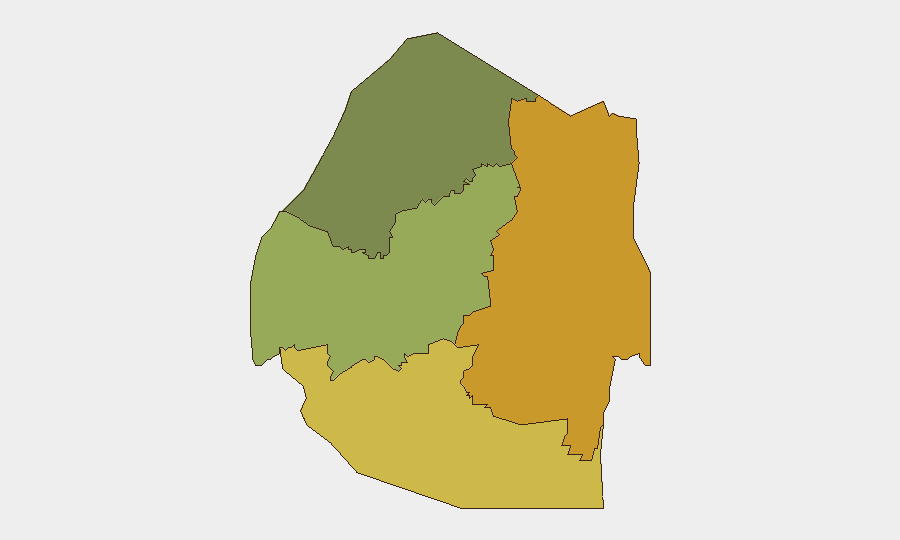
Lubombo (composite risk 72) and Shiselweni (68) dominate the sub-national threat landscape and warrant proportionate monitoring resources. Both regions have historically exhibited elevated civil-unrest potential; Shiselweni's proximity to informal cross-border activity and economic marginalization appear to sustain unrest risk. Manzini Region (55), home to the capital Mbabane and key infrastructure including Matsapha Central Prison, presents secondary but operationally significant risk due to population density and government concentration. Hhohho Region (35) remains comparatively stable. Organizations with personnel or assets in Lubombo and Shiselweni should prioritize localized situational awareness and contingency planning.
How GeoBit Would Assist
Security teams would employ AOI Monitoring & Early Warning to track Lubombo and Shiselweni districts for emerging civil unrest, coupled with Intel Sweep and multi-language OSINT (X/Twitter, Telegram, local media) to detect protest mobilization and rhetoric shifts before demonstrations materialize. Cyber threat assessment capabilities would enable continuous monitoring of Eswatini's digital infrastructure recovery and supply-chain cyber-risk exposure. Routing & Network Analysis supports alternative operational planning for organizations dependent on government services during outages.
7-Day Outlook
The government cyberattack recovery trajectory will be critical; sustained service disruption may amplify public frustration and create secondary unrest risk, particularly if passport or payment systems remain offline for essential populations. Civil-unrest risk remains elevated but not acute in the absence of new triggering events; continued monitoring of Lubombo and Shiselweni for demonstration activity is warranted. No forecast of imminent large-scale security deterioration, though fragility remains evident.
Highest-Risk Areas — Ranked
| # | State / Region | Risk |
|---|---|---|
| 1 | Lubombo | 72 |
| 2 | Shiselweni | 68 |
| 3 | Manzini Region | 55 |
| 4 | Hhohho Region | 35 |
Sources
Previous Weekly Briefs
A new Eswatini brief is written every Monday, covering the week — each with its own risk map and downloadable CSV. Use the calendar to go further back.
- September 22, 2026
- September 15, 2026
- September 8, 2026
- September 1, 2026
- August 30, 2026
- August 28, 2026
- August 26, 2026
📅 Browse past briefs by calendar →
Highlighted days have a brief. Tap a day for that day's map & analysis, or “csv” for that day's dataset ($5).
Atlas — our AI intelligence desk — emails them this snapshot personally. Nothing else, no list.