Situation Summary
France faces a composite threat score of 52 (global rank #38) driven by a convergence of public security incidents, critical infrastructure vulnerabilities, and unresolved threat cases spanning the past 48 hours. Ile-de-France dominates the risk profile at 66.3, reflecting operational concentration in Paris and surrounding zones. The security environment is currently elevated due to heightened law-enforcement activity around Bastille Day (14 July) and World Cup events, compounded by active wildfire response and recent exposure of a Russian-attributed cyber-sabotage campaign targeting European critical infrastructure.
Key Developments
- Paris & inner suburbs (14–15 July): Police arrested 141 individuals suspected of firing pyrotechnic mortars at law enforcement during nighttime operations, indicating organized escalation amid post-Bastille Day tensions.
- Fontainebleau Forest, Seine-et-Marne (mid-July): A volunteer firefighter admitted to deliberately starting one of two major wildfires; approximately 850 firefighters and four water-bombing aircraft remain engaged. Incident demonstrates insider sabotage risk to critical infrastructure response capacity.
- Sarcelles, Val-d'Oise (11 July, ongoing investigation): Police recovered a stolen vehicle containing military-grade assault rifle and handgun parked near a synagogue; 300 residents evacuated. Anti-terror prosecutors have opened investigation; no suspects identified to date. Represents unresolved armed threat.
- Rennes, Ille-et-Vilaine (night of 14–15 July): Woman found seriously injured with bound wrists after falling from 3rd-floor apartment; public prosecutor opened investigation for attempted feminicide, suggesting domestic violence escalation.
- France, national level (early–mid July, announced by Foreign Minister Jean-Noël Barrot): France confirmed detection and countering of Russian FSB-orchestrated cyber-sabotage campaign affecting critical infrastructure across approximately ten European states. French authorities announced diplomatic summons of Russian ambassador and sanctions against nine individuals and four entities.
- Nationwide security deployment (14 July): Approximately 70,000 security personnel deployed for Bastille Day and World Cup semifinal events. Multiple municipalities cancelled or banned fireworks due to active wildfire risk and extreme heat conditions.
Highest-Risk Areas
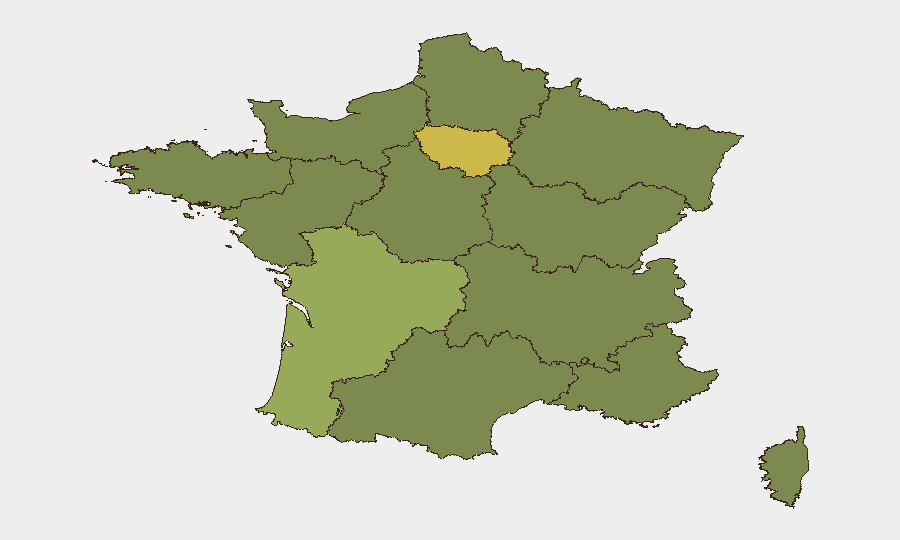
Ile-de-France (66.3) accounts for the majority of tracked threat events and concentrates political, economic, and transport infrastructure vulnerable to both conventional crime and cyber operations. Nouvelle-Aquitaine (58.2) shows secondary elevation; remaining regions cluster between 36–40, suggesting dispersed but lower-intensity risk. The ranking reflects event density and operational significance rather than uniform geographic threat—corporate and government assets in the Paris metropolitan area face compound exposure to public disorder, infrastructure disruption, and cyber targeting. Fontainebleau and surrounding zones (Seine-et-Marne, within Ile-de-France) currently present elevated wildfire-related access and operational risk.
How GeoBit Would Assist
Security teams would leverage Intel Sweep and multi-source OSINT fusion to track ongoing protest activity, extremist communications (Telegram, X), and emerging incident reporting around Paris; AOI Monitoring & Early Warning on Ile-de-France to detect organized public-order escalation or infrastructure threats; and Cyber threat & entity analysis to correlate Russian-attributed cyber operations against corporate network infrastructure. Routing & Network Analysis supports alternative journey planning for personnel and supply chains around active wildfires and police cordons.
7-Day Outlook
Bastille Day security operations will likely sustain elevated police presence through mid-week; wildfire containment in Fontainebleau may extend 5–7 days depending on weather. Russian cyber operations remain persistent and will likely target French critical infrastructure again; coordinated EU sanctions announced 15 July signal official attribution but do not reduce operational threat. Expect continued investigation activity around Sarcelles weapons case and ongoing public-order monitoring in Paris suburbs.
Highest-Risk Areas — Ranked
| # | State / Region | Risk |
|---|---|---|
| 1 | Ile-de-France | 66.3 |
| 2 | Nouvelle-Aquitaine | 58.2 |
| 3 | Pays de la Loire | 39.7 |
| 4 | Hauts-de-France | 37.7 |
| 5 | Bourgogne – Franche-Comté | 37.2 |
| 6 | Brittany | 36.4 |
| 7 | Occitania | 36.4 |
| 8 | Auvergne-Rhône-Alpes | 36.4 |
| 9 | Provence-Alpes-Côte d'Azur | 36.4 |
| 10 | Normandy | 36.3 |
| 11 | Centre-Val de Loire | 36.3 |
| 12 | Grand Est | 36.3 |
Sources
Previous Daily Briefs
A new France brief is written every day — each with its own risk map and downloadable CSV. Here's the last week; use the calendar to go further back.
📅 Browse every day by calendar →
Highlighted days have a brief. Tap a day for that day's map & analysis, or “csv” for that day's dataset ($5).
Atlas — our AI intelligence desk — emails them this snapshot personally. Nothing else, no list.