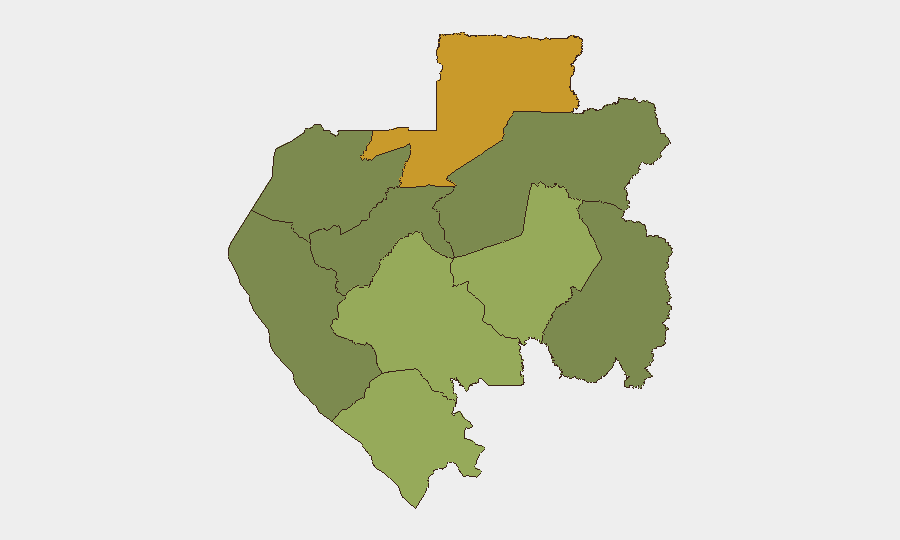
Situation Summary
Gabon remains a low-threat environment at the national level (global rank #147, composite score 3), with no confirmed security, civil-unrest, or acute travel incidents reported in the last 24–48 hours. Open-source monitoring across news, regional risk platforms, and social-media feeds indicates a stable security baseline across the country. However, sub-national risk concentrations in the northeast and southeast require continued monitoring, particularly in Woleu-Ntem Province, where composite risk scores substantially exceed the national average.
Key Developments
- No newly confirmed security or civil-unrest incidents reported in Gabon (28–30 July 2026). Open-source monitoring across West and Central African incident platforms explicitly document no actionable new events in the past 24–48 hours.
- Regional wildfire activity in neighboring Congo continues to be monitored. Cross-border smoke and air-quality impacts may affect northern and eastern border regions; no direct security implications confirmed, but environmental monitoring advised for remote operations.
- Background context (outside 24–48h window but operationally relevant): Detention of opposition leader Alain Claude Bilie By Nze continues; public statements by his legal representatives on 24 July reinforce ongoing political tension in Libreville, though no new arrest or escalation has been reported since then.
- Historical road-safety hazards persist. Accidents in Moanda, Libreville, and regional towns (reported 4–6 July) reflect background infrastructure and driver-safety risks that remain relevant for duty-of-care planning, particularly on secondary routes.
Highest-Risk Areas
Woleu-Ntem Province (risk 72) dominates the sub-national risk profile, followed by Ogooué-Lolo (58) and Ngounié (48). These northeastern and southeastern regions—remote, sparsely monitored, and with limited state presence—concentrate risks associated with cross-border activity, informal mining, and limited law-enforcement reach. Ogooué-Ivindo Province presents negligible risk (0). The capital region (Estuaire, risk 15) remains substantially safer than the periphery, reflecting stronger governance and security infrastructure in Libreville and its immediate surroundings. Organizations with personnel or supply chains in the high-risk northern and southeastern provinces should apply heightened vetting and communication protocols.
How GeoBit Would Assist
Teams managing personnel or assets in Gabon would benefit from persistent Area-of-Interest (AOI) monitoring and early-warning alerts focused on Woleu-Ntem and Ogooué-Lolo to capture emerging unrest, cross-border incidents, or security deterioration before they reach mainstream reporting. Routing and network analysis can identify safer transit corridors between Libreville and remote operations, accounting for infrastructure and conflict-risk patterns. Multi-language OSINT and social-media monitoring (X, Telegram, local outlets) provide early signals of political tension or localized incidents that may precede formal news coverage, enabling proactive evacuation or duty-of-care decisions.
7-Day Outlook
No escalation in national security risk is anticipated over the next seven days. Continued monitoring of opposition political activity and any developments in the detention case is warranted to assess whether political tensions translate into broader unrest. Environmental factors (regional wildfires) and seasonal infrastructure vulnerabilities should remain on risk-team agendas for organizations with operations in border or remote regions.
Highest-Risk Areas — Ranked
| # | State / Region | Risk |
|---|---|---|
| 1 | Woleu-Ntem | 72 |
| 2 | Ogooué-Lolo Province | 58 |
| 3 | Ngounié Province | 48 |
| 4 | Nyanga Province | 42 |
| 5 | Haut-Ogooué Province | 35 |
| 6 | Moyen-Ogooué Province | 28 |
| 7 | Ogooué-Maritime Province | 25 |
| 8 | Estuaire Province | 15 |
| 9 | Ogooué-Ivindo | 0 |
Sources
Previous Daily Briefs
A new Gabon brief is written every day — each with its own risk map and downloadable CSV. Here's the last week; use the calendar to go further back.
📅 Browse every day by calendar →
Highlighted days have a brief. Tap a day for that day's map & analysis, or “csv” for that day's dataset ($5).
Atlas — our AI intelligence desk — emails them this snapshot personally. Nothing else, no list.