Situation Summary
Georgia faces a compound security environment marked by active organized-crime disruptions, transnational narcotics trafficking, and emerging critical-infrastructure cyber risk. Law-enforcement actions over the past 48 hours have dismantled significant drug-trafficking and money-laundering networks, indicating both criminal scale and state capacity to interdict. Geopolitical tensions in the breakaway regions (particularly South Ossetia/Tskhinvali) remain a background driver of instability, while U.S.-attributed cyberattacks on water-sector infrastructure now extend Georgia's exposure to critical-systems compromise. Overall threat trajectory remains elevated but contained in the capital and western regions.
Key Developments
- Tbilisi, August 3: Georgia's Investigative Service announced dismantling of a large psychotropic-drug trafficking and money-laundering scheme, with 17 arrests and ₾53.8 million in illicit medications seized. Network was centered in the capital and signals organized-crime scale and potential asset-exposure risk for businesses.
- Samegrelo–Zemo Svaneti region (western Georgia), August 3: Police arrested two Ukrainian nationals on large-scale methadone trafficking and illegal possession charges, underscoring active cross-border narcotics movement along western travel corridors and supply routes.
- Tbilisi, July 29–30 (reported through last 48h): State Security Service arrested three foreign nationals during an attempted illegal firearms and ammunition sale, seizing weapons, electronics, and suspected narcotics; transnational crime-ring investigation ongoing with additional network members still unidentified.
- Tbilisi, August 3: Opposition figures issued public warnings of Russian-backed integration and annexation risks in South Ossetia (Tskhinvali region), framing geopolitical insecurity and potential Western isolation; signals sustained political-instability friction in the capital.
- Georgia (U.S. state), August 2–3: U.S. federal authorities confirmed cyberattacks on water systems in at least seven states, including Georgia, as part of broader campaign against U.S. water and wastewater infrastructure; Georgia reported limited disruptions and no confirmed contamination to date, but federal investigation ongoing.
Highest-Risk Areas
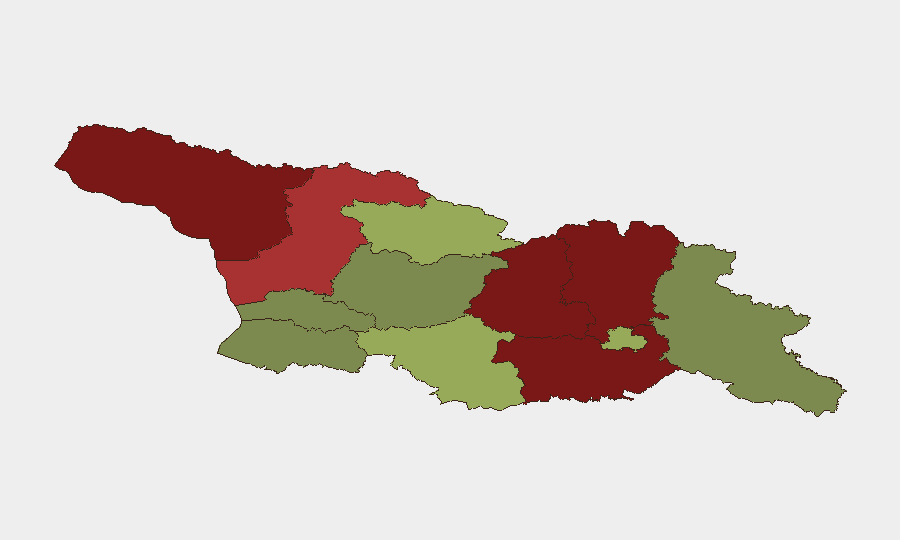
Abkhazia (risk 95), Shida Kartli (88), and Lower Kartli (85) dominate the risk profile, driven by contested sovereignty, military proximity, and historical conflict zones. Mtskheta-Mtianeti (82) and Samegrelo-Upper Svaneti (78) face compounded risk from geopolitical tension and cross-border trafficking activity, respectively. Tbilisi (45) and Samtskhe-Javakheti (48) present moderate but significant risk from organized crime, narcotics networks, and political friction; western regions (Samegrelo, Guria) are conduits for transnational crime. Northern and western corridors warrant elevated scrutiny for personnel and supply-chain movement.
How GeoBit Would Assist
Teams with personnel or assets in Georgia should employ Intel Sweep and multi-language OSINT fusion to track ongoing organized-crime and trafficking-network disruptions in real time, and entity extraction and network analysis to map transnational crime-actor ties and asset-exposure risk. AOI Monitoring and early-warning capability on Tbilisi and western regions (Samegrelo, Guria) would provide persistent alerting to law-enforcement actions, political friction, or trafficking surges. Routing & network analysis supports safer travel planning away from high-crime and trafficking corridors, while cyber and critical-infrastructure search enables tracking of water-sector and broader state-system vulnerabilities.
7-Day Outlook
Law-enforcement activity is likely to continue yielding further arrests and network disruptions as investigations expand. Geopolitical messaging around South Ossetia may intensify ahead of any multilateral diplomatic engagement, sustaining political volatility in Tbilisi. U.S. water-sector cyberattacks may trigger defensive hardening; Georgia's limited reported impact suggests near-term infrastructure risk remains low, but monitoring of state-system advisories is warranted.
Highest-Risk Areas — Ranked
| # | State / Region | Risk |
|---|---|---|
| 1 | Autonomous Republic of Abkhazia | 95 |
| 2 | Shida Kartli | 88 |
| 3 | Lower Kartli | 85 |
| 4 | Mtskheta-Mtianeti | 82 |
| 5 | Samegrelo-Upper Svaneti | 78 |
| 6 | Samtskhe-Javakheti | 48 |
| 7 | Tbilisi | 45 |
| 8 | Racha-Lechkhumi and Kvemo Svaneti | 42 |
| 9 | Kakheti | 38 |
| 10 | Autonomous Republic of Adjara | 35 |
| 11 | Imereti | 32 |
| 12 | Guria | 28 |
Sources
Previous Daily Briefs
A new Georgia brief is written every day — each with its own risk map and downloadable CSV. Here's the last week; use the calendar to go further back.
📅 Browse every day by calendar →
Highlighted days have a brief. Tap a day for that day's map & analysis, or “csv” for that day's dataset ($5).
Atlas — our AI intelligence desk — emails them this snapshot personally. Nothing else, no list.