Situation Summary
India's composite threat score of 38 (rank #47 globally) reflects moderate, dispersed risk concentrated in two metropolitan centers and driven by civil unrest, financial crime, and infrastructure vulnerabilities. Delhi and Maharashtra together account for nearly two-thirds of tracked sub-national risk, with ongoing student-led protest activity in the capital, enforcement actions across financial and security sectors, and isolated incidents of interpersonal violence. The security environment remains fragmented by state rather than systemic, though regulatory gaps in financial-market infrastructure and escalating civil-order responses suggest medium-term volatility in major urban centers.
Key Developments
- New Delhi – 2026-07-19: Delhi Police deployed tear gas, barricades, and heavy security to block thousands of Cockroach Janta Party student protesters marching from Jantar Mantar toward Parliament during the "Sansad Chalo" action protesting NEET exam irregularities; scuffles and reported injuries occurred near the Press Club and Constitution Club areas.
- New Delhi – 2026-07-19–20: Police began clearing a long-running CJP protest sit-in site in central Delhi after weeks of occupation, marking an escalation in authorities' response and adding to civil-unrest and political-instability risk in the capital.
- New Delhi (Jantar Mantar) – 2026-07-19: CJP party leader Abhijit Dipke was attacked with ink by an unidentified female assailant during protest activity, briefly causing disorder and prompting security response.
- Belagavi district, Karnataka – 2026-07-19: Police arrested two directors of Sridevikuge Ventures Pvt Ltd for allegedly operating a ₹25-crore Ponzi scheme affecting over 250 investors, highlighting financial-crime exposure in the state.
- Strait of Hormuz / Indian nationals – 2026-07-19: An attack on a vessel leaving Odesa, Ukraine killed four Indian nationals and critically injured one, elevating maritime-transit risk for Indian shipping workers in conflict-adjacent waters.
- India-wide, financial infrastructure – 2026-07-20: The Securities and Exchange Board of India imposed a ₹10 million fine on Central Depository Services (India) Ltd for cybersecurity and compliance failures tied to a malware attack disrupting depository operations, signaling vulnerabilities in capital-market infrastructure.
Highest-Risk Areas
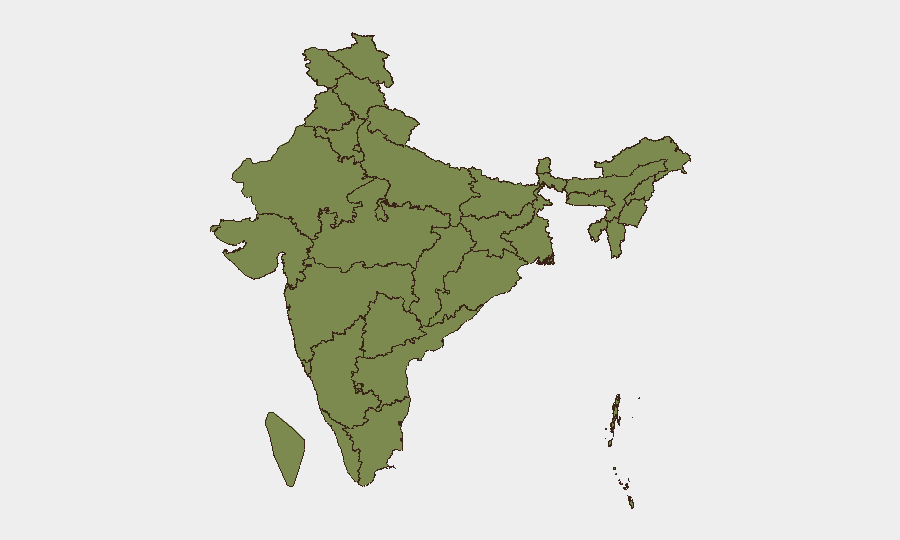
Maharashtra (risk 33.9) and Delhi (risk 30.9) together drive nearly 65% of India's sub-national threat score, reflecting acute civil-unrest exposure, large protest populations, and critical financial/governmental concentrations. Delhi's risk is sharply elevated by current student-protest activity, police enforcement escalation, and vulnerability of central government institutions; Maharashtra's elevation reflects Mumbai's status as the financial center and recurring demand-side protest activity. Uttar Pradesh (14.6) ranks third but is substantially lower, and all other states fall below 11.6, indicating that risk is geographically concentrated and not distributed across the country.
How GeoBit Would Assist
Security teams would employ Intel Sweep and multi-language OSINT to monitor real-time protest activity, police operations, and regulatory enforcement across Delhi and Maharashtra; AOI Monitoring & Early Warning persistent surveillance of Parliament, central Delhi, and financial-district nodes would detect escalation triggers before mass movement. Routing & Network Analysis capabilities would support alternative journey planning for personnel transiting Delhi during high-tension periods, while Risk & Threat Assessment fusion of protest sentiment, police posture, and prior incident patterns would deliver 48–72-hour predictive alerts on blockades or security operations.
7-Day Outlook
Clearing of the Delhi protest sit-in is likely to reduce immediate street-level congestion but may trigger secondary demonstrations or shift protest venues to other parts of the capital and other major cities. Regulatory enforcement activity in financial markets and banking sectors will likely continue, suggesting ongoing operational disruptions and compliance-audit intensity. Overall risk trajectory is stable-to-rising in Delhi and Maharashtra; no major escalation triggers are apparent, but persistence of student-movement momentum and police enforcement cycles presents medium-term civil-order volatility.
Highest-Risk Areas — Ranked
| # | State / Region | Risk |
|---|---|---|
| 1 | Maharashtra | 33.9 |
| 2 | Delhi | 30.9 |
| 3 | Uttar Pradesh | 14.6 |
| 4 | Jammu and Kashmir | 11.6 |
| 5 | Rajasthan | 10 |
| 6 | Karnataka | 9.9 |
| 7 | Punjab | 9.7 |
| 8 | Telangana | 8.8 |
| 9 | Andhra Pradesh | 8.7 |
| 10 | West Bengal | 8.2 |
| 11 | Tamil Nadu | 8 |
| 12 | Madhya Pradesh | 7.4 |
Sources
Previous Daily Briefs
A new India brief is written every day — each with its own risk map and downloadable CSV. Here's the last week; use the calendar to go further back.
📅 Browse every day by calendar →
Highlighted days have a brief. Tap a day for that day's map & analysis, or “csv” for that day's dataset ($5).
Atlas — our AI intelligence desk — emails them this snapshot personally. Nothing else, no list.