Situation Summary
Mexico remains the seventh-highest-threat country globally, driven by sustained criminal and cartel violence across multiple states. The immediate security posture has intensified around major population centers due to World Cup hosting, with federal and local authorities deploying nearly 100,000 personnel to manage both crowd-control risks and underlying criminal activity. The broader threat environment—characterized by armed cartel operations, roadblocks, arson, and targeted shootings—continues to deteriorate in key transit corridors and coastal states, with conditions capable of shifting rapidly.
Key Developments
- Mexico City (Estadio Azteca and surrounding zones) – July 5, 2026
Approximately 7,500 police officers deployed around the stadium ahead of the Mexico–England Round of 16 match, explicitly linked to recent fan deaths and crowd violence; deployment described as part of city-wide security reinforcement across three host cities.
- Mexico City (Angel of Independence & Zócalo) – July 4–5, 2026
Authorities implemented doubled security and strict crowd caps (25,000-person limit at the Angel monument), Metro/Metrobus closures near Paseo de la Reforma, and alcohol-sale restrictions in the city center in response to earlier overcrowding fatalities during World Cup fan gatherings.
- Mexico City (England team hotel, central area) – night of July 4–5, 2026
Riot police and National Guard personnel erected barricades and prevented fan approach after late-night disruptions to the England team's rest; smaller protest groups persisted despite increased perimeter security.
- Mexico City (public transport & city center) – July 5, 2026
Temporary closures and operational changes to Metro and Metrobus lines confirmed, with street alcohol bans extending through the following day, aimed at reducing overcrowding and violence during mass World Cup gatherings.
- Mexico (national advisory context) – updated within 48 hours
International travel-advisory services (e.g., Australia's Smartraveller) reiterated high-caution guidance for Mexico overall, citing persistent shootings, arson, roadblocks, and violent crime; advisories note rapid deterioration potential.
Highest-Risk Areas
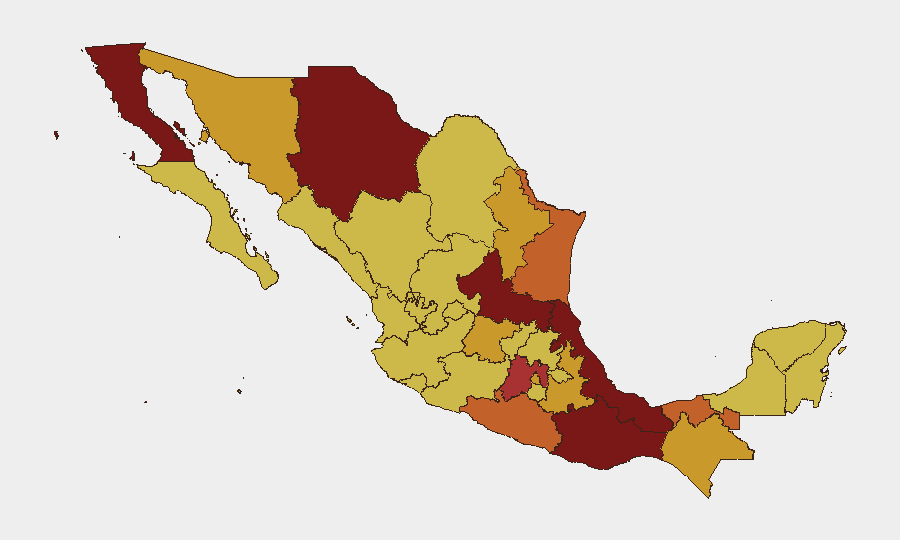
Veracruz (risk 100), San Luis Potosí (96.2), and Chihuahua (88.8) drive the national threat composite, with cartel-controlled trafficking corridors, active territorial disputes, and high rates of extortion, kidnapping, and armed confrontation. Baja California (84) and coastal/border regions (Tamaulipas, Sonora, Nuevo León) remain flashpoints for drug-transit violence and transnational criminal operations. State of Mexico (76.6) and Guerrero (74.5) show elevated risk due to proximity to Mexico City and ongoing cartel presence; Oaxaca (81.2) and Tabasco (74.9) reflect localized instability. Northern and coastal corridors present the highest operational risk to personnel and supply chains.
How GeoBit Would Assist
Security teams should employ AOI Monitoring & Early Warning on high-risk states (Veracruz, Chihuahua, Baja California) to detect cartel activity shifts and roadblock incidents in real time. OSINT fusion and multi-language social/Telegram monitoring would track emerging protest, migrant, and crowd-control risks around World Cup venues and major transport hubs. Routing & Network Analysis and Conflict & Military mapping enable alternative-route planning and force-posture assessment in cartel-dominated transit zones.
7-Day Outlook
World Cup security deployments will remain elevated through at least July 8, with continued crowd-control measures in Mexico City, Guadalajara, and Monterrey. Underlying cartel and trafficking violence is unlikely to pause; monitoring for secondary incidents (arson, roadblocks, targeted attacks) in high-risk states remains critical for duty-of-care compliance.
Highest-Risk Areas — Ranked
| # | State / Region | Risk |
|---|---|---|
| 1 | Veracruz | 100 |
| 2 | San Luis Potosí | 96.2 |
| 3 | Chihuahua | 88.8 |
| 4 | Baja California | 84 |
| 5 | Oaxaca | 81.2 |
| 6 | State of Mexico | 76.6 |
| 7 | Tabasco | 74.9 |
| 8 | Guerrero | 74.5 |
| 9 | Tamaulipas | 73.5 |
| 10 | Guanajuato | 72.8 |
| 11 | Sonora | 72.1 |
| 12 | Nuevo León | 71.4 |
Sources
Previous Daily Briefs
A new Mexico brief is written every day — each with its own risk map and downloadable CSV. Here's the last week; use the calendar to go further back.
📅 Browse every day by calendar →
Highlighted days have a brief. Tap a day for that day's map & analysis, or “csv” for that day's dataset ($5).
Atlas — our AI intelligence desk — emails them this snapshot personally. Nothing else, no list.