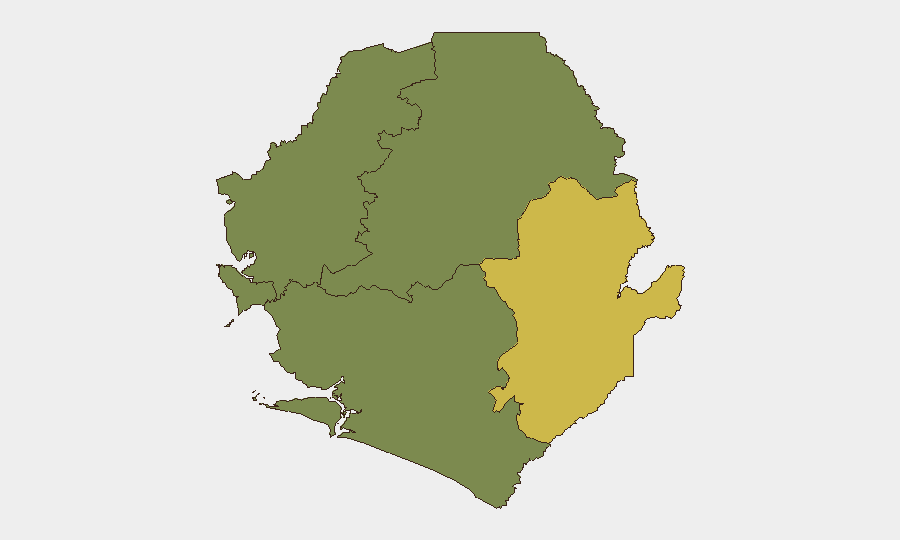
Situation Summary
Sierra Leone remains a low-to-moderate global security concern (rank #106, composite threat score 8) with minimal acute incident activity in the current reporting window. The country's security posture is substantially driven by concentrated risk in the Eastern Province, where governance, resource, and intercommunal tensions persist. Overall trajectory shows stability, though localized vulnerabilities in the east require sustained monitoring to prevent escalation.
Key Developments
No independently corroborated acute security incidents were verified in Sierra Leone during the last 24–48 hours. Unverified social media reports of a weapons seizure at a checkpoint in Kambia (North West Province) circulated online but lack corroborating news reporting or time-stamped sourcing and should not be treated as confirmed. Routine law-enforcement activity and community reporting continue but do not constitute a material shift in the security environment. The absence of confirmed recent events reflects a relatively stable near-term period, though underlying sub-national risk drivers remain in place.
Highest-Risk Areas
Eastern Province dominates Sierra Leone's risk landscape (composite score 68), accounting for the majority of tracked national concern. This region's elevated risk stems from historical communal tensions, resource competition, weak state presence in remote districts, and limited formal dispute-resolution capacity—factors that create conditions for localized conflict and criminal activity. Western Area (risk 35), which includes Freetown and surrounding zones, carries secondary risk driven by urbanization, crime, and transient instability. The three northern and southern provinces register minimal current risk scores, indicating more stable governance and lower immediate incident likelihood, though this should not be interpreted as immunity to future volatility.
How GeoBit Would Assist
Security teams with personnel or assets in Sierra Leone should employ Intel Sweep and multi-language OSINT to detect emerging tensions or incident signals in Eastern Province before they escalate. AOI Monitoring & Early Warning on identified districts in the east (e.g., Kailahun, Kenema) would provide persistent surveillance and real-time alerting if violence, displacement, or intercommunal activity accelerates. Routing & Network Analysis can support duty-of-care planning by identifying secure transit corridors around high-risk zones and calculating contingency movement options for personnel in or near Western Area. Conflict & Military capability and regime-stability assessment help corporate teams understand whether localized eastern tensions could trigger national-level instability.
7-Day Outlook
Sierra Leone's security environment is expected to remain broadly stable over the next seven days, with no indicators of imminent national-level incidents or sudden escalation. Eastern Province risk warrants continued baseline monitoring but does not suggest an acute crisis threshold. Teams should maintain standard duty-of-care protocols and update risk assessments if verified incident reporting emerges from the east or if social-media signals coalesce around corroborated incidents.
Highest-Risk Areas — Ranked
| # | State / Region | Risk |
|---|---|---|
| 1 | Eastern Province | 68 |
| 2 | Western Area | 35 |
| 3 | North West Province, Sierra Leone | 0 |
| 4 | Northern Province, Sierra Leone | 0 |
| 5 | Southern Province, Sierra Leone | 0 |
Sources
Previous Daily Briefs
A new Sierra Leone brief is written every day — each with its own risk map and downloadable CSV. Here's the last week; use the calendar to go further back.
📅 Browse every day by calendar →
Highlighted days have a brief. Tap a day for that day's map & analysis, or “csv” for that day's dataset ($5).
Atlas — our AI intelligence desk — emails them this snapshot personally. Nothing else, no list.