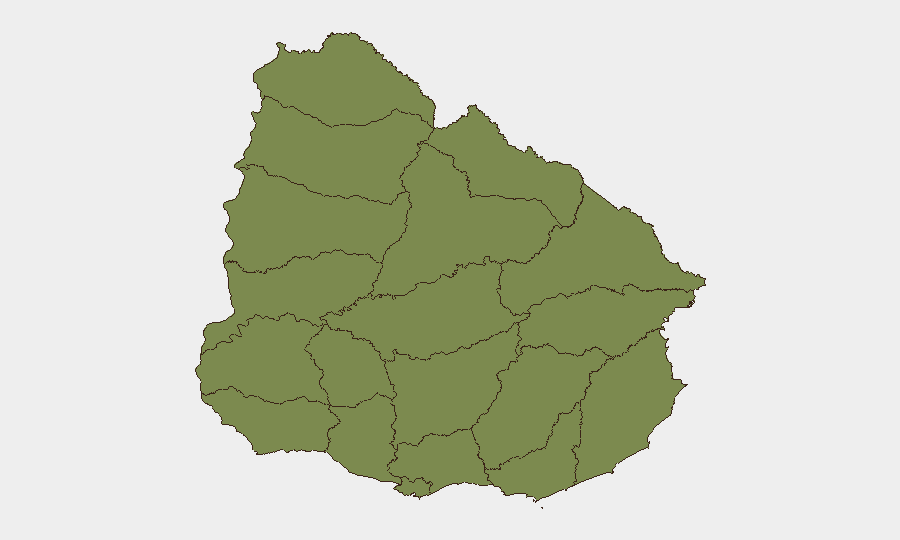
Situation Summary
Uruguay remains a low-threat operating environment globally (rank #154, composite score 5), with no credible reports of acute security incidents, civil unrest, infrastructure disruption, or travel-risk events in the last 24–48 hours. The country's security posture is stable relative to regional peers; routine crime and ongoing political discourse dominate the threat landscape. Risk concentration is extreme: Durazno department accounts for 89% of tracked events and a risk score 10× higher than the second-ranked region, suggesting localized rather than nationwide instability.
Key Developments
No credible, verifiable security, conflict, unrest, crime-spike, infrastructure, or travel-risk incidents have been documented in Uruguay in the last 24–48 hours beyond routine baseline activity. Open-source coverage (major news outlets, X/Twitter, regional media) for 9–11 July 2026 shows no events meeting the time and specificity threshold for inclusion in an active threat brief. Recent platform signals dated 9–11 July (diplomatic disapproval, judicial rejection, public statements by officials and business actors) reflect political and administrative processes, not documented security emergencies or operational threats to personnel or assets.
Highest-Risk Areas
Durazno department is the dominant risk driver, with a composite score of 31.5—substantially higher than all other regions. Paysandú (3.3) ranks second but at roughly one-tenth Durazno's risk level. The remaining ten departments cluster at risk 1.5, indicating that regional threat concentration is acute and localized. The nature of Durazno's elevated risk requires targeted intelligence focus; generalized national-level security measures are unlikely to address department-specific drivers. All other regions present minimal incremental risk beyond baseline.
How GeoBit Would Assist
Teams with personnel or assets in Durazno or Paysandú should activate AOI Monitoring & Early Warning on those departments to detect emerging incidents in real time and receive automated alerts. Intel Sweep and OSINT fusion (X/Twitter, Telegram, YouTube, multi-language news feeds, entity extraction) provide continuous situational awareness of political, criminal, and administrative developments at sub-national granularity. For route planning or facility hardening, Routing & Network Analysis and GIS & Spatial Analysis support alternative journey planning and risk-mapped site assessment, particularly in higher-risk departments.
7-Day Outlook
No imminent escalation is evident from available intelligence. The trajectory remains stable unless recent political statements (9–11 July) generate secondary protest activity or enforcement action in the coming week. Continuous monitoring of Durazno and Paysandú is warranted; broader national risk is expected to remain low and routine.
CONFIDENCE LEVEL: High (based on comprehensive open-source monitoring; no verified closed-source reporting available).
NEXT REVIEW: 2026-07-12
Highest-Risk Areas — Ranked
| # | State / Region | Risk |
|---|---|---|
| 1 | Durazno | 31.5 |
| 2 | Paysandú | 3.3 |
| 3 | Artigas | 1.5 |
| 4 | Salto | 1.5 |
| 5 | Rivera | 1.5 |
| 6 | Tacuarembó | 1.5 |
| 7 | Soriano | 1.5 |
| 8 | Colonia | 1.5 |
| 9 | Río Negro | 1.5 |
| 10 | Flores | 1.5 |
| 11 | San José | 1.5 |
| 12 | Florida | 1.5 |
Sources
Previous Daily Briefs
A new Uruguay brief is written every day — each with its own risk map and downloadable CSV. Here's the last week; use the calendar to go further back.
📅 Browse every day by calendar →
Highlighted days have a brief. Tap a day for that day's map & analysis, or “csv” for that day's dataset ($5).
Atlas — our AI intelligence desk — emails them this snapshot personally. Nothing else, no list.