Situation Summary
Uzbekistan remains a low-threat environment (global rank #146, composite score 5) with no credible reports of protests, armed conflict, infrastructure failures, or traveler-targeted violence in the last 24–48 hours. The security picture is characterized as baseline stable across all 12 provinces. The government is conducting a proactive, nationwide "Safe and Healthy Country" operational-preventive campaign, with recent successes announced against organized cyber-fraud networks, indicating strong law-enforcement posture rather than response to acute instability.
Key Developments
- Tashkent, Mirabad District – 14 July 2026, 10:00
Ministry of Internal Affairs held a public press conference at the Palace of Culture presenting results from the first ten days of the second phase of the nationwide "Safe and Healthy Country" security campaign, underscoring government focus on public order and internal security operations.
- Tashkent, Yashnobod District – announced 14 July 2026
Interior Ministry and State Security Service disrupted a large cyber-fraud call center on the 6th floor of a business center, detaining 97 people (including 5 foreign nationals) engaged in scams targeting European and North American citizens. This represents the campaign's most significant reported organized-crime disruption to date.
- Tashkent, Yakkasaroy District – announced 14 July 2026
Law-enforcement agencies uncovered a second fraudulent call center on the 11th floor of a separate business center, with 34 workers (including 3 foreign nationals) operating investment and cryptocurrency scams targeting foreign victims. Both operations were dismantled without reported violence or public disorder.
- Uzbekistan nationwide – status update 14 July 2026
No new security, conflict, crime, or infrastructure incidents reported in the preceding 48 hours. All provinces, including Tashkent, remain classified as baseline, low-threat, with no protests, demonstrations, intercommunal tension, or forecast deterioration anticipated over the near term.
Highest-Risk Areas
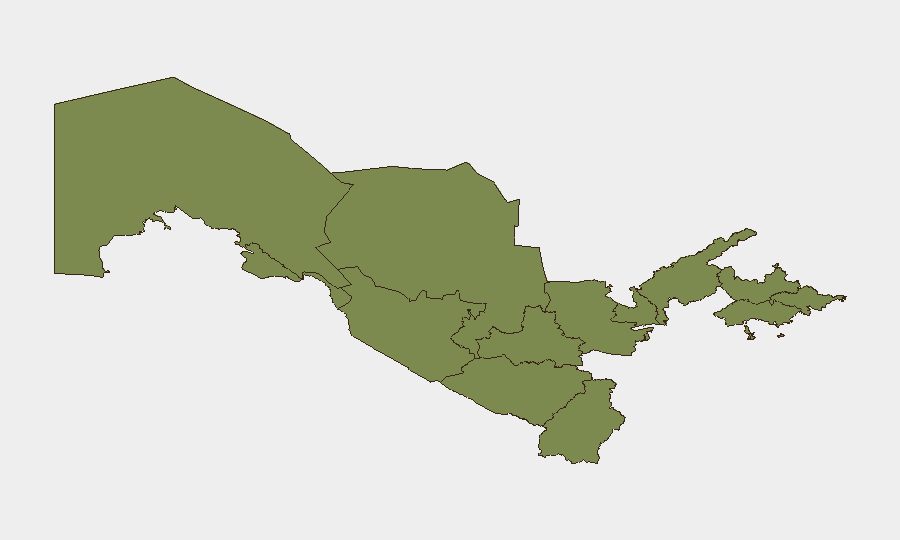
Navoiy Region is substantially elevated above all other administrative divisions (risk score 31.5 vs. 3.1 for Tashkent and 1.5 for all remaining regions), though specific incident details are not resolved in available open-source reporting. Tashkent city, despite being the capital and largest urban center, carries risk score 3.1—significantly lower than Navoiy but reflecting concentrated population, critical infrastructure, and a higher density of organized-crime operations (as evidenced by the cyber-fraud network disruptions announced 14 July). All remaining ten provinces carry identical baseline risk (1.5), indicating neither comparative vulnerability nor recent destabilizing activity. The concentration of detected incident signals in Tashkent reflects law-enforcement activity rather than instability; escalated activity in Navoiy warrants monitoring for contextual drivers (economic disruption, resource competition, or border-adjacent factors) that open-source reporting has not yet clarified.
How GeoBit Would Assist
Security teams should deploy AOI (Area of Interest) Monitoring & Early Warning on Navoiy Region and Tashkent's business districts to track emerging organized-crime, cyber, or civil-order signals; pair this with multi-language OSINT & social-media monitoring (X, Telegram, local platforms in Uzbek/Russian) to detect early indicators of labor unrest, trafficking networks, or infrastructure vulnerability. Network & Actor Analysis on the newly disrupted fraud rings can help identify remaining affiliated cells or international co-conspirators affecting corporate or traveler exposure. Quarterly Risk & Threat Assessment updates incorporating economic and border-stability data will clarify Navoiy's elevated baseline.
7-Day Outlook
No significant security deterioration is anticipated in the next 7 days. The "Safe and Healthy Country" campaign is likely to continue with routine announcements of law-enforcement successes, sustaining the current baseline-stable picture. Routine corporate and traveler security protocols in Tashkent and other urban centers remain appropriate; no enhanced measures are warranted based on current trajectory.
Highest-Risk Areas — Ranked
| # | State / Region | Risk |
|---|---|---|
| 1 | Navoiy Region | 31.5 |
| 2 | Tashkent | 3.1 |
| 3 | Qashqadaryo Region | 1.5 |
| 4 | Surxondaryo Region | 1.5 |
| 5 | Fergana Region | 1.5 |
| 6 | Republic of Karakalpakstan | 1.5 |
| 7 | Xorazm Region | 1.5 |
| 8 | Bukhara Region | 1.5 |
| 9 | Jizzakh Region | 1.5 |
| 10 | Tashkent Region | 1.5 |
| 11 | Namangan Region | 1.5 |
| 12 | Sirdaryo Region | 1.5 |
Sources
Previous Daily Briefs
A new Uzbekistan brief is written every day — each with its own risk map and downloadable CSV. Here's the last week; use the calendar to go further back.
📅 Browse every day by calendar →
Highlighted days have a brief. Tap a day for that day's map & analysis, or “csv” for that day's dataset ($5).
Atlas — our AI intelligence desk — emails them this snapshot personally. Nothing else, no list.