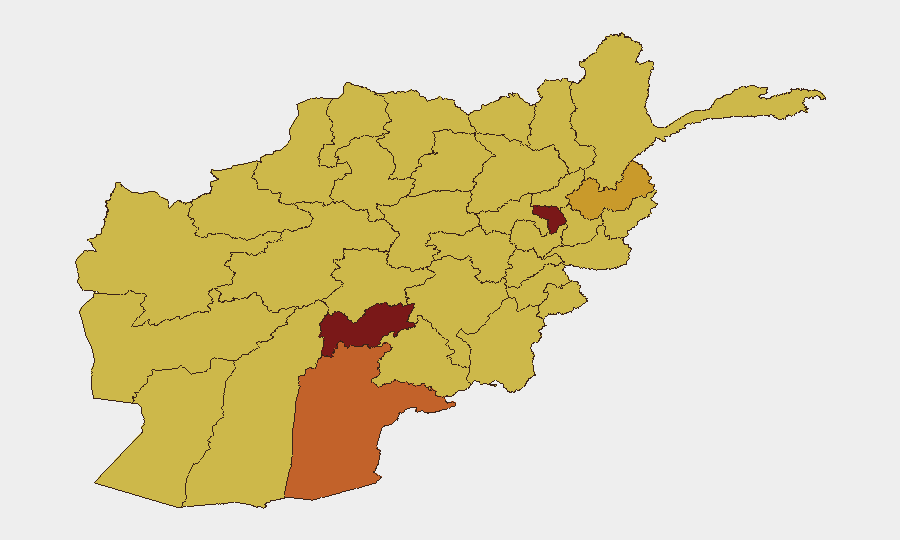
Situation Summary
Afghanistan remains the sixth-highest-threat country globally, driven primarily by ongoing insurgent activity across 39 tracked incidents. The security environment is characterized by fragmented but persistent violence spanning conventional military clashes, small-arms combat, and unconventional attacks, with significant regional variation in risk. Recent developments point to cross-border tensions with Pakistan, severe weather disruption affecting multiple provinces, and continued internal security pressures. The trajectory remains volatile with no near-term stabilization signals.
Key Developments
- Pakistan–Afghanistan border escalation (last 48 hours): Ground operations and retaliatory strikes reported along the border following cross-border fighting that resulted in dozens killed; a 48-hour ceasefire was announced, but risk of renewal remains high given historical pattern of border friction.
- Severe weather event (last 48 hours): Damage across at least eight provinces reported by Afghan disaster agency, including destroyed homes, compromised road infrastructure, and farmland loss; exact provinces not fully specified in available reporting, but compound humanitarian and security access risks.
- Iran–Afghanistan deportations (last 48 hours): Confirmed flows of deportees from Iran crossing into Afghanistan via Torkham and Spin Boldak border crossings, adding to internal displacement and humanitarian pressures.
- Unconventional violence incident (2026-06-27): One event classified as unconventional violence involving an Afghan actor recorded; location and targeting specifics not detailed in current reporting.
- Arrest/detention activity (2026-06-28): Law enforcement action against an unspecified culprit; judicial involvement also noted in separate detentions (2026-06-27), suggesting ongoing criminal or security-related law enforcement activity.
- Small-arms combat (2026-06-28): Active small-arms engagement reported; location not specified in available signals.
- Demand escalations (2026-06-28): Multiple demand events from Afghanistan against American and community-level actors; nature and specific locations not clarified in current reporting.
Highest-Risk Areas
Uruzgan Province remains the acute epicenter (composite risk 100), followed by Kapisa (86.3) and Kandahar (75.8), which together represent the primary drivers of national threat. The southern and eastern provinces—Kandahar, Helmand, Paktika, and Zabul—form a persistent high-risk belt linked to known insurgent sanctuaries and cross-border movement from Pakistan. Kapisa's elevated ranking reflects its proximity to Kabul and regional instability. Ten provinces cluster at identical risk scores (70), indicating widespread dispersal of threat and limited safe corridors outside the capital region.
How GeoBit Would Assist
Security teams should employ AOI Monitoring & Early Warning to establish persistent surveillance on highest-risk provinces (Uruzgan, Kapisa, Kandahar) with automated alerting on violence, movement, and crowd activity. Intel Sweep and OSINT fusion capabilities—including X/Telegram monitoring, multi-language search, and entity extraction—enable real-time tracking of actor statements, group mobilization, and cross-border signals. Conflict mapping and satellite/imagery analysis provide geospatial corroboration of reported incidents and assess infrastructure security (roads, border crossings) relevant to duty-of-care and evacuation planning.
7-Day Outlook
The Pakistan border flare-up and ceasefire are likely to hold short-term but remain fragile; any major cross-border incident would trigger rapid escalation. Severe weather recovery will stretch Afghan disaster response capacity and create secondary security voids. Expect continued low-to-mid-level insurgent activity in southern and eastern provinces with opportunistic small-arms engagements; no major military offensive is signaled in current reporting, but the diffuse nature of threats makes localized surges probable without warning.
Highest-Risk Areas — Ranked
| # | State / Region | Risk |
|---|---|---|
| 1 | Uruzgan Province | 100 |
| 2 | Kapisa Province | 86.3 |
| 3 | Kandahar Province | 75.8 |
| 4 | Nuristan Province | 71 |
| 5 | Zabul Province | 70 |
| 6 | Ghazni Province | 70 |
| 7 | Paktika Province | 70 |
| 8 | Farah Province | 70 |
| 9 | Nimruz Province | 70 |
| 10 | Helmand Province | 70 |
| 11 | Jowzjan Province | 70 |
| 12 | Balkh Province | 70 |
Sources
Previous Daily Briefs
A new Afghanistan brief is written every day — each with its own risk map and downloadable CSV. Here's the last week; use the calendar to go further back.
📅 Browse every day by calendar →
Highlighted days have a brief. Tap a day for that day's map & analysis, or “csv” for that day's dataset ($5).