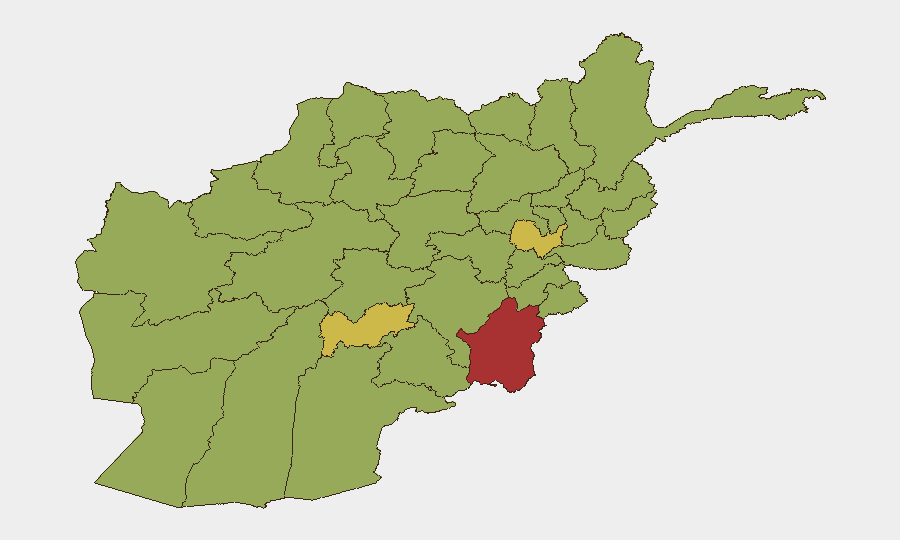
Situation Summary
Afghanistan remains a moderately elevated security environment (global rank #29, composite threat score 71) with acute risk concentrated in its eastern and southern border provinces. A significant escalation in cross-border strikes between Pakistan and Afghanistan over the past 48 hours has introduced immediate civilian casualty risk and underscores fragile state-to-state relations. New Pakistani detention orders affecting undocumented Afghan nationals (effective 10 July) add administrative travel disruption. The security posture is trending toward cyclical tit-for-tat militant and state action rather than systemic destabilization at present.
Key Developments
- Paktia, Paktika, and Kunar provinces (2026-06-29/30): Pakistani military conducted cross-border strikes against alleged militant targets; Taliban and UNAMA both reported civilian casualties and secondary strikes on rescue workers. Civilian harm was documented and verified by UN sources.
- Mandukhel village, Chamanai district, Paktia province (2026-06-29/30): Reported secondary bombing of civilian rescue operations following initial Pakistani airstrike, consistent with broader cross-border operation pattern.
- Bajaur district, Pakistan–Afghanistan border (2026-06-29/30): Pakistani security forces conducted ground intelligence operation before follow-on aerial strikes into Afghanistan, indicating multi-phase coordinated action.
- Afghanistan–Pakistan border region (2026-06-30): UN Secretary-General issued urgent call for cessation of hostilities, signaling international concern about escalation trajectory and civilian exposure.
- Pakistan nationwide (2026-06-29, effective 2026-07-10): Pakistan Interior Ministry ordered detention of undocumented Afghan nationals beginning 10 July, creating administrative and movement risk for Afghan transit populations and those without valid visas.
- Cross-border retaliation cycle (2026-06-29/30): Multiple sources confirm escalation follows prior militant attacks on Pakistani security forces, indicating likelihood of continued tit-for-tat operations over the near term.
Highest-Risk Areas
Paktika, Uruzgan, and Kabul provinces (composite risk scores 79.9, 65.5, and 63.3 respectively) drive the national threat profile. Paktika's dominance reflects sustained militant activity, porous borders, and active cross-border strikes—a pattern underscored by the current Pakistani military operations. Uruzgan and Kabul combine insurgent presence with administrative and economic activity, making them targets for both militant and state action. The eastern corridor (Kunar, Nangarhar, Parwan) and southern belt (Helmand, Kandahar, Zabul) all carry composite scores above 50, reflecting endemic instability and militant sanctuary. Organizations with personnel or assets in Paktika, Uruzgan, or Kabul should prioritize heightened monitoring and contingency review.
How GeoBit Would Assist
Security teams would deploy AOI Monitoring & Early Warning with persistent watch on Paktika, Uruzgan, and Kabul provinces to trigger alerts on hostile activity, civilian harm events, and security force movements. Intel Sweep and OSINT fusion (X/Twitter, Telegram, local media) would track cross-border strike patterns, Taliban statements, and Pakistani military operations in real time. Network & Actor Analysis would map militant and state-actor relationships to anticipate retaliation cycles. Routing & Network Analysis would provide alternative journey planning for staff transiting Pakistan–Afghanistan border zones, accounting for the new 10 July detention order.
7-Day Outlook
Cross-border tensions will likely remain elevated through mid-July as Pakistan and Taliban-led Afghanistan continue reactive strikes and counter-operations. The 10 July detention order will disrupt transit for undocumented Afghans and complicate logistics for organizations reliant on border-crossing operations. Civilian exposure in Paktika, Paktia, and Kunar will remain acute; de-escalation appears unlikely without third-party mediation.
Highest-Risk Areas — Ranked
| # | State / Region | Risk |
|---|---|---|
| 1 | Paktika Province | 79.9 |
| 2 | Uruzgan Province | 65.5 |
| 3 | Kabul Province | 63.3 |
| 4 | Parwan Province | 52.7 |
| 5 | Nangarhar Province | 51.4 |
| 6 | Kunar Province | 50.8 |
| 7 | Helmand Province | 50.3 |
| 8 | Zabul Province | 49.9 |
| 9 | Kandahar Province | 49.9 |
| 10 | Ghazni Province | 49.9 |
| 11 | Farah Province | 49.9 |
| 12 | Nimruz Province | 49.9 |
Sources
Previous Daily Briefs
A new Afghanistan brief is written every day — each with its own risk map and downloadable CSV. Here's the last week; use the calendar to go further back.
📅 Browse every day by calendar →
Highlighted days have a brief. Tap a day for that day's map & analysis, or “csv” for that day's dataset ($5).