Situation Summary
Afghanistan remains the 7th highest-threat country globally, with insurgency as the primary driver and 81 tracked events in the monitoring period. Cross-border military operations by Pakistan into eastern Afghan provinces on 29 June have triggered a significant escalation in tensions, with competing casualty claims and allegations of civilian harm. Concurrently, anti-Taliban insurgent activity continues in the northeast, signaling ongoing fragmentation of the security landscape. The trajectory reflects sustained high-intensity risk concentrated in eastern border zones and select central provinces.
Key Developments
- Cross-border Pakistani airstrikes, eastern Afghanistan (Kunar, Paktia, Paktika) – 29 June 2026
Pakistani military conducted ground operations and airstrikes targeting alleged TTP hideouts along the Afghanistan–Pakistan border. Pakistani officials reported ~29 killed; Afghan government claims at least 36 civilian deaths and 163 injured. Social media footage from villagers corroborates destruction of homes and civilian infrastructure in border districts.
- Afghan diplomatic protest – 29 June 2026
Kabul summoned Pakistan's chargé d'affaires, alleging violation of Afghan airspace and bombing of civilian areas. UN OCHA and Afghan sources report ongoing cross-border strikes killing civilians and destroying livelihoods across multiple border districts.
- Pakistani military escalation announcement – 29 June 2026
Pakistan's military announced new "major intelligence-based operations" (IBOs) along the Pak-Afghan border, targeting militant networks operating from or near Afghan territory. Officials linked 29 June strikes to perpetrators of the recent Karachi Rangers headquarters attack, increasing risk of further retaliatory operations.
- Anti-Taliban insurgent activity, Badakhshan – 29 June 2026
The Afghanistan Freedom Front (AFF) claimed an attack on a Taliban military base in Badakhshan province. No independent confirmation of casualties; claim underscores persistent anti-Taliban resistance in Afghanistan's northeast.
- Ministerial and government statements – 29 June 2026
Multiple high-level disapprovals and administrative sanctions recorded, indicating significant diplomatic friction and potential governance instability.
Highest-Risk Areas
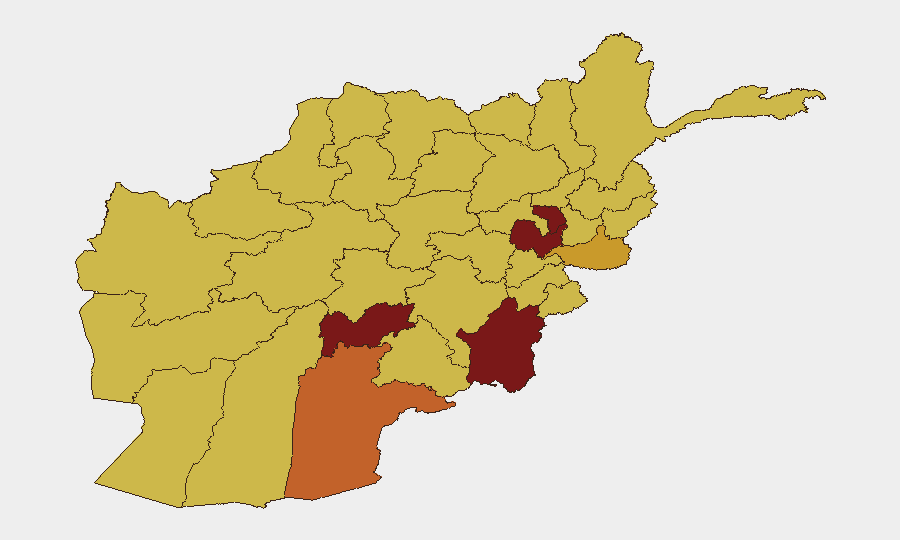
Uruzgan Province holds the highest composite risk score (100), followed closely by Paktika (89.3) and Kabul (88.7). Eastern border provinces—particularly Paktika, Paktia, and Kunar—are experiencing acute escalation due to Pakistani cross-border operations and unresolved casualty disputes. Kandahar, Nangarhar, Helmand, and Zabul remain persistently high-risk due to entrenched insurgent and militant networks. Kabul's elevated score reflects both direct attack risk and governance/diplomatic instability. The concentration of risk in the east and south reflects Taliban control challenges, cross-border militant activity, and regional military intervention.
How GeoBit Would Assist
Security teams should deploy AOI Monitoring & Early Warning on Uruzgan, Paktika, and eastern border districts to track cross-border operations and insurgent movements in real time. Network & Actor Analysis combined with multi-language OSINT (X, Telegram, YouTube) enables rapid identification of threat actor statements, casualty claims, and retaliatory intent signaling. GIS & Spatial Analysis and satellite imagery capability would support route planning and asset positioning away from active strike zones and conflict hotspots, while Conflict & Military battle mapping tracks force positioning and tactical developments in high-risk provinces.
7-Day Outlook
Pakistani cross-border operations are likely to continue or escalate given the stated link to the Karachi Rangers attack and the announced IBO campaign. Kabul's diplomatic protests and casualty claims create risk of further Afghan government–Pakistan tension and potential secondary incidents along the border belt. Anti-Taliban insurgent activity may increase opportunistically as Taliban forces respond to external pressure, raising overall volatility in central and northeastern provinces through early July.
Highest-Risk Areas — Ranked
| # | State / Region | Risk |
|---|---|---|
| 1 | Uruzgan Province | 100 |
| 2 | Paktika Province | 89.3 |
| 3 | Kabul Province | 88.7 |
| 4 | Kapisa Province | 80.7 |
| 5 | Kandahar Province | 73.8 |
| 6 | Nangarhar Province | 72.9 |
| 7 | Helmand Province | 70.2 |
| 8 | Zabul Province | 70 |
| 9 | Ghazni Province | 70 |
| 10 | Farah Province | 70 |
| 11 | Nimruz Province | 70 |
| 12 | Jowzjan Province | 70 |
Sources
Previous Daily Briefs
A new Afghanistan brief is written every day — each with its own risk map and downloadable CSV. Here's the last week; use the calendar to go further back.
📅 Browse every day by calendar →
Highlighted days have a brief. Tap a day for that day's map & analysis, or “csv” for that day's dataset ($5).