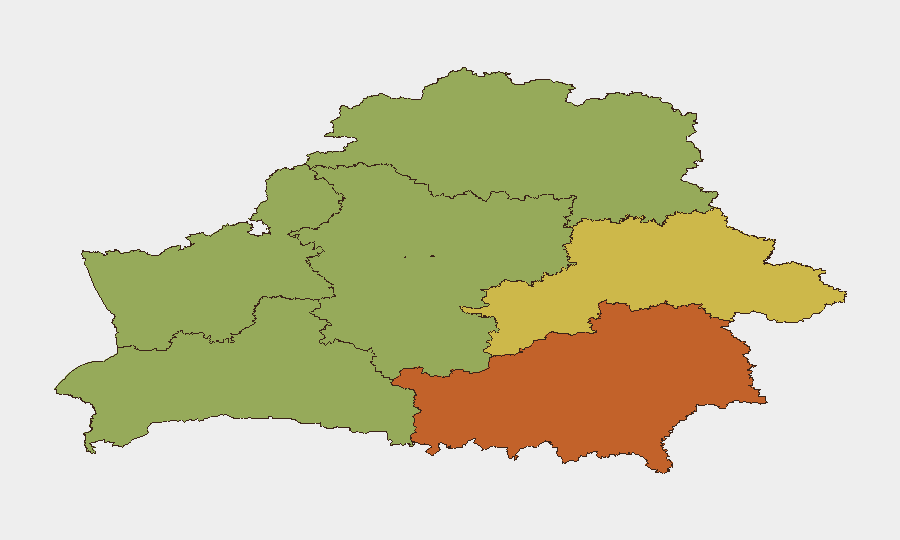
Situation Summary
Belarus remains a low-threat country overall (rank #143 globally) with no major kinetic incidents on its territory in the reporting period, but its role as a transit corridor and enabler of Russian operations against Ukraine—combined with elevated NATO activity on its borders—sustains moderate regional tension. Military exercises near Poland and Lithuania, drone repeater reactivation supporting Russian strikes into Ukraine, and a UAV border incursion into Lithuanian airspace reflect a security posture oriented toward Russian alignment rather than independent threat generation. The country's internal stability remains intact, with reported incidents limited to routine traffic accidents and civil emergencies.
Key Developments
- Western Belarus (border training areas, 15–18 September). Belarus conducted four-day command-and-staff exercises involving mechanized and tank battalions of the Western Operational Command near Poland and Lithuania, practicing border defense, counter-sabotage, and UAV/aircraft repulsion. Minsk claimed drills remained below Vienna Document notification thresholds.
- Lithuania–Belarus airspace (night of 14–15 September, diplomatic action 16 September). Lithuania's Foreign Ministry summoned a Belarusian diplomat and delivered a protest note over an incursion of a UAV from Belarusian territory into Lithuanian airspace and state border, demanding explanation and preventive measures.
- Belarus territory (16–21 September). Open-source conflict monitors reported reactivation of signal repeaters on Belarusian soil used to guide Russian "Shahed" and "Geran" drones deeper into Ukraine (Rivne, Volyn, Lviv regions). This reflects expanded Belarusian facilitation of Russian strikes but no domestic kinetic activity.
- NATO eastern flank (19 September). Multiple open-source alert services reported rapid NATO ground-unit movements toward Belarus borders in Latvia and Lithuania on 19 September, citing Latvian intelligence warnings of potential Russian special-forces incursions via Belarus, particularly targeting the Suwałki Corridor. No confirmed Belarusian offensive action accompanied these movements.
- Poland–Belarus border (18 September). Poland extended a 60-day suspension of asylum applications at its Belarus border, citing repeated "direct attacks" by Belarusian personnel against Polish officers (firearms, stones, lasers) and ongoing migration pressure. The measure restricts humanitarian and travel access.
- Minsk national prison system (16 September). Belarus released 25 prisoners described as political detainees in exchange for partial U.S. sanctions relief and asset unfreezing. The swap, confirmed by U.S. envoy John Coale, reflects ongoing negotiations over political detentions and sanctions.
- Minsk urban area (20 September). A taxi crashed into a pole in Minsk—a routine traffic incident with no indicators of political motivation or wider unrest.
- Gomel Region (19–20 September). Belarus's Emergency Ministry recorded one forest fire in Yelsk District and one peat fire, along with 19 technogenic emergencies nationwide and four rescues. Standard civil-protection incidents with localized impact only.
- Brest Region and Minsk (20 September). Two fatal motor-vehicle accidents reported: a BMW driver in Bohdanovka (Luninets District) and a second collision in Minsk. Both classified as routine traffic incidents.
- National military posture (20–21 September). Assessments of Russian–Ukrainian war developments recorded no new Russian military presence or major escalation in Belarus beyond previously announced exercises.
Highest-Risk Areas
Homyel Region (risk 75) and Minsk (risk 68) dominate Belarus's internal risk profile, driven by proximity to conflict zones, infrastructure density, and concentration of state security apparatus. Mahilyow Region (62) and Brest Region (55) show elevated risk tied to border proximity and migration pressure, particularly along the Polish frontier. Southern and eastern regions near Ukraine and Russia carry heightened exposure to spillover, drone activity, and irregular-migration flows; western regions near NATO borders face exercise-related and perception-driven tension despite no confirmed hostile activity.
How GeoBit Would Assist
Security teams should employ Intel Sweep with multi-language OSINT fusion to track Belarusian military posture, drone repeater activation, and border incidents in real time. AOI Monitoring & Early Warning on Homyel, Minsk, and western border zones would provide persistent alerting on exercise activity, cross-border incursions, and NATO movements. Network & Actor Analysis of Belarusian security services and Routing & Network Analysis for alternative crossing points would support duty-of-care planning for personnel and supply chains.
7-Day Outlook
Belarusian military exercises are expected to conclude; NATO movements will likely normalize absent further Russian escalation signals. Border tension with Poland and Lithuania will persist owing to migration flows and historical friction, but no imminent kinetic outbreak is indicated. Continued low-level Belarusian facilitation of Russian drone operations should be expected as the baseline for the medium term.
Highest-Risk Areas — Ranked
| # | State / Region | Risk |
|---|---|---|
| 1 | Homyel Region | 75 |
| 2 | Minsk | 68 |
| 3 | Mahilyow Region | 62 |
| 4 | Brest Region | 55 |
| 5 | Hrodna Region | 52 |
| 6 | Minsk Region | 48 |
| 7 | Vitsebsk Region | 45 |
Sources
Previous Weekly Briefs
A new Belarus brief is written every Monday, covering the week — each with its own risk map and downloadable CSV. Use the calendar to go further back.
- September 15, 2026
- September 8, 2026
- September 1, 2026
- August 30, 2026
- August 28, 2026
- August 26, 2026
- August 24, 2026
📅 Browse past briefs by calendar →
Highlighted days have a brief. Tap a day for that day's map & analysis, or “csv” for that day's dataset ($5).
Atlas — our AI intelligence desk — emails them this snapshot personally. Nothing else, no list.