Situation Summary
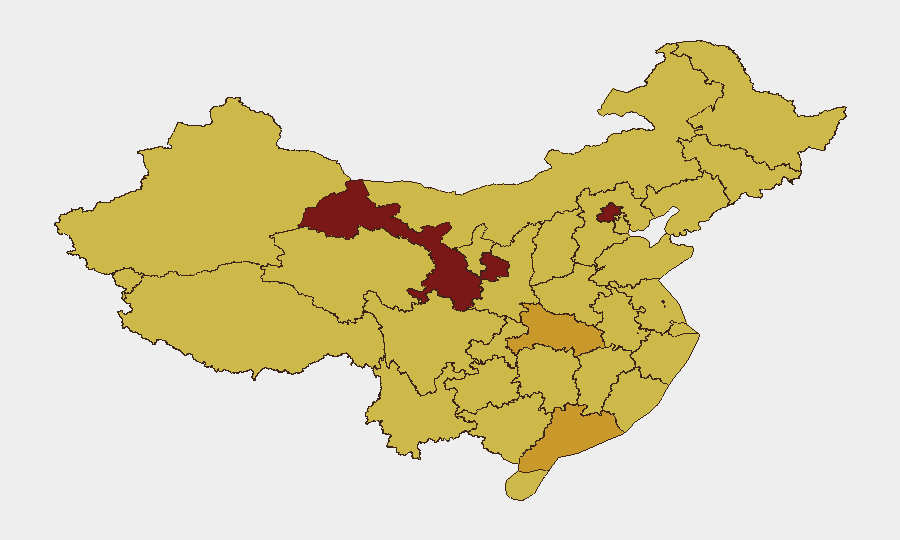
China maintains a composite threat score of 97 (rank #11 globally) with 678 tracked events. Recent signals reflect diplomatic friction with Western allies (US, UK, Germany, EU) and domestic governance tensions, though no verified security incidents or civil unrest have been independently confirmed in the past 24–48 hours. Threat concentration remains heavily weighted toward Gansu (97.6) and Beijing (89.7), with secondary clustering across coastal and central manufacturing hubs. The current trajectory reflects sustained international friction without evidence of acute domestic destabilization, though monitoring windows remain open given data lag and regional opacity.
Key Developments
- 2026-06-30 · Diplomatic Response: China issued public statements responding to Western disapproval (US, UK, Germany, EU all signaled disapproval on 2026-06-29). Statements were directed toward US and EU administrations, suggesting coordinated Western pushback on an unspecified policy or conduct issue.
- 2026-06-30 · Financial/Fiscal Signal: A demand event between China and its Ministry of Finance recorded; nature and severity unclear from available reporting, but suggests internal budgetary or fiscal tension.
- 2026-06-30 · Rejection: China recorded a rejection action; context and target entity not specified in available data.
- 2026-06-30 · Territorial Claim/Dispute: A company initiated or triggered an "occupy territory" action against China, potentially indicating a commercial, jurisdictional, or disputed-asset incident; requires urgent clarification via targeted OSINT.
- 2026-06-28 · Detention Events: Two arrest/detain actions recorded—one general China event and one involving China Mobile in Hubei Province—suggesting law-enforcement or regulatory action; scope and nationality of detainees unknown.
- 2026-06-30 · Threat Signal: China recorded a threat action; target and intent remain unspecified in signal summary.
*Note: Independent verification of these events via open-source multi-language feeds and social-media OSINT has not yet produced corroborating detail. Lag in source availability and Chinese information controls limit real-time transparency.*
Highest-Risk Areas
Gansu and Beijing dominate the risk landscape, with Gansu's composite score (97.6) indicating acute and persistent exposure—likely driven by border instability, resource-sector volatility, or ethnic/administrative tensions documented over longer timeframes. Beijing's score (89.7) reflects political sensitivity, dense foreign-national presence, and central-government decision volatility. Secondary-tier risk (Guangdong, Hubei, Jiangsu, Zhetang, Shanghai, Anhui, Chongqing) clusters across manufacturing, trade, and financial centers where corporate personnel and supply-chain dependencies concentrate; the detention of China Mobile personnel in Hubei warrants monitoring for regulatory or infrastructure-sector escalation. Shanghai and Zhejiang, despite lower absolute scores, host significant multinational corporate operations and require continuous watch for policy shifts or cross-strait incidents.
How GeoBit Would Assist
Security teams should deploy AOI Monitoring & Early Warning on Gansu, Beijing, and coastal manufacturing hubs to detect emerging instability signals in real time. Multi-language Intel Sweep and X/Twitter & Telegram OSINT combined with entity extraction will clarify the nature and scope of the detention events, the "occupy territory" incident, and Western diplomatic pressure. Network & Actor Analysis will map relationships between Ministry of Finance actions, China Mobile, and potential regulatory enforcement; economic & trade tracking will contextualize any fiscal demand signals.
7-Day Outlook
Diplomatic tension with the West is likely to persist over the near term without marked de-escalation signals. Domestic regulatory actions (detentions, fiscal scrutiny) suggest possible tightening of state control over telecommunications and financial sectors; corporate operations in these domains face elevated compliance and personnel-safety risk. Close monitoring of Gansu and Beijing—and reactive watch on Hubei—is advised through the coming week.
Highest-Risk Areas — Ranked
| # | State / Region | Risk |
|---|---|---|
| 1 | Gansu | 97.6 |
| 2 | Beijing | 89.7 |
| 3 | Guangdong Province | 72.1 |
| 4 | Hubei | 71.3 |
| 5 | Jiangsu | 70.5 |
| 6 | Zhejiang | 69.4 |
| 7 | Shanghai | 69.2 |
| 8 | Anhui | 69.1 |
| 9 | Chongqing | 68.7 |
| 10 | Hunan | 68.4 |
| 11 | Tibet | 68.2 |
| 12 | Liaoning | 68.2 |
Sources
Previous Daily Briefs
A new China brief is written every day — each with its own risk map and downloadable CSV. Here's the last week; use the calendar to go further back.
📅 Browse every day by calendar →
Highlighted days have a brief. Tap a day for that day's map & analysis, or “csv” for that day's dataset ($5).