Situation Summary
France remains at composite threat level #39 globally with 231 tracked events, driven by elevated terrorism alerts ("vigilance renforcée") following Bastille Day celebrations and a weapons-discovery incident in the Paris suburbs on 18 July. The discovery of military-grade firearms near a synagogue in Sarcelles has triggered a counter-terrorism investigation and reinforced police/military deployment across major urban centers. The broader security posture reflects sustained concern around public gatherings, transport infrastructure, and crowded venues, with heightened activity expected to persist through major summer sporting events.
Key Developments
- Sarcelles (Val-d'Oise), 18 July, evening: Police evacuated approximately 300 residents after discovering a stolen vehicle containing an assault-style rifle, handgun, and military-grade weapon parked near a synagogue in a busy commercial and residential zone. The anti-terror prosecutor opened an investigation for terrorist criminal organization and weapons offenses; bomb-disposal units confirmed no explosives. This is the highest-profile incident in the current reporting window.
- Nationwide, 17–18 July: French authorities maintained elevated terrorism alert status with ~70,000 security personnel deployed across Paris, Lyon, Marseille and other major cities; reinforced checks and patrols continued around public events, transport hubs, and crowded areas. Multiple municipalities cancelled fireworks displays due to security constraints.
- Nancy (Meurthe-et-Moselle), 17 July, daytime: Street staff discovered a man in his twenties seriously injured from a chest stabbing on Place Stanislas (city center). Victim hospitalized with non-life-threatening injuries; prosecutors opened attempted-murder investigation. Short-term police presence elevated in the city center.
- Paris and inner suburbs, 14–15 July (night): Police arrested 141 people suspected of using mortar-style fireworks against officers during post-Bastille Day disturbances; part of broader crackdown on violent behavior and unauthorized pyrotechnics.
- Clermont-Ferrand (Puy-de-Dôme), 12 July (afternoon): A 34-year-old man arrested after attacking multiple people with a knife and attempting to assault responding police officers. Localized police presence elevated following the incident.
- Clermont-Ferrand (Puy-de-Dôme), 12 July (night): Five men aged 18–27 were shot and wounded (two seriously) near a known drug-dealing point; shooters remain at large. Authorities investigating as drug-related violent crime with heightened local enforcement activity.
Highest-Risk Areas
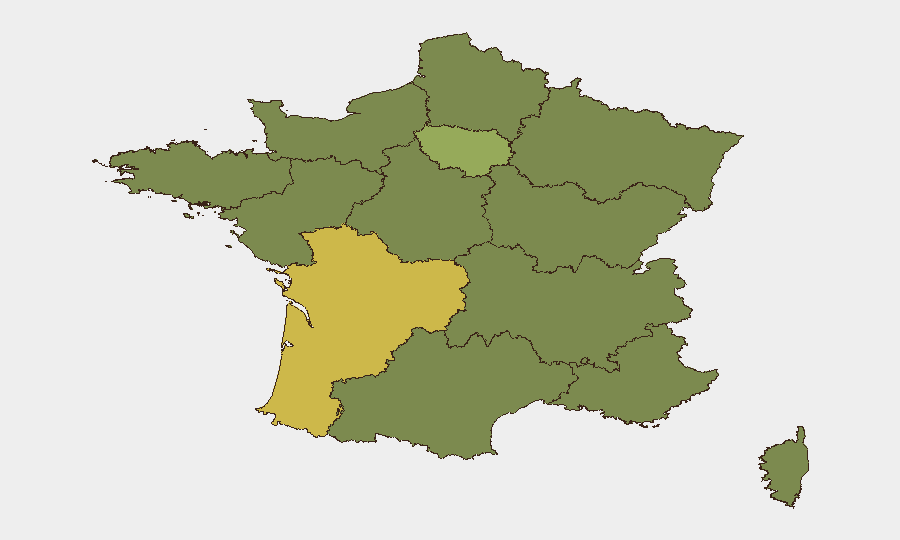
Nouvelle-Aquitaine (64.7) and Île-de-France (53.8) carry the highest composite threat scores, reflecting both terrorist concerns and street-level violence. Île-de-France encompasses the Paris metropolitan area where the Sarcelles weapons discovery and mass arrests occurred; Nouvelle-Aquitaine's elevation reflects broader instability indicators tracked across multiple event categories. Grand Est (36.0), Bourgogne–Franche-Comté (35.8), and Normandy (35.7) follow, indicating regional variance in terrorism signals, violent crime, and public-order incidents rather than uniform national distribution.
How GeoBit Would Assist
Security teams would employ Intel Sweep and multi-language OSINT (X/Twitter, Telegram, YouTube) to detect emerging threats and plot trajectories around major events in real time. AOI Monitoring & Early Warning with persistent geospatial focus on Paris, Lyon, Marseille and transport nodes would flag anomalies and incidents within hours. Entity extraction and network analysis across French-language threat communities and extremist channels would support detection of weapons procurement, radicalization activity, and pre-incident signaling ahead of public gatherings.
7-Day Outlook
The terrorism alert is likely to remain elevated through the end of July pending operational developments and intelligence assessment. Summer sporting events, stadium gatherings, and transport infrastructure will see sustained police and military presence. Episodic street violence (drug-related, post-celebration disorder) will continue in urban centers, particularly Île-de-France and major provincial cities.
Highest-Risk Areas — Ranked
| # | State / Region | Risk |
|---|---|---|
| 1 | Nouvelle-Aquitaine | 64.7 |
| 2 | Ile-de-France | 53.8 |
| 3 | Grand Est | 36 |
| 4 | Bourgogne – Franche-Comté | 35.8 |
| 5 | Normandy | 35.7 |
| 6 | Brittany | 35.2 |
| 7 | Hauts-de-France | 35 |
| 8 | Occitania | 34.9 |
| 9 | Centre-Val de Loire | 34.7 |
| 10 | Pays de la Loire | 34.7 |
| 11 | Auvergne-Rhône-Alpes | 34.7 |
| 12 | Provence-Alpes-Côte d'Azur | 34.7 |
Sources
Previous Daily Briefs
A new France brief is written every day — each with its own risk map and downloadable CSV. Here's the last week; use the calendar to go further back.
📅 Browse every day by calendar →
Highlighted days have a brief. Tap a day for that day's map & analysis, or “csv” for that day's dataset ($5).
Atlas — our AI intelligence desk — emails them this snapshot personally. Nothing else, no list.