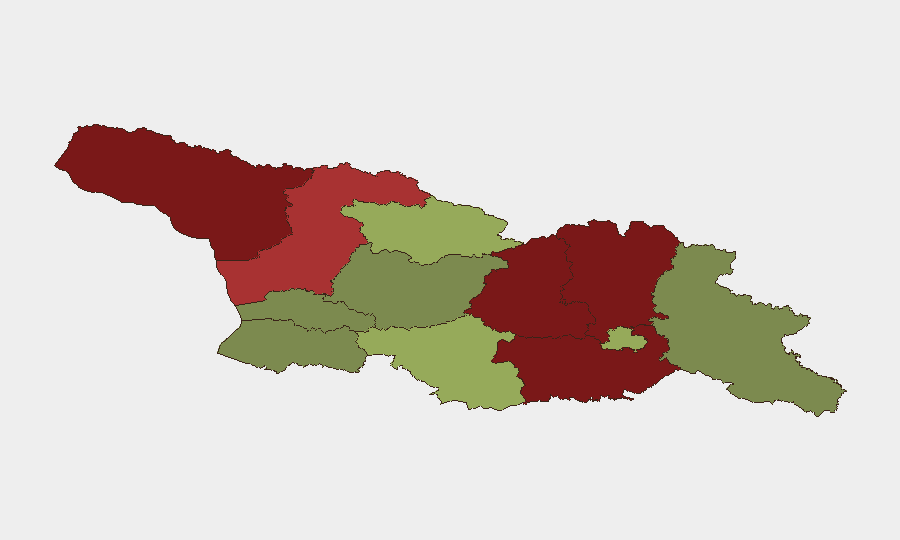
Situation Summary
Georgia remains a fragmented security environment, with threat intensity concentrated in the separatist-controlled north and Russian-aligned territories rather than in government-controlled population centers. The country's composite threat score of 14 reflects both chronic instability in contested regions and periodic criminal/infrastructure incidents in the core. Current intelligence indicates no discrete major incidents in the past 24–48 hours; however, persistent vulnerabilities in critical infrastructure and cross-border trafficking networks warrant sustained monitoring.
Key Developments
- Power grid sabotage investigation (Tbilisi, 24–25 July): Georgian authorities opened a formal sabotage probe into coordinated blackouts affecting the national power grid, signaling potential state or non-state actor targeting of critical infrastructure. Investigation status as of 5 August unknown.
- Drug trafficking arrests (Tbilisi, late July): Law enforcement announced arrests in a large-scale psychotropic-drug trafficking and money-laundering case; network scope and suspected sources remain under investigation.
- Methadone trafficking interdiction (Samegrelo–Zemo Svaneti, late July): Police arrested two Ukrainian nationals on methadone trafficking charges, consistent with ongoing transit-route vulnerability for narcotics from the Caucasus and Black Sea region.
- No acute military or terrorist incidents reported (past 48 hours): No credible reports of armed clashes, explosions, or major security incidents in government-controlled territory or the buffer zones as of reporting time.
- Routine international military exercise (Mukhrovani, eastern Georgia, date within last 7 days): The multinational special operations exercise Trojan Footprint 2026 commenced; standard NATO-allied interoperability activity with no security incident associated.
Highest-Risk Areas
The Autonomous Republic of Abkhazia (risk 95) and the Shida Kartli and Lower Kartli regions (88, 85) drive Georgia's sub-national threat profile. These territories remain either de facto independent (Abkhazia) or heavily disputed and subject to Russian military presence, creating sustained risks of armed confrontation, coercive integration, and limited rule of law. Mtskheta-Mtianeti (82) and Samegrelo–Upper Svaneti (78) follow, reflecting their proximity to the contested Abkhazia region and exposure to cross-border instability. Tbilisi itself (45) ranks mid-tier, reflecting urban crime, trafficking infrastructure, and critical-infrastructure vulnerability rather than acute armed conflict.
How GeoBit Would Assist
Security teams should leverage AOI Monitoring & Early Warning on the Abkhazia/Lower Kartli buffer zones to detect force mobilization or armed incidents in real time. OSINT fusion and multi-language social/news monitoring would provide 24–48 hour situational awareness of trafficking, infrastructure sabotage, and political developments across dispersed sources. Conflict battle mapping and force-structure tracking would support scenario planning for escalation in the contested territories, while alternative routing and network analysis would help teams plan secure transit and supply-chain resilience in high-risk provinces.
7-Day Outlook
No major escalation is anticipated in the near term, but the power grid sabotage investigation and ongoing drug-trafficking activity suggest adversaries retain capability and intent to disrupt both critical infrastructure and rule of law. Routine security vigilance in Tbilisi and transit routes through Samegrelo and Kakheti remains warranted; monitor for any change in Russian military posture or escalation rhetoric in separatist media.
Highest-Risk Areas — Ranked
| # | State / Region | Risk |
|---|---|---|
| 1 | Autonomous Republic of Abkhazia | 95 |
| 2 | Shida Kartli | 88 |
| 3 | Lower Kartli | 85 |
| 4 | Mtskheta-Mtianeti | 82 |
| 5 | Samegrelo-Upper Svaneti | 78 |
| 6 | Samtskhe-Javakheti | 48 |
| 7 | Tbilisi | 45 |
| 8 | Racha-Lechkhumi and Kvemo Svaneti | 42 |
| 9 | Kakheti | 38 |
| 10 | Autonomous Republic of Adjara | 35 |
| 11 | Imereti | 32 |
| 12 | Guria | 28 |
Sources
Previous Daily Briefs
A new Georgia brief is written every day — each with its own risk map and downloadable CSV. Here's the last week; use the calendar to go further back.
📅 Browse every day by calendar →
Highlighted days have a brief. Tap a day for that day's map & analysis, or “csv” for that day's dataset ($5).
Atlas — our AI intelligence desk — emails them this snapshot personally. Nothing else, no list.