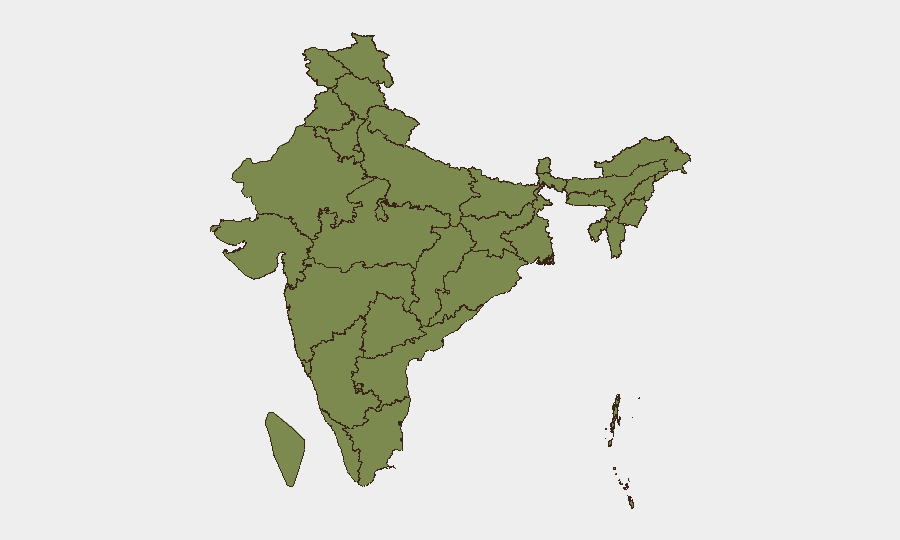
Situation Summary
India's composite threat score remains moderate (rank #43 globally, score 38) but is driven by acute concentration of risk in three jurisdictions: Delhi, Maharashtra, and Uttar Pradesh collectively account for the majority of tracked security events. The past 24–48 hours have seen a sharp spike in political and civil unrest centered on competitive-examination irregularities, with violent student protests in central Delhi followed by high-profile political demonstrations at the Prime Minister's residence. While isolated incidents of infrastructure failure and maritime security concerns are present, the primary near-term threat vector is escalation of street-level confrontation in Delhi between security forces and mobilised student and opposition-party constituencies.
Key Developments
- New Delhi, July 20 – Student and youth protests over exam-paper leaks turned violent near Jantar Mantar, Connaught Place, and Parliament Street; police deployed lathi charges and tear gas; stone-pelting and vandalism reported; over 118 security personnel injured, 70+ protesters detained.
- New Delhi, July 21 – Senior Congress leaders, including Rahul Gandhi and Priyanka Gandhi Vadra, led protests at Prime Minister's residence (7, Lok Kalyan Marg); government sources characterised action as security threat; forcible detentions reported.
- New Delhi, July 21–22 – Congress sit-in outside PM residence and Left-party marches to Jantar Mantar continued as solidarity actions; protests described as peaceful but concentrated in same high-density zones that witnessed July 20 violence, elevating escalation risk.
- Sikkim, July 21–22 – Tunnel explosion at hydroelectric project site resulted in at least ten fatalities and multiple missing persons, reportedly triggered by gas leak; search-and-rescue operations ongoing; localised travel and infrastructure disruption likely.
- Odesa, Ukraine (affecting India), July 20 – Commercial vessel MV Golden Leo attacked while departing port; four Indian nationals killed, one critically injured; Ministry of External Affairs condemned incident and summoned Russian diplomat; signals elevated maritime-security risk for Indian-flagged and Indian-crewed vessels in conflict zones.
- India (national), July 20–21 – Char Dham Yatra high-altitude pilgrimage routes temporarily suspended, then reopened after safety review; indicates ongoing environmental and safety sensitivity on those routes.
Highest-Risk Areas
Delhi dominates the current threat picture (risk score 33.5), driven entirely by the July 20–21 student-protest violence and subsequent political demonstrations in and around central business and government districts. Maharashtra (23.3) and Uttar Pradesh (17.8) remain elevated by historical event density but show no acute developments in the past 48 hours. Jammu & Kashmir (14.1) and the northeastern states (Manipur, Punjab, West Bengal at 8.2–8.6) retain structural risk from border and inter-communal tensions but are not active in current reporting. For duty-of-care purposes, companies and personnel in central Delhi should implement heightened situational awareness and contingency routing around Lok Kalyan Marg, Parliament Street, Jantar Mantar, and Connaught Place through at least mid-week.
How GeoBit Would Assist
Security teams monitoring India would deploy AOI Monitoring & Early Warning on high-risk zones (central Delhi, Mumbai, Lucknow) to track protest mobilisation and police response in real time. Intel Sweep and OSINT fusion across X, Telegram, and news feeds would provide 24-hour corroboration of event scale, injury counts, and political intent before narrative hardening. Routing & Network Analysis would enable rapid alternative-route planning for personnel transiting central Delhi during ongoing unrest, reducing exposure to blockages and crowd-control operations.
7-Day Outlook
The examination-irregularity issue and police response are likely to sustain opposition and student mobilisation for 5–7 days, with further demonstrations probable around Parliament and the PM's residence. Police deployments will remain heavy in central Delhi; periodic confrontations and detentions should be anticipated. Secondary risks include solidarity actions in Mumbai and other metros, though scale appears lower than in Delhi.
Highest-Risk Areas — Ranked
| # | State / Region | Risk |
|---|---|---|
| 1 | Delhi | 33.5 |
| 2 | Maharashtra | 23.3 |
| 3 | Uttar Pradesh | 17.8 |
| 4 | Jammu and Kashmir | 14.1 |
| 5 | Manipur | 8.6 |
| 6 | Punjab | 8.4 |
| 7 | West Bengal | 8.2 |
| 8 | Andhra Pradesh | 8.2 |
| 9 | Telangana | 8 |
| 10 | Karnataka | 7.8 |
| 11 | Uttarakhand | 7.5 |
| 12 | Tamil Nadu | 7.1 |
Sources
Previous Daily Briefs
A new India brief is written every day — each with its own risk map and downloadable CSV. Here's the last week; use the calendar to go further back.
📅 Browse every day by calendar →
Highlighted days have a brief. Tap a day for that day's map & analysis, or “csv” for that day's dataset ($5).
Atlas — our AI intelligence desk — emails them this snapshot personally. Nothing else, no list.