Situation Summary
Iraq remains a complex, fragmented threat environment ranked #17 globally with a composite threat score of 85, driven primarily by persistent insurgent activity across 375 tracked events. The country faces concurrent pressures from internal armed-group violence, regional state competition (notably Iran and Turkey), and governance instability, with Baghdad Governorate presenting the single highest risk concentration. Current signals suggest elevated tension across multiple actor categories—state, non-state, and international—with violence, public statements, and military posturing all active in the past 48 hours.
Key Developments
- Baghdad, 1 July 2026: Municipal authorities announced intensified work on four major overpass projects to address traffic congestion, resulting in intermittent road closures and diversions across central districts. This represents increased movement friction for corporate personnel and supply chains in the capital.
- Fallujah, Al-Anbar Governorate, 1 July 2026: Iraqi security forces dismantled a drug-trafficking network in two coordinated raids across multiple neighborhoods, arresting suspects and seizing narcotics. This reflects continued organized-crime activity and police responsiveness in Iraq's second-highest-risk governorate.
- 1 July 2026: Violent protest/riot activity reported nationally (location unspecified in available reporting); concurrent public statements from Iraqi government entities and military indicators suggest heightened political/sectarian tension.
- 1 July 2026: Conventional military force activity reported between Iraq and Kurdistan Regional Government forces, signaling potential escalation of long-standing resource and autonomy disputes.
- 29 June 2026: Conventional military force activity reported between Iraq and Iranian forces along or near the border, consistent with regional proxy-competition patterns.
- 1 July 2026: Iran-attributed threat signals toward Iraqi targets (unconventional violence category) and explicit threat statement from Iran toward Iraqi entities; coupled with Iraqi military activity, suggests acute bilateral tension.
- 30 June 2026: Sweden issued threat statement toward Iraqi targets; context unclear from available reporting but merits monitoring for sanctions, legal, or designations escalation.
Highest-Risk Areas
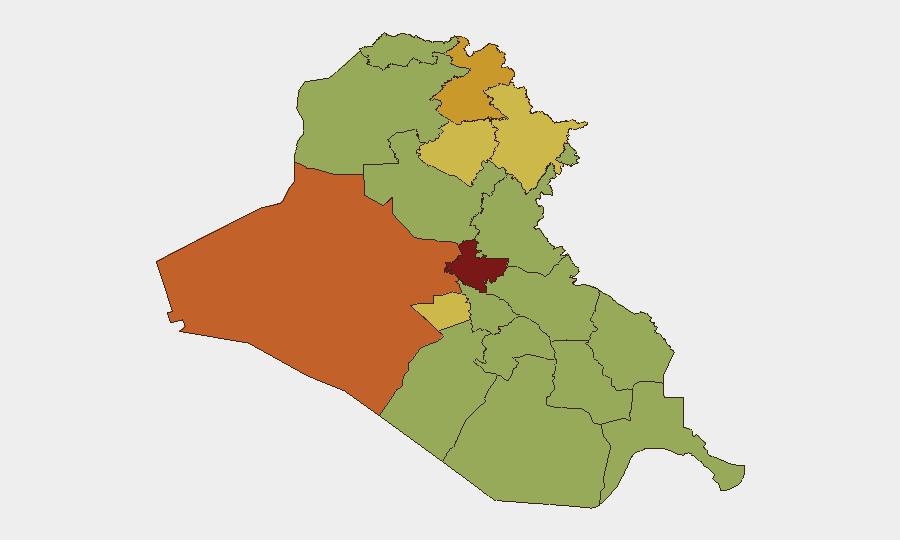
Baghdad Governorate (89.4) dominates the threat landscape and accounts for the majority of national risk, driven by insurgent activity, sectarian tensions, and governance challenges in the capital and surrounding urban belt. Al-Anbar (74.6) and Erbil (72.9) follow as secondary risk nodes; Al-Anbar remains an insurgent stronghold despite security operations, while Erbil faces both internal Kurdish factional dynamics and external Iranian and Turkish pressure. The remaining southern and eastern governorates cluster in the 59–60 range, reflecting endemic organized crime, militia activity, and cross-border smuggling but lower acute conflict intensity than the north and center.
How GeoBit Would Assist
Corporate security teams should deploy AOI Monitoring & Early Warning on Baghdad, Al-Anbar, and Erbil to detect protest, military, or attack signals with real-time alerting. Routing & Network Analysis paired with GIS & Spatial Analysis enables identification of safe corridors and alternative travel routes around the announced Baghdad overpass closures and broader instability zones. Network & Actor Analysis combined with Intelligence & OSINT (including Telegram and social-media feeds) tracks militia, drug-trafficking, and cross-border actor movements to support threat forecasting and duty-of-care assessments.
7-Day Outlook
The next week will likely see continued jockeying between Baghdad, Iran, and Kurdish regional forces, with public statements preceding or following military posturing. Protest activity and organized-crime operations are expected to persist as background noise; escalation risk concentrates on Iraq–Iran border incidents and central-Baghdad instability linked to political/sectarian grievance. Travel delays in Baghdad and security-force operations in Al-Anbar should be anticipated as routine operational constraints.
Highest-Risk Areas — Ranked
| # | State / Region | Risk |
|---|---|---|
| 1 | Baghdad Governorate | 89.4 |
| 2 | Al-Anbar Governorate | 74.6 |
| 3 | Erbil Governorate | 72.9 |
| 4 | Karbala | 63.9 |
| 5 | Kirkuk Governorate | 60.1 |
| 6 | Sulaymaniyah Governorate | 60.1 |
| 7 | Wasit Governorate | 59.9 |
| 8 | Babil Governorate | 59.4 |
| 9 | Al-Qadisiyah Governorate | 59.4 |
| 10 | Dhi Qar Governorate | 59.4 |
| 11 | Al-Muthanna Governorate | 59.4 |
| 12 | Maysan Governorate | 59.4 |
Sources
Previous Daily Briefs
A new Iraq brief is written every day — each with its own risk map and downloadable CSV. Here's the last week; use the calendar to go further back.
📅 Browse every day by calendar →
Highlighted days have a brief. Tap a day for that day's map & analysis, or “csv” for that day's dataset ($5).