Situation Summary
Ukraine remains at composite threat level 3 globally, with 1,142 tracked security events and continued high-intensity Russian missile, drone, and conventional military operations across multiple regions. The last 48 hours have seen mass aerial strikes on urban centres (Kyiv, Dnipro, Kharkiv), sustained attacks on port and energy infrastructure in Odesa and Chornomorsk, and cross-border strikes in Sumy, resulting in at least 11–12 civilian deaths and 40+ injuries. Concurrent domestic political unrest—triggered by Defence Minister Fedorov's dismissal—adds civil stability risk. The trajectory remains volatile with no near-term de-escalation signalled.
Key Developments
- Odesa Port Strike (18 July). Russian attack on a civilian vessel at Odesa region port killed one person and forced evacuation of 17 sailors, directly disrupting commercial shipping and port operations.
- Chornomorsk & Odesa Infrastructure Damage (17–18 July). Missile and drone strikes damaged grain, sunflower oil, and storage infrastructure; Kernel Holding halted Chornomorsk operations after what it described as some of the largest wartime strikes on its facilities.
- Mass Aerial Attack on Kyiv, Dnipro, Kharkiv (17 July). Russian forces conducted a coordinated missile and drone strike on three major cities, killing at least 11–12 civilians and causing extensive damage to residential and infrastructure targets.
- Sumy Airstrikes (18 July). Russian airstrikes on Sumy killed three people and injured seven, underscoring persistent cross-border strike risk in the northern region.
- Political Protests (17 July). Demonstrations spread across Kyiv and multiple Ukrainian cities following President Zelenskyy's dismissal of Defence Minister Fedorov, indicating domestic political tension alongside active conflict.
- Black Sea Shipping Campaign (17–18 July). Ukrainian drone forces reported striking 15 additional Russian vessels overnight as part of an ongoing 12-day campaign; 159 vessels in the Black Sea and Sea of Azov have been targeted since 17 July, with trade routes suspended or heavily restricted.
- Cross-Border Strikes on Russian Logistics (last 24 hours to 18 July). Ukrainian drones struck a Russian logistics centre, killing seven personnel and igniting a petroleum facility fire, signalling continued capacity for deep strikes that may prompt Russian retaliation affecting Ukrainian security.
Highest-Risk Areas
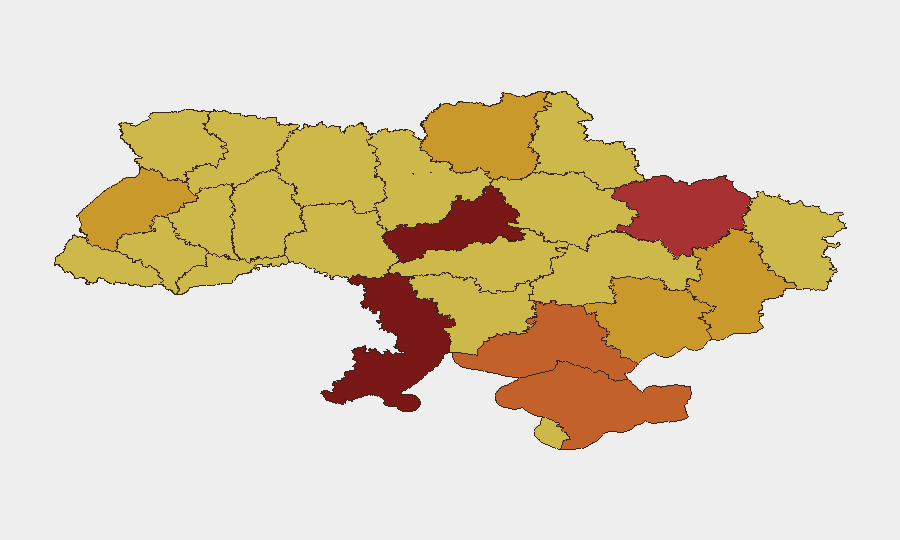
Kyiv (risk 100) and Odesa Oblast (86.1) drive the composite threat score, reflecting concentrated Russian air and missile targeting of the capital and critical Black Sea port infrastructure. Cherkasy (86.1), Kharkiv (77.7), and Kherson (73.4) follow, forming a concentration across eastern, central, and southern regions where conventional military operations, strikes on civilian infrastructure, and supply-line disruption are most active. Northern regions (Chernihiv, Sumy) face elevated cross-border strike and artillery risk. Port cities and energy infrastructure remain highest-priority Russian targets.
How GeoBit Would Assist
Security teams would deploy AOI Monitoring & Early Warning on Kyiv, Odesa, and port zones to detect strike patterns and receive real-time alerts; Satellite & Imagery Analysis to assess damage to critical infrastructure and operational continuity; and Conflict & Military mapping to track force positions and air-defense status. Maritime & Aviation Tracking would monitor vessel movements and drone/missile flight corridors affecting business continuity in the Black Sea. Routing & Network Analysis would identify alternative supply and evacuation routes around active strike zones and port closures.
7-Day Outlook
Russian aerial and maritime strikes are expected to continue at current or elevated intensity, with Odesa and Chornomorsk ports likely remaining primary targets. Political instability in Kyiv following the Defence Minister dismissal may complicate command coherence and civil-military coordination, creating secondary operational risk. Commercial maritime activity in the Black Sea will remain severely constrained; supply chains dependent on Odesa/Chornomorsk should activate alternative routing immediately.
Highest-Risk Areas — Ranked
| # | State / Region | Risk |
|---|---|---|
| 1 | Kyiv | 100 |
| 2 | Cherkasy Oblast | 86.1 |
| 3 | Odesa Oblast | 86.1 |
| 4 | Kharkiv Oblast | 77.7 |
| 5 | Kherson Oblast | 73.4 |
| 6 | Autonomous Republic of Crimea | 73.1 |
| 7 | Zaporizhia Oblast | 72.7 |
| 8 | Donetsk Oblast | 72.6 |
| 9 | Lviv Oblast | 71.5 |
| 10 | Chernihiv Oblast | 71.4 |
| 11 | Luhansk Oblast | 70.8 |
| 12 | Dnipropetrovsk Oblast | 70.6 |
Sources
Previous Daily Briefs
A new Ukraine brief is written every day — each with its own risk map and downloadable CSV. Here's the last week; use the calendar to go further back.
📅 Browse every day by calendar →
Highlighted days have a brief. Tap a day for that day's map & analysis, or “csv” for that day's dataset ($5).
Atlas — our AI intelligence desk — emails them this snapshot personally. Nothing else, no list.