Situation Summary
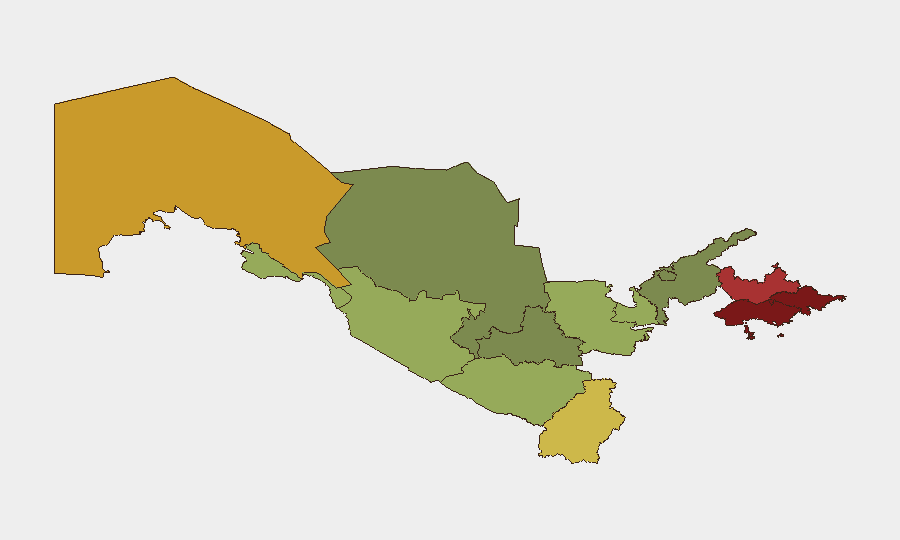
Uzbekistan maintains a composite threat score of 3 with no tracked active events as of 2026-07-23, indicating a stable near-term security environment. However, sub-national risk concentration in the Fergana Valley—particularly Andijan (risk 88), Fergana (82), and Namangan (78) regions—reflects persistent underlying vulnerabilities in border security, trafficking networks, and militant history. Recent event signals include a 2026-07-20 arrest/detention incident linked to prison operations, though details remain limited. Overall risk trajectory remains contained but regionally heterogeneous.
Key Developments
Insufficient verified recent incident data (last 24–48 hours) is available from current sources to populate a reliable 6–8 bullet development summary. Web research yielded several undated or partially sourced reports—including an explosion near Tashkent at an AGNCS facility (three injured), drug trafficking interdiction (3.2 kg), and a traffic fatality in Samarkand—but none carry confirmed dates within the reporting window or cross-source corroboration required for inclusion in an operational brief.
Single confirmed signal: Arrest/detention activity linked to prison administration was logged on 2026-07-20; specifics and location require follow-up.
Recommendation: To enable reliable 24–48-hour event tracking for Uzbekistan, GeoBit collection should incorporate real-time Telegram/X monitoring of Uzbek law-enforcement and regional security channels, supplemented by UzA (Uzbekistan national agency) wire feeds and cross-corroboration with Central Asian news aggregators.
Highest-Risk Areas
Andijan, Fergana, and Namangan regions account for the three highest risk scores (88, 82, 78 respectively), reflecting their position astride the Fergana Valley's porous borders, historical militant activity, and role as transit corridors for narcotics and irregular movement. Karakalpakstan (72) adds secondary concern due to border proximity with Turkmenistan and economic fragility. Surxondaryo Region (65) rounds the top five, driven partly by southern border permeability. In contrast, Samarqand (35), Navoiy (38), and Bukhara (42)—central and western regions—show substantially lower composite risk, correlating with urban development, state presence, and distance from conflict zones. Risk is sharply front-loaded toward the north and east.
How GeoBit Would Assist
Intel Sweep & OSINT Fusion would aggregate Telegram, X, and Uzbek media sources in real time to detect emerging incidents, arrests, border crossings, and trafficking signals across all twelve regions, with automated alerts for high-risk zones (Fergana Valley). AOI Monitoring & Early Warning would maintain persistent watch on Andijan and Fergana regions, triggering notifications if event density, security force deployments, or incident clustering signals escalating risk. Network & Actor Analysis would map trafficking networks, militant cells, and smuggling routes to support duty-of-care planning for personnel in transit or stationed near borders.
7-Day Outlook
No escalation indicators are apparent in the current signal stream; the environment is expected to remain stable over the next 7 days unless border incidents, large-scale arrests, or trafficking disruptions generate secondary effects. Routine administrative security activity (arrests, inspections) should be monitored as normal baseline. Heat stress and summer travel season may elevate accident and health risk, particularly in remote southern and western regions, though this is a secondary concern relative to border and organized-crime risks in the north.
Highest-Risk Areas — Ranked
| # | State / Region | Risk |
|---|---|---|
| 1 | Andijan Region | 88 |
| 2 | Fergana Region | 82 |
| 3 | Namangan Region | 78 |
| 4 | Republic of Karakalpakstan | 72 |
| 5 | Surxondaryo Region | 65 |
| 6 | Qashqadaryo Region | 58 |
| 7 | Sirdaryo Region | 55 |
| 8 | Jizzakh Region | 48 |
| 9 | Xorazm Region | 45 |
| 10 | Bukhara Region | 42 |
| 11 | Navoiy Region | 38 |
| 12 | Samarqand Region | 35 |
Previous Daily Briefs
A new Uzbekistan brief is written every day — each with its own risk map and downloadable CSV. Here's the last week; use the calendar to go further back.
📅 Browse every day by calendar →
Highlighted days have a brief. Tap a day for that day's map & analysis, or “csv” for that day's dataset ($5).
Atlas — our AI intelligence desk — emails them this snapshot personally. Nothing else, no list.