Situation Summary
Botswana remains a low-threat environment (global rank #161, composite score 7) with no tracked discrete security events this week. However, recent incidents highlight persistent vulnerabilities in financial crime, border management, and road safety. The operational environment shows elevated activity in Gaborone and Francistown, alongside intensified cross-border enforcement operations, indicating police responsiveness to emerging risk vectors rather than systemic instability.
Key Developments
- Gaborone, 9–11 September: Four suspects arrested for sophisticated bank fraud and KYC scam targeting a pensioner; P1.4 million stolen. Suspects charged with fraud and remanded pending trial on 22 September, indicating organized financial crime capability targeting vulnerable populations.
- Francistown, 13–15 September: A 28-year-old Zimbabwean national arrested near Shashe Mooke village for illegal border entry without travel documents and suspected unlawful possession of human remains. Forensic analysis ongoing; case heard in Francistown Magistrate Court 15 September. Indicates border vulnerabilities and potential serious crime.
- Palapye–Martins' Drift road, 12 September: Fatal collision between BMW and two horse-and-trailer trucks killed two people. Incident highlights significant road-safety hazard on main corridor, with implications for employee commuting and goods movement.
- RSA–Botswana border (Northern Cape sector), 13–16 September: Joint cross-border operation by South African and Botswana police targeted stock theft, stolen vehicles, illicit firearms, drugs, and undocumented migration. Multiple arrests and cash/cannabis seizures reported; potential temporary disruption at border crossing points.
Highest-Risk Areas
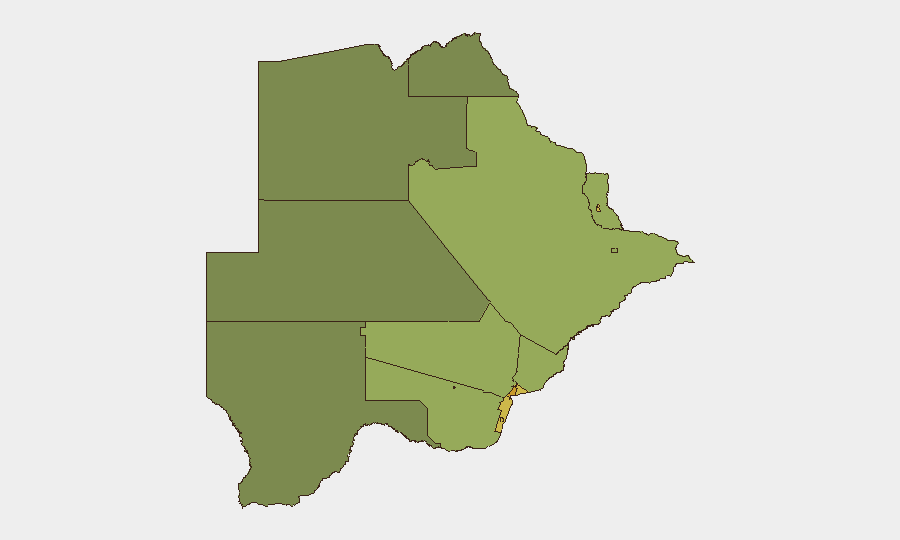
Gaborone (risk 72) and South-East District (68) are the dominant risk drivers, reflecting the capital's concentration of financial institutions, population density, and organized-crime activity—exemplified this week by the P1.4 million fraud case. Francistown (62) and Lobatse (65) follow, with Francistown's border-adjacent position and recent human-remains arrest underscoring transnational crime and irregular-migration pathways. Mid-tier regions (Jwaneng, Selebi Phikwe, Southern District: 61–55) show baseline urban crime and border-transit risks. Northern and western districts (risk 38–45) remain comparatively lower-risk, consistent with lower population density and commercial activity.
How GeoBit Would Assist
Security teams with personnel or assets in Botswana would deploy AOI Monitoring & Early Warning on Gaborone and Francistown to track emerging crime patterns and border incidents in real time. Network & Actor Analysis combined with Intel Sweep (X/Twitter, Telegram, multi-language OSINT) would identify organized financial-crime networks and cross-border trafficking syndicates before incidents escalate. Routing & Network Analysis would assess safe commute corridors and supply routes, flagging high-incident areas such as the Palapye–Martins' Drift road segment for avoidance or timing adjustments.
7-Day Outlook
The intensified RSA–Botswana border operation is likely to persist through late September, creating temporary friction at crossings and heightened law-enforcement presence. Financial-crime cases in Gaborone suggest ongoing targeting of corporate and pensioner populations; security teams should review KYC compliance and employee financial-account monitoring. Road-safety incidents remain seasonal; commercial travel on major corridors (A1, A3) warrants continued due-diligence review.
Highest-Risk Areas — Ranked
| # | State / Region | Risk |
|---|---|---|
| 1 | Gaborone | 72 |
| 2 | South-East District | 68 |
| 3 | Lobatse | 65 |
| 4 | Francistown | 62 |
| 5 | Jwaneng | 61 |
| 6 | Selebi Phikwe | 58 |
| 7 | Southern District | 55 |
| 8 | Kgatleng District | 50 |
| 9 | Kweneng District | 48 |
| 10 | North-East District | 45 |
| 11 | Central District | 42 |
| 12 | North-West District | 38 |
Sources
Previous Weekly Briefs
A new Botswana brief is written every Monday, covering the week — each with its own risk map and downloadable CSV. Use the calendar to go further back.
- September 9, 2026
- September 3, 2026
- August 31, 2026
- August 29, 2026
- August 26, 2026
- August 24, 2026
- August 22, 2026
📅 Browse past briefs by calendar →
Highlighted days have a brief. Tap a day for that day's map & analysis, or “csv” for that day's dataset ($5).
Atlas — our AI intelligence desk — emails them this snapshot personally. Nothing else, no list.