Situation Summary
Croatia maintains a stable, low-threat security environment as of 2 August 2026, with no confirmed security incidents, civil unrest, infrastructure failures, or travel-risk events reported in the last 24–48 hours. Current official travel advisories recommend only normal safety precautions. The country's composite threat score remains at 6 globally, reflecting a consistent baseline of manageable risk across most regions.
Key Developments
- No verifiable security incidents reported in the last 24–48 hours. Open-source monitoring, Croatian national police news feeds, and regional media outlets show no newly published incidents affecting public security, transport, or critical infrastructure as of 2 August 2026.
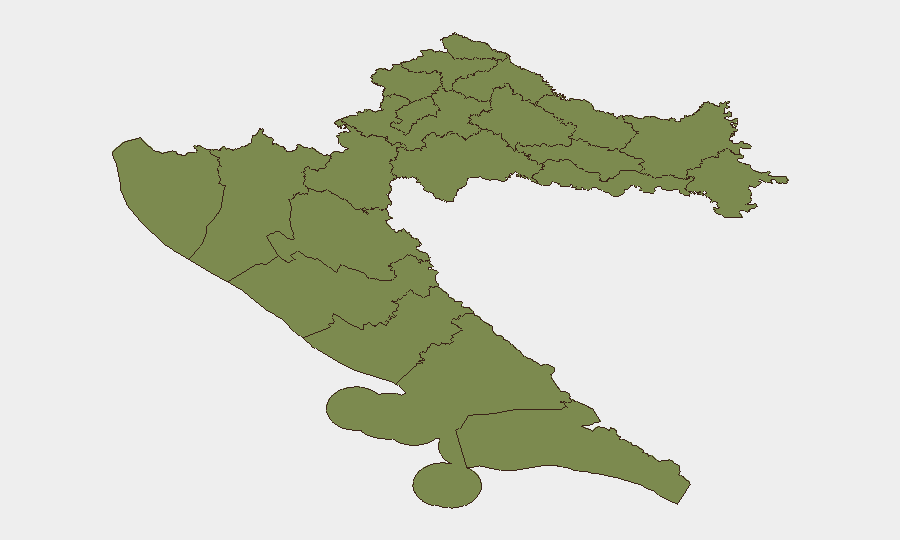
- Zagreb remains the concentrated risk locus. The City of Zagreb accounts for a composite risk score of 31.3—approximately 24 times higher than any other sub-national region—driven by urban density, transit volume, and historical event clustering; all other 11 counties score uniformly at 1.3.
- Two tracked events on the GeoBit platform (both dated 2 August) remain unconfirmed by independent open sources. Event classifications include a threat-intelligence signal and a public statement flagged by citizen reporting; neither has been independently corroborated by police, news media, or government advisories.
- Official travel and safety guidance unchanged. Foreign government advisories (as of 7 July 2026) contain no new alerts, warnings, or incident updates specific to Croatia in the last 24–48 hours.
- Regional cross-border monitoring shows no spillover incidents. Neighboring media networks and regional security reporting (Serbia, Bosnia, Slovenia) report no Croatia-specific security or unrest events that would indicate transnational threat escalation.
Highest-Risk Areas
Zagreb dominates the country's threat profile, with a composite risk score significantly exceeding all other regions. This concentration reflects the capital's role as the primary hub for political activity, international business, transit infrastructure, and media visibility. The remaining 11 counties—including Krapina-Zagorje, Međimurje, Zadar, and Istria—cluster at uniformly low risk (1.3), suggesting either minimal event activity or lower strategic/asset density outside the capital. For corporate teams operating outside Zagreb, baseline security protocols associated with low-threat European environments remain appropriate.
How GeoBit Would Assist
Security and risk teams covering Croatia would deploy AOI Monitoring & Early Warning capabilities focused on Zagreb's administrative, commercial, and transit nodes to detect emerging incidents in near-real time. OSINT Fusion & Corroboration across police news feeds, social media, and regional media would validate signals (such as the 2 August events flagged above) and distinguish genuine threats from false positives. Routing & Network Analysis would support contingency planning and alternative journey routes for personnel or asset movement, particularly within and around Zagreb, should conditions shift.
7-Day Outlook
No indicators suggest material deterioration in Croatia's security profile over the next 7 days. Monitoring should remain focused on Zagreb's concentration of risk and the resolution/corroboration of the two unconfirmed 2 August signals. Standard duty-of-care protocols for low-threat European environments are expected to remain sufficient.
Highest-Risk Areas — Ranked
| # | State / Region | Risk |
|---|---|---|
| 1 | City of Zagreb | 31.3 |
| 2 | Krapina-Zagorje County | 1.3 |
| 3 | Međimurje County | 1.3 |
| 4 | Varaždin County | 1.3 |
| 5 | Koprivnica-Križevci County | 1.3 |
| 6 | Zagreb County | 1.3 |
| 7 | Karlovac County | 1.3 |
| 8 | Sisak-Moslavina County | 1.3 |
| 9 | Istria | 1.3 |
| 10 | Primorje-Gorski Kotar County | 1.3 |
| 11 | Lika-Senj County | 1.3 |
| 12 | Zadar County | 1.3 |
Sources
Previous Daily Briefs
A new Croatia brief is written every day — each with its own risk map and downloadable CSV. Here's the last week; use the calendar to go further back.
📅 Browse every day by calendar →
Highlighted days have a brief. Tap a day for that day's map & analysis, or “csv” for that day's dataset ($5).
Atlas — our AI intelligence desk — emails them this snapshot personally. Nothing else, no list.